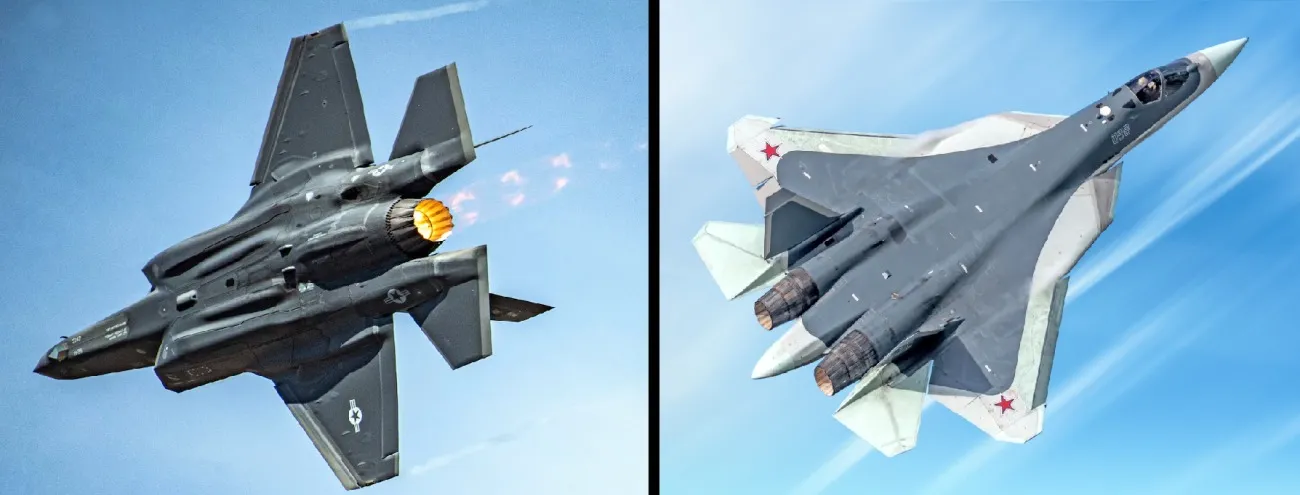
The other day I was perusing through some random links on my site, and I came across a poast that I wrote nearly 7 (!!!) years ago, on the subject of the legendary “Fighter Mafia”. These were the men who waged a covert bureaucratic war – and that is what it was – within the confines of the Five-Sided Wind Tunnel, to create the best fighter and attack aircraft the US has ever built. Those aircraft became what we know of today as the F-15 Eagle, the F-16 Fighting Falcon/Viper, the F/A-18 Hornet, and (as an offshoot) the A-10 Thunderbolt II/Warthog.
In that poast, I wrote the following about the lessons that the Russians learned from the colossal and disproportionate expenditures the FUSA has made on “stealth” technology
The Russians, for their part, have spent the intervening 20 years both designing highly manoeuvrable fighters like the Su-57, and developing long-wave radars with highly advanced cleanup and detection algorithms specifically built to catch out every stealth aircraft around. The Russkies don’t pretend to be as good as the Americans at building stealthy aircraft – they openly admit that the Su-57 is not as stealthy as the F-35. But they also designed the Su-57 along much more sensible principles, to be much more powerful, with a much better thrust-to-weight ratio, and a far bigger wing area. That makes it agile, which the F-35 most decidedly is not.
Proponents of the F-35 point out that the Su-57 is not stealthy and has a much lower “Beyond Visual Range” (BVR) capability for missile engagements. They argue that the stealth characteristics of the F-35 make it able to engage enemy fighters at very long range and shoot them down long before they ever know what hit them.
Before I proceed, it is critical to highlight what I wrote about the obsession with all things stealth within the US MIC. This means that the USAF and other fighting arms of the military have invested gigantic amounts of money in things like the F-22 Raptor and the F-35 Joint Strike Flying Piano Turducken Morris Marina. My scorn for the latter has only grown ever greater as more and more evidence emerges about just how bad this flying kludge really is, in terms of reliability, maintenance, capability, and cost.
That being said, I would like to revisit here the two lines in the quote above that I have highlighted, because we now have nearly 4 years’ worth of evidence on the subject of the combat capabilities of the Su-57.
The fact is that the Su-57 is now the most heavily combat-tested “fifth-generation” fighter aircraft in the entire world. (Never mind that this hoo-hah about “fighter generations” is mostly a marketing tactic.) No other air force has ever tested its premier platform against a near-peer opponent, and against its opponent’s latest technologies, the way that the Russians have been able to do against Ukraine and the entire combined West.
The FUSA has certainly never done it. No branch of the active military in the US can claim to have gone up against the best Russian AD and early warning systems – not the Navy, not the Air Force, not the Marine Corps.
The use of the F-35 against real serious AD systems has always been limited and restricted. The only recent examples of the F-35 being used, in any configuration, against real enemy air defences, are of the Israeli Air Force’s incursions into Iranian airspace – and that too only AFTER their ground-based operatives hacked the domestic AD systems and crippled them in a coordinated attack. Most of the time, the F-35 loiters well outside the range of those AD systems and gathers information.
China’s J-20 “Mighty Dragon” appears to be a worthy and highly capable aircraft, but – as with just about everything else the Chinese build for their military – it has never been tested in actual combat.
And that brings us to the two sentences I highlighted above.
We now have sufficient information from the battlefields in and above Banderastan that I can say, conclusively and definitively, that I was one hundred and ten percent of WRONG when it came to the Su-57’s “Beyond Visual Range” (BVR) and stealth capabilities.
The evidence is in, and it shows clearly that the Su-57 is more than capable of operating within the envelope of Ukrainian AD systems, and is perfectly capable of shooting down Ukrainian (that is to say, NATO) aircraft at ranges exceeding 300Km.
Let us start with the Su-57’s ability to penetrate deep behind enemy lines. I correctly stated that the Russians themselves admit the “Felon” is not the stealthiest aircraft. According to data from Russian sources, the frontal radar cross section (RCS) of between 0.1 and 0.5 square metres:
This is actually quite large, relative to the RCS of the F-22 and F-35, as the video above points out. However, the point of the Su-57 was NEVER to be totally invisible. The design priorities behind it were very, very different from those of its American counterparts. From the beginning, the Su-57 was designed and built to be capable of covering huge ranges – which is critical given the sheer size of the country the Russian Aerospace Forces have to defend – and targeting multiple enemies at long range, while being relatively easy to maintain, and preserving the characteristics of the Sukhoi lineage that made the world’s best dogfighters.
This meant that the Su-57 prioritised the use of much simpler composite materials to reduce, but not eliminate, its RCS. It incorporates engines designed specifically to operate from challenging environments and runways with relatively lower maintenance requirements than Western analogues. It also incorporates multiple radars across the entire airframe – including radar arrays in the wing roots, side-looking radars, and (in the latest builds) countermeasures designed specifically to spoof heat-seeking missiles.
Put simply, the Su-57 was built in line with the practical realities that Russia faced. It was NOT built to be the best of the best, or to be a platinum-plated super-dooper all-powerful weapon.
The result is a highly versatile and flexible fifth-generation fighter and air superiority platform that can perform a wide variety of missions – from seeking and destroying enemy aircraft, to penetrating enemy air defence umbrellas and killing an opponent’s missile defence systems, to outright ground attack missions.
And that is precisely what we see from its combat record in Banderastan. The Su-57 has successfully conducted reconnaissance and deep-strike missions – including with its S-70 “Okhotnik” drone wingman – while evading radar locks from both old Soviet S-300 variants, and more modern Western PATRIOT, IRIS-T, and SAMP systems.
That deals with the question of stealth. Yes, the Su-57 is not as stealthy as the F-35 or F-22. But it is stealthy enough for what matters. And given the appallingly poor fleet availability rates of its Western counterparts, the Su-57 wins where it actually matters – being able to show up for the fight.
Then we get to the Su-57’s actual armaments. Unlike the F-22, which is severely hampered by its inability to house and use the latest and most up-to-date weapons in its internal bays, the Su-57 is capable of using the latest and best weapons the Russians have available. On top of that, the Russians are crafting cut-down smaller versions of their externally-mounted cruise missiles that can fit into the Su-57’s internal bays.
Those weapons include the R-37M, which is among the longest-ranged and fastest air-to-air missiles (AAMs) in the world. That missile alone is responsible for multiple kills by Russian pilots against Ukrainian ones – and the Su-57 is known to have killed at least one, and almost surely many more, Ukrainian MiG-29 and Su-27 jets, from ranges that the Ukrainians simply cannot handle.
This fact negates and corrects what I wrote above about how the Su-57 is not as good at BVR engagements as the F-35. This is plainly wrong. The F-35 does not have anything like the weapons the Su-57 has. The R-37M, in particular, has a range and speed that no American-made missile can match – it hits at Mach 6, i.e. hypersonic speeds, and the 404 War has shown clearly that once it locks on, the target is effectively dead.
The Russians have created, quite simply, an absolute BEAST of a warplane,that also happens to be a work of art. It is genuinely a gorgeous machine. And they keep making improvements to it, based on all the feedback and data they get from both pilots in the field, and their own Sukhoi test pilots – particularly the legendary Sergey Bogdan, who knows how to fly this aerial assassin masquerading as a ballerina better than perhaps anyone else alive:
This is also why the Russians have managed to significantly arrest the slide their arms industry has experienced for the past decade or so, ever since Drumpf signed the “Countering American Adversaries Through Sanctions Act” (CAATSA). This was one of the dumbest pieces of legislation ever signed by any US President, and it was particularly stupid of President Trump to sign it, back in the day.
He really had no choice, it is true, given the hard alignment of the entirety of Congress against him and his original intention to pursue a policy of rapprochement with Russia. But the plain fact is that CAATSA forced multiple non-Western countries, that had once been willing to consider buying Russian aircraft and weapons, to void those sales and suspend their cooperation with Russia.
That was then. Back at that time, the Russians had not tested their latest weapons in a serious high-intensity war against the West. They now have, and it is VERY clear that they know how to make really effective and deadly weapons, while the West does NOT.
Western weapons are hyper-expensive Rolex timepieces that fall apart the moment you expose them to any kind of rough handling. Russian weapons, by contrast, are like Casio watches – rugged, tough, not very fancy (except when it comes to the the all-glass cockpits of their latest aircraft, and their cutting-edge engine technology, which even the Chinese do not yet fully have), but designed and built specifically to take a beating under real-world conditions.
That is precisely why multiple countries – Algeria, Sudan, Iran, North Korea, and especially India – are now looking to buy Russian weapons, and particularly the Su-57.
Why?
Because the Russians have never forgotten the lessons they learned from decades of aircraft design, rooted in a doctrine that NEVER assumed air supremacy.
Western, especially American, weapons design has this very arrogant and frankly idiotic assumption embedded within it, that the US will always and everywhere have air superiority. This is a big part of the reason why the US cannot do serious air defence. It is also why the US is not merely a few years, but multiple DECADES, behind Russia (and now China) in the realm of hypersonic stand-off strike weapons across all ranges.
The Russians and Chinese, by contrast, never assumed they would have air superiority. They assumed, instead, that they would have to win air superiority using reliable, effective, capable, tough, survivable combat aircraft, backed up by a web of systems. That is why the Russians have built the Su-57 to be a fully net-centric aircraft, which can communicate with their early-warning aircraft, tanks on the ground, infantry, drones, and so on and so forth.
Put simply, the Russians know how to fight real wars. They design their weapons for real wars. And they test them in real wars.
It is the height of irony, is it not, that the very people who learned the lessons of the Fighter Mafia the best, are the ones that the Fighter Mafia were trying to build effective and useful weapons to defeat.









1 Comment
I’ll bet this is why Top Gun: Maverick featured the F-18 instead of the F-22 and F-35.