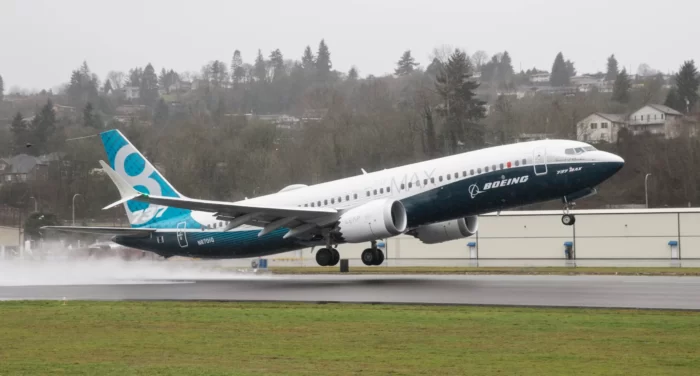
The Boeing 737 MAX is back in the news, for all the wrong reasons, after Alaska Airlines AS1282 suffered a very serious hull breach, with part of the fuselage literally blowing out in mid-flight:
The angels were looking out for the people on this flight, no question. There was a boy sitting in that very aisle – no one was sitting in the seat next to the bit that blew out, thankfully – and his shirt literally got ripped off his body after the depressurisation event.
Anyone sitting in that seat adjacent to the window, probably would have died.
This is, of course, not at all the first failure of the Boeing 737 MAX series. The original Boeing 737 MAX fleet was grounded after two fatal crashes that killed hundreds of people, thanks to the installation of the new MCAS system, as detailed extensively in various documentaries:
The root cause of the problem appeared to be a major shift in Boeing’s internal culture, after the McDonnel Douglas acquisition, though there is some debate about the true problem. All I can say for sure is, the problems have not gone away.
Which is why I can say, without hesitation, that if you have to travel, and you have any way of finding out the plane is a 737 MAX – refuse to fly. Book on another airline. Go via another city. DO NOT FLY ON THIS PLANE.
I recently had to travel from Moscow to another city, via Dubai. I only found out as I boarded my flight on the trip out of Dubai, that the plane was a 737 MAX 9, and I was not at all pleased about that fact. Fortunately, nothing happened on that flight (obviously), but I am not going to take that chance again.
Boeing is not solely responsible for the failures of the 737 MAX. Whoever it was at the FAA that cleared these death-traps for flying again, needs to answer some serious questions. These planes are not safe, even if this one incident is an isolated one, because the list of problems with the 737 MAX is considerable and longstanding:
- OCTOBER 2018: A Lion Air MAX plane crashes in Indonesia, killing all 189 people on board.
- NOVEMBER 2018: The FAA and Boeing say they are evaluating the need for software or design changes to 737 MAX jets following the Lion Air crash.
- MARCH 2019: An Ethiopian Airlines MAX crashes, killing all 157 people on board. China’s aviation regulator becomes the first in the world to ground the MAX, followed by others including the U.S. Federal Aviation Administration.
- APRIL 2019: The FAA forms an international team to review the safety of the 737 MAX. Boeing cuts monthly production by nearly 20%.
- JULY 2019: Boeing posts its largest-ever quarterly loss.
- SEPTEMBER 2019: Boeing’s board of directors creates a permanent safety committee to oversee development, manufacturing and operation of its aircraft.
- OCTOBER 2019: Boeing fires Kevin McAllister, the top executive of its commercial airplanes division.
- DECEMBER 2020: The company fires CEO Dennis Muilenburg in the wake of the twin crashes.
- JANUARY 2020: Boeing suspends 737 production, its biggest assembly-line halt in more than 20 years.
- MAY 2020: Boeing resumes 737 MAX production at a “low rate.”
- JUNE 2020: Boeing begins a series of long-delayed flight tests of its redesigned 737 MAX with regulators at the controls.
- SEPTEMBER 2020: An 18-month investigation by a U.S. House of Representatives panel finds Boeing failed in its design and development of the MAX as well as its transparency with the FAA, and that the FAA failed in oversight and certification.
- NOVEMBER 2020: The U.S. FAA lifts the grounding order, allowing the 737 MAX to fly again.
- DECEMBER 2020: Congress passes legislation to reform how the FAA certifies new airplanes, including requiring manufacturers to disclose certain safety-critical information to the FAA.
- JANUARY 2021: The European Union Aviation Safety Agency approves the MAX’s return to service in Europe.
- MARCH 2021: China’s aviation regulator says major safety concerns with the MAX needed to be “properly addressed” before conducting flight tests.
- APRIL 2021: Boeing halts 737 MAX deliveries after electrical problems re-ground part of the fleet.
- NOVEMBER 2021: Current and former Boeing company directors reach a $237.5 million settlement with shareholders to settle lawsuits over safety oversight of the 737 MAX.
- OCTOBER 2022: The FAA tells Boeing that some key documents submitted as part of the certification review of the 737 MAX 7 are incomplete and others need a reassessment.
- DECEMBER 2022: Congress agrees to extend a deadline for new standards for modern cockpit alerts stemming from the 2020 legislation after intense lobbying from Boeing.
- APRIL 2023: Boeing pauses deliveries of some 737 MAXs to deal with a new supplier quality problem involving noncompliant fittings.
- JULY 2023: Boeing’s first delivery of the 737 MAX 7 is delayed to 2024.
- AUGUST 2023: Boeing identifies a new 737 MAX supplier quality problem involving improperly drilled holes on the aft pressure bulkhead.
- SEPTEMBER 2023: Boeing 737 MAX deliveries fall to their lowest levels since August 2021.
- DECEMBER 2023: Boeing makes its first direct delivery of a 787 Dreamliner to China since 2019, seen as a precursor to China potentially unfreezing deliveries of the 737 MAX.
- JANUARY 2024: An Alaskan Air flight is forced to conduct an emergency landing after a cabin panel blowout on a brand-new 737 MAX 9 plane. The U.S. FAA grounds certain 737 MAX 9 aircraft for safety checks.
Enough is enough. This thing needs to go.
Keep in mind, I do not extend this opinion to other Boeing aircraft. I have flown many times in the 747, which is an amazing aircraft, and the 777. The latter is a wonderful plane. I have also taken a few flights on the 787, and I can confirm it is quiet, comfortable, clean, efficient, and really quite a pleasant ride.
I also think highly of the original 737, which I have flown in many times on short-hop flights all over the world (including in Russia, as recently as August last year, which manages to keep its fleet flying just fine, despite sanctions on spare parts and insurance).
But I have no interest whatsoever in flying on the 737 MAX, of any variant, ever again.
Ground them all, get rid of them, and start over again with a complete clean-sheet design. Yeah, it will hurt Boeing very badly to do that, but it’s not like the FUSA will ever let the company go bankrupt, after all.
Better to take the pain now, than to have any more of these disasters recur.









3 Comments
yeah, that whole MCAS thing was, at root, the decision to allow software to use a single indicator ( known to fail ) to take over control of the aircraft in direct opposition to pilot inputs.
.
which indicates multiple failures throughout the design process. iirc, the Max actually came with dual AoA sensors they just weren’t wiring the 2nd sensor as a “cost savings” measure.
A simple solution to this cost cutting presents itself, good old “lex talionis” law. Here is my proposed piece of legislation (which will never pass, alas): “if the builder or engineer’s product/design should result in the death of the user that builder/engineer shall be put to death. Exceptions: should the user deliberately use the product/design to commit suicide/self-harm the builder/engineer shall not be found liable. Deliberate or indeliberate use of the product/design for purposes it was not designed for (such as trying to use a solar panel to power your heater in Antarctica) that result in the suicide/self/-harm/harm of the user the builder/engineer shall not be held liable for.”
to no one’s surprise, Alaska and United are finding more Max’s with loose bolts.
blancolirio – https://www.youtube.com/watch?v=ubCQZtLTAug
Dan Gryder – https://www.youtube.com/watch?v=waEw41Rtp6w
.
even better, it turns out the cockpit door automatically unlocks in the case of a de-pressurization. due to this, the pilots didn’t have any checklists because all of the pads and clipboards got sucked out of the cockpit. that’s nuts. and definitely indicates that at least a couple of checklists need to be tethered near the pilots.