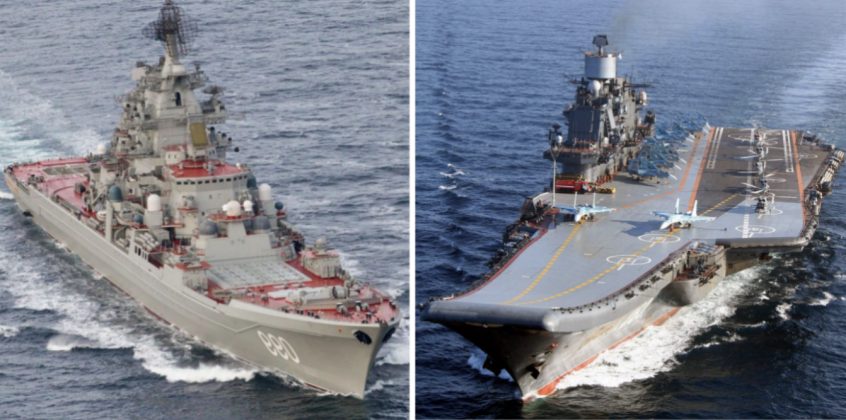
The following is adapted from a poast on my Telegram channel, in which I analysed a recent article looking at the particular choices facing the Russian Navy. The article made the argument for mothballing Russia’s sole remaining Kirov-class nuclear-powered cruiser, and investing the funds in modernising its sole aircraft carrier.
There was recently a rather boneheaded article, on the eve of the Day of the Russian Navy, from the otherwise usually sensible Military Watch Magazine, about how Russia faces a “difficult strategic choice” between modernising its Kuznetsov-class aircraft carrier, the Admiral Kuznetsov, which has been in drydock for years, or its remaining Kirov-class nuclear-powered battlecruiser, Pyotr Velikiy.
(The third choice is, of course, to do neither, and simply mothball and eventually scrap both ships.)
The article argued that Russia would be far better off simply modernising the Kuznetsov, using Chinese help. But that is genuinely silly. Aircraft carriers are, these days, giant floating white elephants. Russia has the ability to sink every aircraft carrier in existence, using hypersonic ship-sinking in-atmosphere cruise missiles, at ranges and speeds that no non-Russian AD complex can intercept.
The Chinese may well want supercarriers of their own, and might end up building as many as 9. But that entire way of thinking comes from American naval power projection doctrine, which still sits in the 1990s, and has not taken into account the very scary realities of modern hypersonic stand-off strike weapons.
The Russian military way of thinking is completely different. The fully refurbished Admiral Nakhimov reflects this. It carries a navalised version of the S-400 A2AD system – with 96 missile launchers, equivalent to a full 3 battalions of S-400 missiles. On top of that, it can fire off the full range of Russian stand-off strike weapons – Kalibr, Oniks, and Tsirkon missiles – with some 80 vertical launch cells.
In other words, it is capable of both attack and defence – while its twin nuclear reactors give it the ability to sustain speeds of 30 knots, faster than any destroyer, frigate, or corvette, in any NATO navy.
Simply put, the thing is an absolute monster, capable of simultaneously defending a significant sector of Russia’s Arctic coastline, while also wiping out an entire US carrier battle group on its own, andwith LOWER running costs than any Nimitz-class or Ford-class carrier, simply because it does not have to maintain a huge air wing.
That being said, bringing Admiral Nakhimov back into service has been a multi-decade effort, with a colossal amount of money spent on its modernisation. The estimated cost of its deep refurbishment and total overhaul is something like US$5.5B – around half the cost of a single new Ford-class supercarrier.
This does not include the original cost of building a single Kirov-class nuclear-powered battlecruiser, of which the Soviets built 4. Only 2 of them survive into the modern day – the fully refurbished Admiral Nakhimov, and its twin sister (or brother, I suppose), Pytor Velikiy.
Rebuilding the second Kirov-class cruiser is unlikely to be sustainable for the Russians, given their much-reduced industrial base. Instead, the Russians are putting their faith in smaller, faster, cheaper, conventionally-powered surface ships that pack massive punches relative to their size, along with what is probably today the world’s most advanced attack and ballistic missile submarine fleet. Hypersonic missiles now make it possible for a frigate to have the equivalent combat effectiveness of a destroyer in certain areas, and allow attack submarines to act as force multipliers in ways that the Americans (and Chinese, for that matter) cannot match.
In other words – the Russians know what they are doing with their navy. They recognise that their own hypersonic ship-killing missiles have made aircraft carriers obsolete – just as carriers themselves made battleships obsolete.
If anything, the Russians need to invest more in building out full-sized destroyers, as this is the major part of their fleet that is way behind the competition.
On that last point, is important to note that, on Russia’s Navy Day itself, the Big Cheese of the Russian Navy, Admiral Moiseyev himself, made a series of statements about the future capabilities of the service that warrant serious attention and scrutiny.
First, for the first time in nearly 40 years, the Russians are exploring the possibility of an actual destroyer programme. This effectively means a substantially larger missile platform, combined with a helicopter, that can perform multiple functions at sea. These include serving as a missile launch platform, an anti-submarine area patrol ship, and a fast escort. Their current destroyers are all ageing platforms that are roughly as old as the American Arleigh Burke-class, and are significantly out of date in terms of their systems and capabilities.
On top of that, the Russian Navy is investing heavily in expanding its world-leading fleet of Yasen’-M-class attack submarines, and Borei-A-class missile submarines. The Perm will enter service this year, as the first Yasen’-M sub designed specifically from the outset to wield the Tsirkon system.
The Khabarovsk, which appears heavily based on the existing Borei-A platform, is now in service, and carries six Poseidon nuclear-powered autonomous drones. The Russians designed these drones to deploy off the coast of an enemy state, and then just sit there and lie in wait, until they receive a signal from the Russians to detonate. They cannot easily be detected, and once deployed, are effectively invisible.
More Yasen’-M subs are on the way. Several more ballistic missile carriers will also be built. All of these new systems are cutting-edge, and put the Russian Navy far ahead of its American rival, which cannot build anything like the same range of ships at anywhere near the same speeds.
This is worth putting into context. Just this week, the US Navy signed a contract with General Dynamics for US$76.6 BILLION, to build 14 submarines – 9 Virginia-class attack subs and 5 Columbia-class ballistic missile boats. The problem is that if you do a little MAFF, you quickly realise this works out to an average cost of US$5.5B, per ship.
The Russians are capable of building 5 Yasen’-M-class submarines for that kind of money – or, alternatively, refurbishing a single Kirov-class battlecruiser.
So the Russians have decided to invest their money in ships that are modern, fast, well-equipped, and extremely dangerous, with full complements of the latest range of weapons. Given how far behind the curve they are in carrier operations, trying to rebuild or refurbish their existing aircraft carrier is likely a foolish decision.
It bears pointing out that the Kuznetsov-class carrier they currently have mothballed, has been nothing but trouble for the Russians. The ship has caused one huge headache after another for their fleet – from engines that generate thick smoke, to mechanical failures, to fires, to pipes that freeze up in cold northern seas. And that is before we get to the fact that its ski-jump configuration severely limits the take-off weight of its fighter complement.
Add to that the cost of equipping a full carrier wing, and we quickly run into the serious issue of cost once again. At present, the Russian Navy has its Su-33 navalised and enhanced versions of its venerable Su-27 platform, and it has an older set of MiG-29s. But, for a truly modern carrier wing, it needs a navalised version of its Su-57. And that is a long way off.
Russia did have plans, years ago, to build a 100,000-tonne supercarrier, with at least three competing designs that I have heard of – but when the former head of the Russian Pacific Fleet himself says that carriers are basically an obsolete, expensive, and inefficient platform, then that probably reflects the kind of thinking going on in the General Staff.
In short, the Russian Navy is likely planning for a future where most of its firepower comes from fast, agile, heavily armed surface ships, and nearly silent, nearly undetectable submarines. Both of them will be able to patrol and cover many thousands of square kilometres with long-range hypersonic ship-killers that render the many billions of dollars worth of American hardware effectively obsolete.
To understand why, you need to know a little something about the MAFF of missile defence.
The explanation in the paper linked there are a little on the technical side, but basically, if you have a desired probability level for intercepting and destroying a single ballistic or cruise missile, and you know what the probability of kill of an interceptor missile is, then you can figure out how many missiles you need to destroy a single hypersonic ship-sinker.
Grandpa Grumpuss loves to talk about this on his site, and with good reason. Let’s say you need n interceptor missiles, each with an independent probability of Pk of destroying a single incoming cruise or ballistic missile. You want to know how many interceptors you will need to destroy that one incoming missile, with a probability of Pd. Given each interceptor has an independent and equal probability of destroying that missile, the equation reduces down to:
Solving for n is then pretty trivial.
Let us say a single American SM-3 or SM-6 missile has the likelihood of intercepting and destroying a Russian 3M-22 Tsirkon ship-sinker of about 30% – this is a gross exaggeration, given how badly American missile defence performs in general, but let us give it that much. And let us say an American aircraft carrier battle group needs to have a level of confidence of destroying that incoming missile of 95% to ensure the safety of a US$15B carrier and its vast complement of air power.
How many missiles does that take?
The simple MAFF above tells you that such a task requires 8.4 missiles.
Given each SM-3 missile, alone, costs something like US$12M, and each SM-6 missile costs something like US$4.3M, a SINGLE Tsirkon missile launched by a Russian submarine, frigate, or Admiral Nakhimov, will cost the US Navy a total of US$36-100M.
And that is with wildly unrealistic interception probabilities for the Tsirkon. When you get back down to a more realistic interception probability Pk of around 5% – which IS realistic, given US PATRIOT missile systems have proven totally ineffective at taking out Tsirkon missiles in Ukraine, and THAAD systems have failed spectacularly in intercepting Iranian hypersonic ballistic missiles – then you get to a total missile expenditure of 48 missiles in a single salvo.
The cost of interception then skyrockets to between US$208M-571M.
Yes, you read that right – somewhere between a quarter and a half a BILLION DOLLARS to intercept a SINGLE missile.
Admiral Nakhimov, all by its lonesome, can launch multiple Tsirkons at ranges far outside a CVBG’s reach, which manoeuvre violently on terminal approach, and which fly on non-ballistic trajectories that existing American missile defence systems cannot handle.
This is, I repeat, simple hard MAFF. It is sufficient to explain exactly why a single Russian hypersonic ship-killer, worth around US$5M each, is enough to render an entire carrier battle group, worth something like US$50B in total, completely obsolete and useless.
The Russians are at least as good at this kind of MAFF as I am – and I am just some yutz with a laptop who knows basic equations and spreadsheets. Given their access to supercomputers and high-speed simulations, they are undoubtedly able to do far more sophisticated calculations of attrition warfare against American fleets.
Which is precisely why they will make the smart strategic decisions, and will avoid overinvestments in floating white elephants.









0 Comments