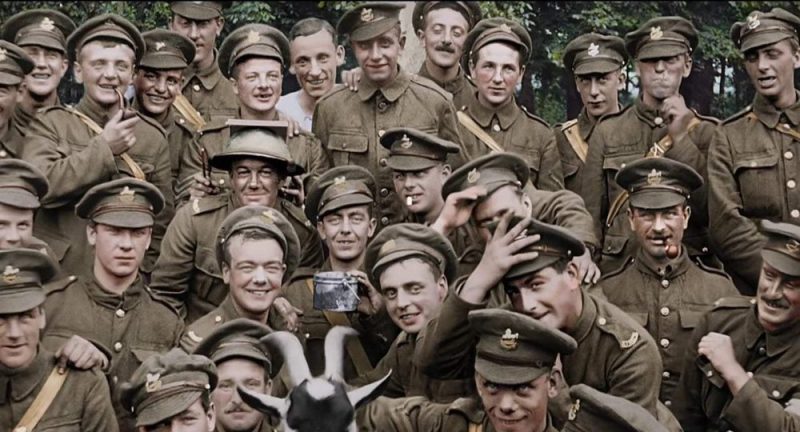
Today is Veterans’ Day in America, and Remembrance or Armistice Day in much of Europe. As we all know (or should, anyway), at exactly 11am on November 11, 1918, the guns fell silent on the Western Front, as the armistice went into effect. That marked the end of active hostilities in the Great War – up to that point, the single most destructive conflict in recorded human history.
The losses were appalling by any measure. Between 15 and 20 million soldiers and civilians died across Europe, Russia, and Turkey. Even to this day, we probably still do not have a truly accurate death toll across the Western and Eastern Fronts.
The death toll among soldiers was – there is no other word for it – apocalyptic. The German Empire alone lost over 2 million men at arms; the Russian Empire lost 1.8 million; the British Empire, across the home islands and the colonies, lost on the order of 1 million; France lost 1.3 million; the Austro-Hungarian Empire, which soon afterwards ceased to exist, lost 1.4 million.
By the end of the war, the great imperial civilisations of Europe lay in ruins. France, Germany, Britain, Russia, and Austria-Hungary all underwent profound and extremely destructive changes. The Russian Empire collapsed and mutated into the atheistic and repressive Soviet Union. The German Empire was forcibly broken up; huge chunks of the reunified Germany were ripped away from the heartland and given to other countries. Austria-Hungary simply disappeared.
The War to End All Wars, in fact ended European civilisation. As I wrote in a long piece on the 100th anniversary of Armistice Day, this was the true and terrible legacy of WWI: the death of Europe.
And this is the heartbreaking, awful reality of the Great War, 108 years after it ended:
The men who fought and bled and died in their millions, did so in vain.
I hate even to write those words. I was taught to revere the heroism and valour of the men who fought and bled in the World Wars – on all sides. Those who doubt that the Imperial Germans, for instance, had great soldiers and decent human beings fighting for the Kaiser, should read a book called In Stahlgewittern (Storm of Steel), by Ernst Junger. It is a true classic of the war, and serves as a powerful counterpoint to deeply anti-war books like All Quiet on the Western Front.
Men like Junger, and the millions who signed up to fight on both sides in the heady early days of the war, did so in the firm belief that they were fighting to protect their homelands and their civilisations. They thought, with terrible naivete, that the war would be over quickly, and normal life would resume. They were horribly, catastrophically wrong. The new way of industrialised warfare that had taken root across Europe, meant that the old infantry-based tactics no longer worked.
This year also marks the hundredth anniversary of the start of the Battle of the Somme. That one battle left a horrendous scar on the soul of Britain. The Somme Offensive was supposed to break through the German lines and achieve an operational and strategic victory; instead, it resulted in a meat-grinder of hideous proportions. The British alone lost nearly 20,000 dead on the FIRST DAY of the war, out of nearly 60,000 total casualties. By the end of the offensive, the British and the Germans had both lost roughly half a million men killed or wounded.
That kind of toll is unimaginable by modern standards.
And that was just one of the many, many terrible episodes of that horrible war. We can go on down the list. Ypres. The Marne. Paschendale. The Argonne. The Battles of the Masurian Lakes. The Brusilov Offensive – which resulted in a tactical and operational success, but a strategic stalemate at best, at hideous cost to the Russian Empire.
Time after time, meatgrinder after meatgrinder, where men on all sides fought with both indomitable courage, and unbelievable savagery.
The men who participated in those battles, on both sides, fought and bled and died in the most awful conditions imaginable for nearly four long years, before the Germans – yes, really – began to figure out how to use combined-arms warfare to break the deadlock of trench warfare. By that point, they lacked the logistics and the mechanisation needed to truly exploit their tactical and operational innovations, but they created the template that the rest of the powers quickly began to follow.
And yet… it was almost all in vain.
Look at what Europe has become. Britain, as I have written before, is lost. The society that once did so much good, on balance, for the entire world, is broken beyond repair. This is the country that brought light, medicine, education, science, technology, railways, jurisprudence, and the best aspects of representative democracy (back when it actually sort of worked) to the rest of the world. It is the country that gave us the Anglosphere, perhaps the happiest alliance of like-minded nations and peoples in history. It is the country that first moved to end slavery worldwide – at immense cost to itself. It spread Christianity to America, Africa and Asia.
Today it is a deracinated and miserable country, full of Arabs, Wakandans, and Indians, where the White majority lives in abject terror of its own government. It is doubly occupied – from without by American troops, and from within by Asians and Africans that have turned its once-gleaming and beautiful cities into sordid shitholes that stink of weed and garbage.
France is no better – indeed, it is far worse. Rioting is the national pastime. The entire country is effectively ungovernable. Well over half of everything the country produces, is a function of government spending – which means that, in fact, it produces very little of anything, since governments cannot, by definition, produce.
Germany is utterly broken. Its government is so dysfunctional that a man with a 10% popular approval rating can pull together a coalition to rule over a people that cannot fight back. Its taxes are insane, its cost of living is unbelievable, its public services lie in ruins, its once-vaunted train system is falling apart, and good luck trying to get an internet connection to your house there in under 6 weeks. The country lives under effective American occupation. It meekly allowed the Americans and Ukrainians to blow up its source of cheap energy, and castrated itself from using nuclear and coal power; as a result, its industrial heartland is dying.
No matter where you look, the continent of Europe is sick and bleeding out. The sole exception is Russia, where the entire nation has rebuilt itself, and is in the process of forging a new identity as a thousand-year Eurasian civilisation-state. It is proud, strong, free, sovereign, and independent. Russia has plenty of problems, to be sure – but a lack of national identity is not one of them.
If the men who fought and bled in those trenches could see what their descendants have become… would they ever have picked up arms in the first place?
Would they ever have signed up to die for countries that hate them, spit on their legacy, and treat them in a disgustingly patronising manner when they dare to voice their anger and frustration at what has happened?
Is this what European men fought for? To see their countries beaten, broken, pathetic, spineless, occupied, faithless, spiritually neutered, and cowering in fear from outsiders that they themselves invited in good faith?
The descendants of those who died, broke faith with their ancestors. Today’s Europe is the direct result of that failure.
In Flanders fields the poppies blow
Between the crosses, row on row,
That mark our place; and in the sky
The larks, still bravely singing, fly
Scarce heard amid the guns below.We are the Dead. Short days ago
We lived, felt dawn, saw sunset glow,
Loved and were loved, and now we lie,
In Flanders fields.Take up our quarrel with the foe:
— “In Flanders Fields”, by John McCrae, 1915
To you from failing hands we throw
The torch; be yours to hold it high.
If ye break faith with us who die
We shall not sleep, though poppies grow
In Flanders fields.









0 Comments