The Epstein Coalition’s war against Iran has revealed, in no uncertain terms, the total bankruptcy and inadequacy of the Coalition’s economic capabilities. We have seen the New Evil Empire throw just about everything it has available at Iran, and it has failed utterly to do much more than cosmetic damage. Meanwhile, American air defence systems across the Middle East have shown themselves to be utterly incapable of intercepting even relatively simple Iranian ballistic missiles, with anything like the accuracy that the Ameribros claim.
I keep hearing American pundits – including many who really ought to know better, like Col. Douglas Macgregor, for whom I have immense respect and will always listen to whenever he speaks – tell us that American air defence systems are very good, highly effective, and some of the best in the world. I literally heard the historian Darryl Cooper say the same thing while speaking to #BasedTucker a week or so ago – I got so annoyed with this that I switched away from it to another video while out for a ramble in the countryside.
Let us be very direct and blunt about this: American air defence systems are GARBAGE, relative to their exorbitant costs. That is not hyperbole, it is rooted in FACT, including the testimony of Prof. Theodore Postol from MIT, who analysed the performance of the latest PATRIOT PAC-3 systems, and concluded that their actually effective interception rate is around 2-3%.
Prof. Postol, to be clear, is not everyone’s cup of tea. Grandpa Grumpuss does not have many kind things to say about him – mostly because the former thinks the latter does not have a clue about Russia’s Oreshnik intermediate-range strike weapon. On this subject, the Russian grouch is probably correct.
But, when it comes to the actual effectiveness of American AD systems, all we can say is that it is terrible.
Even when it works, it takes far more missiles than is cost-effective or sensible, to intercept the most straightforward targets. Take a look at this propaganda video of PATRIOT AD systems based in Qatar, attempting to intercept Iranian missiles:
It is very hard to keep track of what is going on, but as far as I can see, the Qataris launched something like 25-30 missiles, and successfully intercepted 5-6 targets.
That means they fired off somewhere between 5 and 6 interceptors per target.
The news gets worse when you look at the latest ramblings of various Western military “experts”. One unusually illuminating admission comes from Dr. Jack Watling of the UK’s (self-proclaimed) oldest military think tank, the Royal United Services Institute. He wrote an article for The Guardian’s “Comment Macht Frei” section – I exaggerate for effect, but only slightly – which Alexander Mercouris picked up on in a recent video of his.
In that article, Dr. Watling, who is very obviously strongly pro-Ukrainian, talked about the badly degraded effectiveness of Ukraine’s US-provided PATRIOT AD systems as follows:
To intercept a tactical ballistic missile, such as Russia’s Iskander, a defensive system needs to be remarkably sophisticated. Its target will be descending from the high atmosphere at more than five times the speed of sound. The incoming missile will also be manoeuvring through the air, rather than following a predictable ballistic trajectory. The defensive system needs to be able to track the precise location of this incoming missile and communicate this to the intercepting missile, allowing the latter to adjust course while climbing against gravity. Building the radars, data links and interceptors for such a task involves a huge amount of research and development, and across Nato most states have been happy for Washington to invest over decades to make the Patriot up to the job.
The US and licensed manufacturers in Germany and Japan are able to produce about 840 Patriot interceptors a year. About 240 of these are older, larger PAC-2 interceptors, which climb until they are close to the target and then explode – meaning they must carry the weight of a warhead to the target – and 600 are PAC-3s, which are smaller and fly directly into the target. The latter approach is more effective but requires even more precise navigation. The former can be used against other target types.
Russia produces about 750 Iskander missiles a year and is looking to increase production. In addition, Russia uses air-launched Kinzhal ballistic missiles and repurposed air-defence missiles to conduct strikes, along with its arsenal of cruise missiles and drones. To have a high probability of success, it is generally recommended to fire two to three interceptors against each ballistic missile. When you also factor in that the launchers themselves can only protect a relatively small area, and Ukraine is a vast country, then it becomes clear that Kyiv would ideally have three to four times the annual global production capacity of Patriot missiles to protect itself. Countries supporting Ukraine have therefore had to give their own stockpiles to Kyiv.
Even before the US decision to attack Iran, western allies were nervous about depleting their own stocks by giving Patriot missiles to Ukraine, knowing that it would take a long time for them to be resupplied. The US attack on Iran – prompting Tehran to fire ballistic missiles across the Middle East – has created an acute global shortage. Where Russia usually fires fewer than 10 ballistic missiles in a single attack, Iran has launched upwards of 170 a day during the current and last year’s war. A portion of Iran’s missiles were also advanced. In one instance, it took 17 Patriot interceptors to defeat a missile. And Iran has many more missiles in storage.
Read the last sentence in bold again. It took the Americans and their Arab vassal-states SEVENTEEN interceptor missiles to take out ONE Iranian ballistic missile.
It is not difficult to figure out why, either.
Recall that, not too long ago, I wrote a poast that referenced a paper which lays out the MAFF of missile defence using a relatively simple set of equations. To understand how bad things are for the US, you need to understand that missile defence rests on two independent and one dependent variables:
- The probability of kill, Pk, of any ONE interceptor missile hitting and/or destroying an incoming attacking missile – whether by detonating near the incoming missile, or by striking it directly;
- The number of interceptors, n, required to take out one incoming missile, with each interceptor having an independent Pk;
- The probability of destruction, Pd, of the incoming missile, which depends on Pk and n, and essentially comes down to the level of certainty that we want for the missile’s destruction;
The equation that describes this relationship is as follows:
It does not take a whole lot of effort to take this simple equation and solve backwards for any one of the three variables, provided you know the other two.
Let us now go back to Dr. Watling’s key sentence again: it took 17 interceptors to destroy one incoming missile. Given this fact, what is the probability of kill of any given interceptor, assuming we want a 95% level of certainty that the incoming missile will be destroyed?
Apply that equation in reverse, and you very quickly realise that it is around 16%.
Yeah. One single PATRIOT interceptor has a probability of hitting and destroying an incoming ballistic missile of around 16%. Barely one in six.
Keep in mind that there are a large number of variables involved which affect the Pk dramatically, including, but not limited to, the height of the incoming missile, the wind resistance, the spin of the Earth, the angle at which the incoming missile is detected, the power of the radar aperture doing the detection, the relative speeds of the interceptor versus the incoming missile, and so on and so forth. Be under no illusions: missile interception is REALLY DAMNED HARD, starting with the sheer challenges of the MAFF involved, and going on to the actual operational realities of shooting down a missile.
Those who know how this stuff works, have likened it to “shooting a bullet with another bullet” – while firing at an angle. They are right. If anything, that dramatically understates how hard it is.
You can arrange the equation into a table if you know what you are doing in Excel – it’s really not hard. Here is what the result looks like as a heatmap, with the first column containing increasing Pd values, and the first column containing increasing Pk values. The numbers in the table itself are the number of interceptors required corresponding to the Pd–Pk pairs:
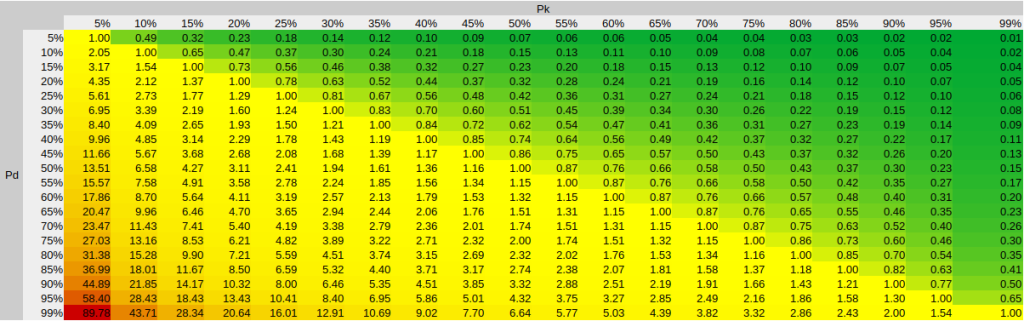
The MAFF simply says – rather obviously – that the lower the probability of kill of an individual interceptor, the more missiles you need to ensure destruction of the incoming to a certain confidence level.
If Prof. Postol is right, and the PATRIOT PAC-3 system has an effectiveness rate of around 5% per interceptor, then one does not need 17 missiles per incoming – one needs more like FIFTY EIGHT, statistically speaking.
It gets worse, though. Keep in mind, this is ONLY for relatively simple ballistic missiles, which go up and come down on a parabolic arc that is mathematically comparatively straightforward to compute.
What happens when you try to apply that same logic of missile intercepts to a manoeuvring incoming missiles that violently corkscrew and twist in their flight paths, change directions rapidly, and DO NOT use a ballistic flight path?
That, after all, is what Russian Iskander-M missiles do. They fly on a depressed ballistic trajectory after launch, then pop up, then slam down at a steep angle. The Kinzhal air-launched hypersonic missile flies in at speeds of Mach 9+, with its MiG-31K launch vehicle already imparting tremendous kinetic energy from the outset.
The monstrous Russian Kh-32 carrier-killer is 11 metres long, flies at around Mach 5, and comes STRAIGHT DOWN on top of its target. That profile means it is fully capable of flying past the cone of detection of a PATRIOT system, which has a specific set of angles that it can manage.
And then we come to the issue of cost.
A Popular Mechanics article from a couple of years ago outlined the costs involved. They are eye-watering. The table below is from that article:
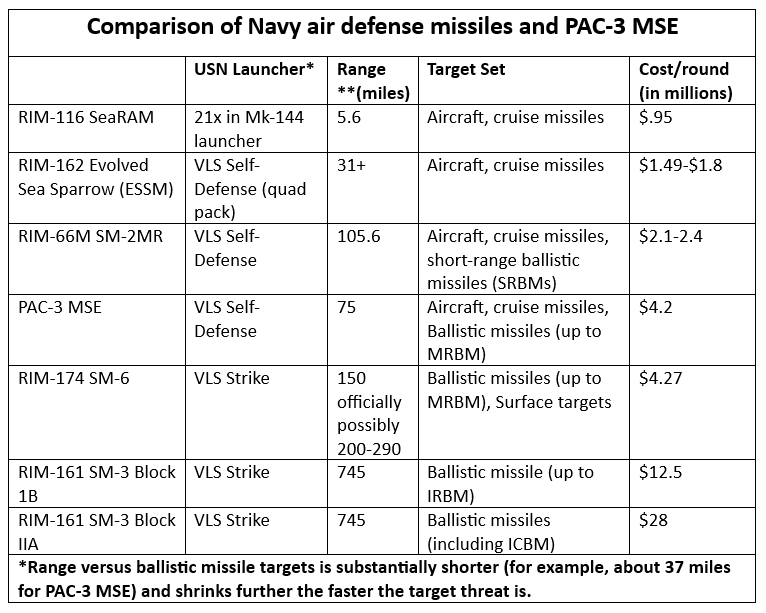
If we go by the number of 5 PATRIOT PAC-3 interceptors needed to stop a single incoming attacking missile, that costs the US$21M. If the real number is more like 17 missiles, that is US$71.4M.
These numbers are staggering. And that is before we get to the hard limits on PATRIOT PAC-3 production. The entire combined West cannot produce more than 1,000 PATRIOT interceptors a year – and only about 600 of those are PAC-3s, as the article from Dr. Watling states. Assuming he is right, and assuming it takes, on average, about 15, not 17, missiles to stop any incoming ballistic missile of any kind, that means the US can afford to stop precisely FORTY missiles out of its own annual production.
After that, the FUSA starts eating into its stockpiles.
Keep in mind, Russia fires off between 20 and 40 missiles in ONE attack on 404 – Country Not Found these days, along with hundreds of cheap single-use drones. The Iranians were known for shooting off 150 or more missiles at a time.
This means the US’s missile defences would last all of 3-5 days in a serious all-out war with an adversary capable of launching large numbers of missiles at it. After that, most of the incoming missiles would get right through.
That is exactly what happened to Izzrael during the recent war. Toward the end of the 12-Day War last year, Israelis themselves admitted that 80% or so of Iran’s missiles were getting through. In the most recent round of hostilities, things might have gotten even worse.
No matter how you look at this, no matter which perspective you take, the MAFF is unmistakable and undeniable. There is absolutely no way to get past this fact:
The FUSA cannot defend itself and its bases with adequate levels of anti-missile interceptors.
This should, in theory, inspire some humility among the neoclown lunatics leading the New Evil Empire headlong into disaster. It very obviously has not, because neoclowns and Zioclowns have no understanding of basic MAFF. They seem to think that, simply because the US has the world’s biggest economy, based on (artificial and nonsensical) GDP numbers, it can always buy itself out of trouble.
It cannot.
There are hard physical limits on what the US can do. It does not have the industrial base, the resources, the supply chain, or the labour force needed to build out a truly independent, self-sustaining MIC any longer.
When you combine this dismal MAFF with the awful stories we are now hearing about Navy servicemen at the end of their collective rope from endless deployments without relief or shore leave, and plummeting morale among ordinary servicemen on the ground, you get a picture of an empire falling apart at the edges, as the rot spreads from the centre.
We can be even more blunt:
US missile defence has been a gigantic waste of BILLIONS of dollars of taxpayer money. The planned US “Golden Dome” is built on lies and false promises, and will fail to be effective in any way. It will simply increase the already staggering wealth of the defence oligarchies like Lockheed Martin and its shareholders, without providing effective defences of any kind.
Until the US and its allies confront this reality head-on, and rebuild their entire approach to missile defence in particular, and defence spending in general, from the ground up, this will never change.









3 Comments
I think it was you that said they were using up the old stuff, and keeping the best for later for both the 404 and the Iranian wars. Then, we crossed the FAFO line, and Iran said the gloves are off. Just when we’re running shy of radar, launchers, and missiles. I cracked up when one witness said the Iranian missile jinked and faked out the interceptor.
“Hayeeee! I didn’t know they had those!”
I think that’s why Israel has backed off, saying out loud they are content for us to fight their battles. Because they know if they start up, they’ll be missing salinization plants and a refinery in no time.
I think you also said it earlier – the Iranians win by sticking around. All they have to do is wait for the interceptor missiles to run low, as well as our petroleum reserves. That’ll probably hit us around mid-term time.
Neither Iran or Russia is stupid. They’re playing the long game and we aren’t.
Yeah indeed. The Russians are, by and large, saving their best stuff for what they see as the inevitable long-term war with the West.
funniest thing about what the Ukies are doing now? by which i mean bombing the Wildberries warehouses.
explain to me what Amazon equivalent Ukraine has for Russia to attack their Chinaslop warehouses? you know, because if the Ukies don’t have a Wildberries/Amazon analog then Russia couldn’t even make response attacks “in kind”, even if they wanted too.
but the more important point, how is this playing in Ukraine? can you imagine? a young woman just had her fiancee stolen out of her arms, she has to go home and inform her prospective mother and father-in-law that their son has been sent to the abattoir.
and now these families get to revel in the glorious destruction of Russian assets as is Ukraine wasting drones and missiles to not even destroy a military target. how furious and depressed must these people be?