Back in 1951, that deceased old monster and pederast, Arthur C. Clarke, published a short story in The Magazine of Fantasy and Science Fiction called “Superiority”. You can read it for free using that link I provided. And it is well worth the time and effort, given the subject matter – though I must say, I am very glad that the author is burning in Hell, where he belongs.
(Mildly interesting aside: I visited Sri Lanka at the end of 2025, and spent a few days in a small town on the southeastern coast called Hikkaduwa. It turns out that is exactly where that degenerate lived for over 50 years – diddling little boys for much of that time. And, amazingly, they celebrate that shit – I stayed in a villa about 400m from the beach, but you could walk along it and get to a place called “Arthur C. Clarke Villa”, or some such, right near a very nice set of beach-front cafés.)
My revulsion for Clarke’s personal… peccadilloes aside, the story itself is an apt and apposite summation of the problems facing the US Military Industrial Complex in the modern day. I finally got around to finding that story after listening to DA KERNEL HIZZSELF!!!, D-Mac, referencing it in podcast after podcast for many months on end. The story Col. Macgregor discusses, is all about a war between two spacefaring civilisations – the particulars of which are never given.
All we are told in the story, is that the narrator is from the civilisation that lost – and that civilisation was the one with the more advanced technology and the greater scientific research base.
The story goes into the details of how the narrator’s civilisation lost, in very easy-to-follow terms. Put simply, the losing side invested enormous resources into hyperweapons that were incredibly powerful – but took far longer than anticipated to build, required far greater resources than planned, and were much harder to use than the scientists originally promised.
The tale culminates with a technology so staggeringly powerful that it makes warships effectively invisible to enemy sensors, and unreachable by enemy weapons, once activated – but in so doing, it warps the user’s ship at the most fundamental level, making each ship distinct and different from every other one of its class. This of course makes repairs and maintenance impossible, because now every ship is effectively in a class of ONE, and therefore totally bespoke.
The losing side finds itself in a situation where, despite suffering very few losses, their space navies are completely demoralised and broken by their inability to fight properly. The enemy side, using simpler, easier-to-maintain, more standardised technology, albeit several generations behind that of the narrator’s side, triumphs because of those virtues.
I bring all of this up because last week, I wrote at some length about the fact that the Russians are weighing up a choice between refurbishing the Admiral Kuznetsov aircraft carrier, and refurbishing the Pyotr Velikiy nuclear-powered battlecruiser. And I pointed out that Russian naval doctrine increasingly rejects the aircraft carrier as a concept and platform, because the Russians are perfectly capable of seeing that these things are floating white elephants, vastly expensive and actually quite obsolete despite their tremendous offensive firepower.
Instead, the Russians are resorting to simpler, more effective, proven designs that incorporate far greater amounts of lethal long-distance firepower, over expensive and unproven designs or ideas that will take so long to develop that they will be obsolete before they are finally realised.
Two recent news items underscore the wisdom of this approach.
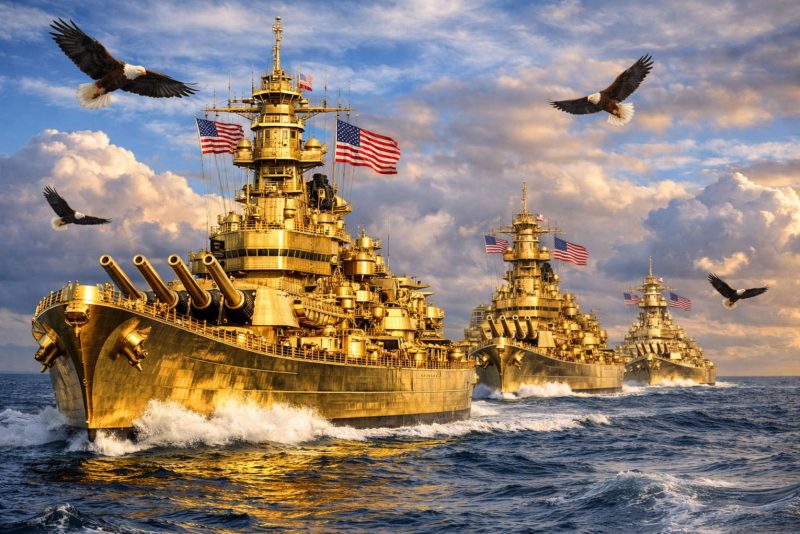
The first comes from the FUSA, where just learned that the much-hyped, much-vaunted, and frankly ridiculous Trump-class battleships of the BBG(X) programme, will now cost a staggering US$275 BILLION over a 28-year period. The very first nuclear-powered battleship of this programme will be called the USS Defiant, and will supposedly have the following characteristics:
If built, the 35,000-ton nuclear battleship, according to the report, will be the most heavily armed surface vessel the U.S. Navy has ever built, possessing anti-air, land-attack and anti-ship missiles, hypersonic missiles, nuclear cruise missiles, large lasers and a rail gun.
The authors apparently left out the bit where it comes with a squadron of TIE Fighters as standard…
And the cost of the very first one of this particular floating white elephant?
US$23.4 billion.
Each one of these things is going to cost US$18.3B after the first one rolls down the slipway – and that is today’s estimate. That, by the way, is roughly the cost of a fully loaded Ford-class nuclear-powered supercarrier – with its full complement of fighters and crew.
None of this accounts for the inevitable cost overruns and delays that ALWAYS come from American shipbuilding projects these days – and, indeed, of the last 40 years. The US is not capable of building ships – or tanks, or planes, or really much of anything else – quickly and cost-efficiently anymore. Its industrial base has degraded to the point where even producing interceptor missiles for air defence is a catastrophically expensive endeavour – and the results are actually pretty useless.
When you look at the past history of similar programmes, the warning signs are very clear. The Zumwalt-class destroyer programme was a mortal insult to the memory of Admiral Elmo Zumwalt himself – the man who did a great deal to shape the illustrious history of the US Navy, which once was unquestionably the best navy in the world. The original cost of the programme was supposed to be US$1.4B per ship, for an order of 32 ships – but the Navy eventually paid an unbelievable US$32 BILLION for just THREE ships, and none of them lived up to the original promised capabilities.
The Navy originally envisaged the Zumwalt-class as a gun-carrying destroyer, each one wielding a pair of great big 155mm main cannons with an extremely long range. Yet these superguns never worked out, and were obsolete long before they ever made it past the testing stage, because the Russians started deploying ship-sinking hypersonic missiles years ago, at ranges of 1,000Km (and now significantly more than that) – over an order of magnitude farther out than the Zumwalt-class’s guns could reach.
Instead, each of the three destroyers had their main guns ripped out – and the shells for those guns were never cost effective either. The Navy replaced the guns with vertical launch systems for various missiles, including America’s much-vaunted (and never actually realised) hypersonic weapons.
To this day, the Zumwalt-class has NEVER lived up to its original design requirements. It has NEVER been a reliable or useful weapons platform. And it has proven to be a colossal waste of time, energy, and resources.
The same is true for weapons system after weapons system in the US. The Littoral Combat Ship (LCS) programme is another example of such a disaster. My thoughts on the F-35 Joint Strike Flying Piano Turducken Morris Marina are well known at this point. The Ford-class carrier has been nothing short of an embarrassment. The “Dark Eagle” hypersonic weapons programme is the laughingstock of modern missile weaponry. American air defence systems have shown themselves to be catastrophically inadequate for handling even subsonic drones and cruise missiles.
(I have heard far too many people, who really ought to know better, proclaim that the US has “the best” A2AD in the world. This is absolute nonsense, and the dismal performance of staggeringly expensive American PATRIOT PAC-3, THAAD, and SM-3/SM-6 missiles in both the Persian Gulf and Ukraine should have put this idiotic notion to bed by now. Yet both Daryl Cooper and D-Mac have repeated this bilge. And it is bilge. The PAC-3 has an interception rate of between 6% and 30%, depending on the incoming missile type, and I do not believe it has never successfully shot down a hypersonic missile, at all. The Standard Missile system was a certified debacle. The THAAD is so expensive that it might as well be firing off projectiles made of solid platinum – that miss anyway.)
In every single case, we are looking at weapons programmes designed to be the best in the world – and failing miserably, because they are too costly, too difficult to mass produce, too hard to maintain, and way too complicated to manufacture on a reasonable time-scale.
This is not a military-industrial complex designed to win wars. It is an MIC designed specifically to do ONE thing, and one thing only:
Enrich shareholders.
To be clear, I have no strong objections to private military companies making money. If I had the cash lying around, I would probably invest in a few of them. I have no problems at all with the idea of capitalists achieving a rate of return from capital – I am, after all, strongly in favour of free markets as a general principle (though time and experience have shown me there must be certain limits on some behaviours). But there is a huge difference between private military companies making effective weapons, and PMCs making bucketloads of money on margin-on-margin contracts designed to fleece the taxpayer.
One other example, from another part of the world, shows us the folly of trying to build the perfect weapons system for some theoretical point in the future, instead of using what is proven, reliab le, and effective TODAY.
That comes from India, where the Pajeets never seem to miss an opportunity to do something really stupid with their own military. Their Defence Minister recently stated that India would not, in fact, acquire any Su-57E fifth-generation fighter aircraft from Russia, whether in single- or two-seat formats.
That is not actually exactly what he said. This is:
Defence secretary R.K. Singh, who is scheduled to retire in about three months, has clarified in an interview that India is currently not considering the acquisition of any new Sukhoi variant, even though he did not specifically mention the Su-57. Singh indicated that the priority was upgrading the existing Su-30MKI fleet, which India has been producing under licence from Russia.
So essentially, India has turned down the battle-tested, thoroughly proven, highly effective, relatively affordable, and exceptionally agile Su-57E, for a package of enhancements to its existing fleet of Su-30MKI fighters, most of which were built under license by India domestically anyway. And it will then focus significant efforts on producing its own domestic stealth fighter, the AMCA – even though the latter will not fly for many years, and will already be effectively obsolete by the time it hits the skies.
Why, exactly, did the Pajeets turn down the Su-57E? Apparently, because it is not stealthy enough, its engines are not quite up to spec, and the level of technology transfers promised by the Russians is not as great as the Indians would like. Never mind that the Su-57 has flown against REAL enemy air defences and successfully penetrated serious, dense radar nets – apparently, that is not good enough for the Jeets.
On top of that, India is reputedly going to spend a colossal amount on buying already useless and obsolete Rafale jets from France, in its attempts to play its games of “multivector diplomacy”, all in a vain effort to keep up with China and Pakistan.
It is not going to work. The Chinese already possess the world’s fastest-growing fleet of fifth-generation jets, and field not one but TWO different such fighters. The fact that neither the J-20A nor the J-35 are combat-proven platforms, is irrelevant against the fact that the J-10C is, and in Pakistani hands proved capable of shooting down at least one, and as many as four, Indian Rafales last year. That latter detail was a severe humiliation for the Indian Air Force and the government, which had the devil’s own time explaining to the Indian people why their absurdly expensive new jets were so badly outclassed by the lightest and least powerful Chinese fighter classes.
In fact, the Chinese use at least seven different platforms – the J-10, the J-11, the J-15, the J-16, JF-17, the J-20, and the J-35. Three of those fighter classes are based on the old Russian Su-27 platform, which the Chinese have significantly enhanced and improved upon through extensive use of composite materials and home-grown avionics. The Chinese “knockoffs” are now at the point where they potentially outclass the Russian Su-35S, which is in itself quite an achievement.
To repeat, none of the Chinese designs, except the J-10C, are combat-proven, so we have absolutely no idea how they would actually perform under the stresses of a real war. The Chinese are great at coming up with really amazing designs and then manufacturing them at high speed; whether any of them can withstand the rigours of combat, though, is an entirely different question.
But that is not the point.
The true point is that the Russians, Chinese, North Koreans, Iranians, and others, have proven over and over again for the past 5 years that simple, cheap, cost-effective, rugged, reliable designs ALWAYS win out over complex wunderwaffen in the end.
Even Admiral Nakhimov, the floating terror that the Russian Northern Fleet now can use for a wide range of uses, is itself a deep modernisation of a proven platform. It is not some all-singing all-dancing wonder-weapon that falls apart the moment you so much as sneeze in its general direction.
The lessons from the Banderastan War, and now the Iran War, should have been absorbed by now in the US. But they cannot be, and will not be, because the standard revolving door for American generals and admirals involves them leaving the Five-Sided Wind Tunnel and going straight onto the boards of military contractors, using their clearances and connections to enrich themselves and their new friends, while costing the American taxpayer TRILLIONS in useless weapons that are only effective at killing civilians.
Clarke’s short story is a sobering warning from more than 70 years ago about the perils of relying on technology alone to win wars. The reality of war is that victory requires the use of systems of systems, connected together by operational art into a single coherent strategy, NOT brilliant individual but disjointed tactical victories.









2 Comments
I think the key part of that story is that the head scientist never once demonstrated anything that had not been perfected in a laboratory – key phrase, in a LABORATORY – and that while the Wunderwaffen all worked, they inevitably had some unexpected flaw or other issue that only became apparent under combat conditions, and that it was too late to fix by the time they figured it out.
You can point to any big new U.S. weapons system in the past 30 years and see examples of this, but “Fat Amy,” as you’ve documented extensively, might be the the most glaring one. (I got to see one fly up in Maine last month – that thing is LOUD. Like, you’ll hear it coming miles before you ever see it loud.)
It is interesting it is like Nazi Germany in 1942. Technology wise the weapons were amazing but it both took longer to build and was harder to repair in the field. Germany they were outnumbered, being bombed and had less raw resources than its enemies. USA now is like this and yet instead of pulling back and trying to rebuild its industrial base and allies, is risky wars that even if won would be Pyrrhic victory. The Weapons and tactics are built for WW2 2.0, but the world is changing, what might of beaten the USSR in 1980s and 90s but now drones and missiles are king.