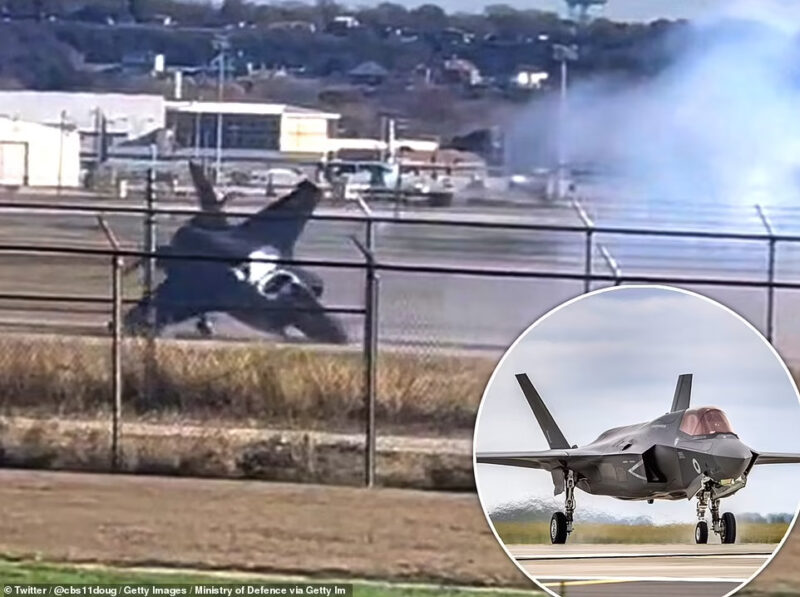
It has been, again, about 10 minutes since we last mocked the greatest boondoggle and waste of time and money in military history – the F-35 Joint Strike Flying Piano – so let us redress that egregious oversight right now. It turns out that, despite having an estimated US$1.7 TRILLION price tag associated with all of the various production blocks, upgrades, changes, bug fixes, software patches, and assorted unFUBARing required just to make the stupid Turducken Plane fly right and shoot straight (or, at least, not shoot itself in the ass, which is an extremely difficult feat for most planes to manage, but not for the Turducken)…
… the readiness level of the world’s most expensive Morris Marina still only approaches about 30%:
The U.S. Military’s fleet of F-35 is reportedly suffering from very lower availability rates due to a range of maintenance issues and performance defects, with the manager of the fighter program Air Force Lieutenant General Michael Schmidt reporting that only around 30 percent of the aircraft in service are capable of flying all their missions. Schmidt’s written testimony to the House Armed Service Committee stressed that “this is unacceptable,” in the latest of a series of now well over 100 scathing criticisms issued by both military and civilian officials. Thus while around 540 F-35s are in service across the Air Force, Navy and Marines, only around 160 are fully mission capable placing availability rates among the very lowest in the U.S. Military – rivalled only by those of the fighter’s heavier counterpart the F-22 which has consistently been in the lead for poor availability due to even more serious maintenance issues. As a relatively light single engine fighter, the F-35 was designed to have modest maintenance requirements and operational costs allowing it to easily replace the Air Force’s F-16 Fighting Falcons and the Navy’s F-18 Hornets, but the aircraft grew heavier and more complex during its design phase as the program suffered from cost overruns of close to $150 billion. The latest result of this is that the F-35 is expected to require a new engine, with the existing F135 having been designed when the fighter was projected to be much smaller and lighter fighter. Issues with the F-35 are currently a leading cause of low availability rates as well as performance issues and overheating.
The F-35 is one of just two fighters of its generation both introduction and fielded at squadron level strength today alongside the much larger twin engine Chinese J-20, with which it had its first encounter confirmed in March 2022. The fighter program has faced harsh criticism for over a decade, with the last holder of the post of Secretary of Defence under the Donald Trump administration, Christopher C. Miller, referring to the program as a “monster” the military had created and to the fighter itself as “a piece of…” Former Senate Armed Services Committee Chairman John McCain previously called it “a textbook example’ of the country’s ‘broken defence acquisition system,” stressing in a briefing to the Senate: “the F-35 program’s record of performance has been both a scandal and a tragedy with respect to cost, schedule and performance.” [This is one of the very few intelligent things John McCain ever uttered – Didact] On the basis of its serious shortcomings the F-35 has been very harshly criticised by sources ranging from individuals such as the Pentagon’s chief weapons tester Michael Gilmore and Marine Captain Dan Grazier, to military think tanks such as the NSN and the RAND Corporation, and organisations such as the Project on Government Oversight. The Pentagon has repeatedly highlighted that the fighter suffers from poor reliability and that its high operational costs could make it unaffordable to acquire in the numbers initially intended, with technical challenges repeatedly delaying the granting of approval for full scale production. The U.S. Air Force is has considered deep cuts to F-35 orders, with orders for 2023 notably having seen a 35 percent cut over the previous year.
Issues with the F-35 have been far from restricted to the American fleet, with the South Korean National Assembly’s National Defence Committee revealed in October to have found the country’s F-35s suffered from 234 flaws over 18 months from January 2021 to June 2022. These included 172 ‘non-flying status’ and 62 ‘cannot perform specific mission status’ cases, with the 117 flightless and 45 mission specific failures that occurred in 2021 seeing little improvement in the first half of 2022. The fighter’s suitability for combat in the event of war on the Korean Peninsula was seriously questioned by officials at the time.
All of that, of course, is BEFORE we get to the fact that F-35 parts are actually quite difficult to acquire, because the US Military Industrial Complex long ago moved to a “just-in-time” logistics system – very much unlike the way the Chinese and especially Russians do things:
The ‘just-in-time’ supply chain that provides the parts used to make America’s F-35 fighter jets could jeopardize the ability of US forces to keep the aircraft in service during the country’s next major war, the officer in charge of the program has reportedly claimed.
The F-35 program will need “a more resilient supply chain to ensure the military can keep it flying in a future, highly contested war,” Defense News reported on Monday, citing comments by US Air Force Lieutenant General Michael Schmidt. Speaking at the Navy League’s Sea Air Space conference on Monday in Maryland, Schmidt warned that parts shortages could lead to disaster in a major conflict.
“When you have that [just-in-time] mentality, a hiccup in the supply chain, whether it be a strike . . . or a quality issue, becomes your single point of failure,” the program chief said. “We need to look at, what does ‘right’ look like in the future, to give us more resilience in a combat environment.”
‘Just in time’ refers to a distribution strategy used by businesses to maximize profitability by keeping inventory costs to a minimum. The idea is to have supplies ready and in place just when they’re needed, rather than being set aside in a warehouse for future use. Such a system works well in the private sector, Schmidt said, but for a military fighting a war in “highly contested environments,” it can have disastrous consequences.
In other words, the F-35 is an unreliable and absurdly expensive platform that STILL has not been tested in actual, serious air-to-air combat against anything like a comparable air force, anywhere in the world. Where it has been used for attack missions, such as during Israel’s blatantly illegal bombing campaigns against Russian-backed Syrian government forces, the presence of Russian air defence systems and electronic countermeasures have largely forced the Israelis to use stand-off tactics and engage various military (and more than a few civilian) sites at a distance. And their countermeasures apparently can spoof Israeli AGMs, though that remains somewhat speculative.
We come back to the same question that everyone who has kept an eye on this colossal turkey of a weapons procurement programme has been asking for years now:
What happens when the Turducken Plane goes up against an actually competent and capable air force, which can both detect the supposed “stealth” fighter using long-wave radar and modern signal processing algorithms, and engage it at FAR beyond visual range (BVR) using hypersonic missiles that cannot be intercepted?
This is no longer the realm of theory. There is a pretty significant body of evidence to suggest that a Russian Su-57 shot down a Ukrainian Su-27 at a range of well over 200Km, using an R-37M missile – which hits at speeds in excess of Mach 6, meaning it cannot be intercepted and is extremely difficult to avoid. There is also good reason to believe the Russians have been using their very small number of Su-57s to suppress Ukrainian air defence systems – which is to say, the Russians have used their stealth fighters against some of the best air defence systems available in the world today, that they themselves created and built, and which still, to this day, prevent the Russian Aerospace Forces from directly bombing Ukrainian positions with their conventional heavy bombers.
The Russians, therefore, have an actual, combat-tested, cost-effective, capable, net-centric, stealthy weapons platform that can do everything the F-35 is supposed to be able to do – at about half the cost, and probably a lot less than that.
The Chinese J-20 is the world’s most extensively produced fifth-generation fighter platform, but nobody knows how it will actually perform in combat. The true combat record of the People’s Liberation Army, Navy, and Air Force is actually quite poor, but that dates back all the way to the war for independence back in the 1940s. We simply do not know how their jets and combat doctrines would perform under actual combat conditions in a modern industrial war.
Either way, the BIBLICAL unreliability of the Turducken Plane, does not bode well for its future – or for those who would use it in anger.
The Finns ordered 64 F-35s back in 2021, and then very stupidly chose to abandon their neutrality and join NATO. They have also invested very heavily in the joint American-Israeli air defence system known as David’s Sling, but there is an open question as to whether the Russians already know how to hack and counteract it. If the Finns are genuinely dumb enough to go to war with the rest of NATO against Russia – as seems increasingly likely, given the severe defeat the Russians seem ready to inflict on NATO proxies in Banderastan – what happens then to the F-35?
As far as I can tell, the answer is: a lot of destroyed aircraft – and a lot of dead pilots.
By the standards of American weapons programmes, then, this one is working out spectacularly well. It has delivered very little of actual value, while costing RIDICULOUS amounts of money, and will keep its customers coming back for constant upgrades and bug fixes.
Come to think of it… one might almost say the F-35 is the Microsoft Jet.









2 Comments
I’ve been a Jet Mechanic for over 40 Years now, watching (but not participating in) the Transition from Airplanes designed by Engineers who did Hands-On Work, even Flying their own Designs, like Scott Crossfield did. The current generation (well, maybe the last Two) of “aircraft designers” have Lost the ability to use common sense in favor of “Computer-Aided Design” and “Computer Modelling” instead of the Experimental/Prototype/ Production sequence that produces Airplanes that Work.
Aircraft Design is always about Compromises made for Performance- the Performance Goals must be Defined, and rather Narrow in order to produce a good, even Great, Aircraft. The A-10 is probably the last example of this principle being applied to a USAF Plane. It is Slow, Maneuverable, Heavily-Armored, carries a lot of Bombs and Rockets, and is fitted with a Big Gun. Everything needed to Shoot Up stuff on the Ground.Claims that the F-35 can 'replace' the A-10 in the Ground Attack role are pure Stupidity, sold by those in the MIC who are driven only by One Goal - Profitability. The Overcomplexity of the 'Turducken' in an attempt to build "One Plane to Rule them All" has had the Expected (by us Old-School guys) result of a Plane that doesn't do Anything very well, and certainly not as Good as any 'purpose-built' Plane that has One, and only one Role to perform.
The consolidation by 'financialization' of the Aviation Industry has led Directly to all aspects of Airplane Design and Production being 'managed' by people who not only have No Clue as to the basic Physics of Flight, but couldn't Change the Oil in a Turbine Engine to save their worthless lives. (Pro Tip- it's usually Easier and Cleaner than on a Car).
Such a system works well in the private sector, Schmidt said
.
the fun thing is that JIT only “works well” in the private sector so long as nothing unusual happens.
.
remember the fake ass Corona shut down? remember the toilet paper shortages? you know why that happened? because of JIT supply chain practices. the same thing happened to the auto manufacturers getting jammed up by the lack of IC chips and artificial demand for face masks and hand sanitizer, etc.
.
JIT renders any product very sensitive to hiccups in the supply chain and also renders the market easily subject to people who try to corner the market or hoard product like that guy who bought up all of the hand sanitizer in his county and then tried to sell bottles for a many multiple markup.
.
and, of course, JIT is exactly the smartest cost cutting measure to take when you’ve off shored most of your industrial production to China … while Joe Derpy Biden rattles sabres at China.