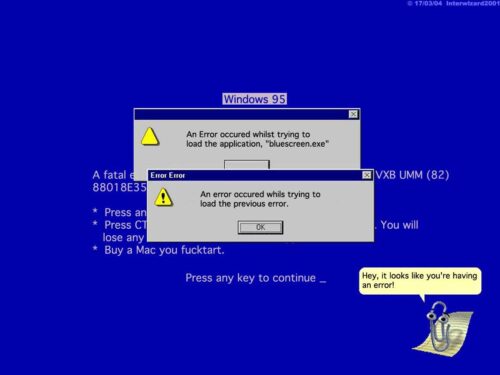
A reader and podcast listener alerted me this morning to a truly hilarious story about everyone’s favourite corporate whipping boy. Apparently, a huge swathe of Microsoft’s core cloud services went offline, and as far as anyone can figure out, it was likely due to an update that one of their development teams applied:
Microsoft’s online authentication systems are inaccessible for at least some customers today, locking those subscribers out of tons of Redmond-hosted services if they are not already logged in.
And, according to the software giant, its attempt to rectify the system failure, by backing out a recent change, did not work.
Microsoft, via its cloud platform’s status page, said the breakdown started around 2125 UTC (1425 PDT) on September 28. “Customers using Azure Active Directory may experience HTTP 503 errors when accessing the Azure portal,” the notification message said, promising further updates as events warrant.
[…]
Beyond Microsoft’s public and government cloud wobbles – good luck, JEDI – the authentication system outage has hit its other online services, including Outlook, Office, Teams, and Microsoft Authenticator. If you’re not already logged in, it appears, you may be unable to get in and use the cloud-based applications as a result of the ongoing downtime.
This is what happens when you hire a bunch of H-1Bs to program your primary systems. And since Microsoft is basically an Indian software company at this point, there is simply no getting past the fact that a LOT of the code involved in MSFT’s basic systems are created, built, and maintained by Indians.
A lot of Indians reading that will undoubtedly be outraged and call me racist and bigoted and so on. As far as I’m concerned, if they don’t like what I have to say, they can send a very trenchant email to idgaf@myass.com. They are more than welcome to blow up at me if they like.
The problem for them is that I know exactly what I’m talking about.
I’ve worked with Indian software developers for years in the financial services industry. I had to deal with the extraordinarily painful results of constantly buggy code, extremely unreliable mission-critical systems that routinely crashed during peak hours when they absolutely needed to be up and running, and constantly delayed development cycles.
I have often argued that you could hire three Indians, in India, for the price of a single Ukrainian DEV guy, QA tester, or UAT checker – and you could hire FIVE Indians for the price of a single highly qualified Russian. But the quality of the work done by the Slavs would be far better, the errors would be far fewer, there would be much less “smelly” code, the comments would actually make sense, and the debugging and development cycle would be much faster.
At my last banking job, the development teams for the Rates business’s primary risk calculation engine were eventually moved over to Russia because the Indian teams were so hopeless. Once most of the infrastructure development, testing, and release teams were moved over, the business immediately saw a huge improvement in terms of quality, customer responsiveness, and usability. (That in turn set off an interesting chain of events that led to me spending a lot of time in Russia over the past few years, but that’s for another day.)
Put simply, the reputation that Indians have for being amazing tech workers has a core of truth to it, but is in general vastly overblown. I’ve seen far too many f***-ups caused by Indians who don’t understand how clients think and don’t know what the end product actually needs to look like, to have much patience for the stereotype that Indians know what they are doing.
I also happen to have experience as a former H-1B hire. I know the system and I know what it does to people. The H-1B system of work visas gives heavy incentives to employers to hire lowest-common-denominator types, pay them shitty wages, exploit them as hard as possible, and keep them strung along for years if not DECADES in menial dead-end jobs with virtually no hope of getting out and transferring their skills, in the forlorn hope of getting an extremely valuable and coveted American green card.
Again, I know what I’m talking about because I was in that system for TWELVE YEARS of my life. That is time that I will never, ever get back. I was chewed up and used and spat out by three different companies in the USA, and though I bear no ill will to Americans whatsoever, I do think that the H-1B system is completely immoral and needs to be destroyed immediately.
So when I say that Microsoft’s problems are due to hiring too many Indians – I’m saying that because it’s true.
If you look at the appalling state of Microsoft Windows 10, which is an AWFUL operating system, about the only good thing that you can say about it is that it’s not as bad as Windows 8.
If you look at Microsoft’s Azure cloud computing platform, and you look in particular at the Azure Data Factory component of that platform, it’s simply nowhere near what it needs to be. You could run an SQL stored procedure on five database tables and manipulate about 10,000 records to sift through, concatenate, filter, join tables, generate new reports, and merge things, and it would run in under a minute. I’m not joking about that – SQL is an extremely powerful and fast language and if you know what you’re doing, you can get some seriously amazing things done very quickly.
In ADF, by contrast, the same set of procedures takes – no malarkey, kiddies – THIRTY MINUTES to run remotely on Microsoft’s servers. I know. I did a test run on ADF for my last corporate job.
Even Microsoft Office, which was and still is the absolute gold standard of corporate productivity software, has moved almost entirely online – but if you use the desktop version of their software, it gets more annoying and stupid and difficult to use every year. If you are a true Excel whiz – and I used to be, and in some ways still am – then you know and understand where all of the important functionality is. You know how to get there and navigate through the menus and you know all of the necessary shortcut keys.
But Microsoft keeps switching around and changing the user interface. When they replaced the menus with ribbons, all of the old-school users absolutely hated it because nothing was where they needed it anymore. The last time that I checked on the UI for Office 365, it was even worse – I had no idea where the hell anything was and I couldn’t find what I needed to.
And Microsoft’s software seems to get buggier and cruftier and dumber with every passing year – anyone who has to deal with the excruciating experience of a major WinDOZE 10 update knows what I mean.
So the fact that Mr. Softy’s systems got a serious case of BSOD balls doesn’t really surprise me. It’s the inevitable end result of piling all sorts of junk on top of an increasingly creaky infrastructure that is desperately trying to maintain backwards compatibility with software sets that go back some twenty years.
There are still parts of the world where people use Windows XP, and refuse to upgrade or update simply because any such change would immediately wreck their systems.
All of that being said – there is some good news in the midst of all of the woe and misery of using Microsoft’s systems.
No less a personage than Eric S. Raymond reckons that eventually Microsoft Windows is basically going to become an emulation layer sitting on top of a Linux kernel:
Raymond’s argument, posted to his blog late last week, kicked off with some frank admiration for Windows Subsystem For Linux, the tech that lets Linux binaries run under Windows. He noted that Microsoft is making kernel contributions just to improve WSL.
Raymond is also an admirer of software called “Proton“, an emulation layer that allows Windows games distributed by Steam to run under Linux.
Raymond rated Proton as “not perfect yet, but it’s getting close”.
His next item of note was Microsoft’s imminent release of its Edge browser for Linux.
That collection of ingredients, he argued, will collide with the fact that Azure is now Microsoft’s cash cow while the declining PC market means that over time Microsoft will be less inclined to invest in Windows 10.
“Looked at from the point of view of cold-blooded profit maximization, this means continuing Windows development is a thing Microsoft would prefer not to be doing,” he wrote. “Instead, they’d do better putting more capital investment into Azure – which is widely rumored to be running more Linux instances than Windows these days.”
From what little I know of the subject, I do think that ESR is right. I had some experience with creating VMs within Azure – not much, mind you, I couldn’t get past the CLI involved to instantiate and startup a new machine – and from what I saw, Linux VMs were and remain far more popular than WinDOZE ones.
In fact, Microsoft isn’t even attempting to defend Windows 10 as intellectual property anymore. Seriously, if you wanted to, you could go online right this very moment to Microsoft’s website and download a fully functional version of Windows 10, which you could then install on your PC or as a virtual machine (like I have in my Linux partition right now).
That Windows 10 instance will still update, still run, and still be compatible with the latest games – which, unless you work in a corporate environment, is really the only compelling reason to stick with Windows right now. In fact, most corporate environments don’t strictly need Windows anymore, because Office 365 is almost fully online and can be run out of a web browser.
Once Windows games run through a Steam emulator on Linux correctly, then there will simply no longer be any need whatsoever for a Windows installation.
In fact, ESR’s comments have me seriously tempted to try out this Proton emulation layer, which is based on Wine and may well be significantly better. Steam already installs and runs on Linux. If I can get HALO: The Master Chief Collection, HALO WARS, and STAR WARS Republic Commando to run on Linux through Steam, then I’m simply going to delete my entire Windows partition completely and be fully Linux-based again.
There is literally no other compelling reason for someone like me to use Windows anymore. And that reason shrinks with every passing month.
In the meantime, Microsoft is undoubtedly going to carry on hiring outsourced Indian tech workers to run its platforms and systems, and the rest of us will undoubtedly continue to groan and suffer as a result.
But that strategy will fail in the end. We can see the inevitable failure coming already. I don’t think we’ll have to wait too much longer before we see Microsoft becoming a purely cloud-based productivity and computing company, with a significant and powerful gaming arm, and a much smaller and downsized operating system unit that spends most of its time porting things to a Linux back-end with an emulation layer floating on top of it.
People like me have been forecasting the death of Windows on desktop for decades. We were always and consistently wrong, and with good reason. But the time is coming when these endless failures caused in no small part by too many diversity and outsourcing hires will catch up with the company. It looks like that is already happening.
Can’t happen fast enough, in my personal opinion.








9 Comments
yep, switched to openoffice years ago (and then to libreoffice when openoffice was invaded by clueless SJW’s and eventually became as bad as msoffice) and while my needs for spreadsheets are limited (I use them solely for character sheets… I have an amazing mekton mecha build sheet I am very proud of as well as much BETTER Pathfinder, mutants and masterminds 2, and champions sheets than any others I have ever seen) Libreoffice is the classic excel interface plus more graphics-handling tools, and the whole suite is better than MS office since 97.
Honestly, if it weren’t for Kindle Unlimited’s jacked-up online reader and Epic Games I would have ditched windows in favor of Ubuntu a decade ago (I already did for my laptops)
I am by no means a power user or a core compiler (Thus Ubuntu instead of a less user-friendly but more powerful distro) in fact I cannot code at all… I was a COBOL guy for the three years leading up to Y2k, and the experience burned me out so badly I re-upped and never wanted to ouch ANY kind of code again (except html and spreadsheets and a little python, weirdly)
But MS has gotten so unbelievably awful I even briefly considered grabbing one of those Chinese OS’s.. thankfully I came to my senses.
There are problems with Ubuntu these days too. I strongly dislike their current desktop manager, which is why I switched over to the Ubuntu-derived Linux Mint. Other good alternatives include zorinOS and Elementary OS, which are also heavily Ubuntu-based but have very slick-looking window managers.
The best way to really screw Microsoft over these days is to download and install Windows 10 and never pay for the software license. You can run everything on that installation without problems – it even updates on its own, as far as I can tell.
But yeah, WinDOZE these days is really only good for games – and not even great for that either, anymore.
I was actually looking at Mint, as my ubuntu distros are CD loaders for 15+ year old systems I use as ‘loaners’and display units (I could give a crap if some jerk at my booth steals a ‘computer’ that cost me less than 5 bucks from Deseret)
I will assume that this is a bit of an endorsement.
I do really like Linux Mint – been using it since, I think, 2013 or so. Before that I used Ubuntu for about 4-5 years. I liked Ubuntu a lot until they introduced that stupid Unity screen manager with the weird dock system.
Canonical has also changed the package management system in the background, which removes control from the user and allows packages to send data to Ubuntu’s app store without you knowing about it. Linux Mint’s DEV team has flatly refused to follow that route and continues to use the Debian APT package manager, which is much more transparent.
If you have older hardware, both modern Ubuntu and Mint (and most Linux distros) will be too heavy for them. A better alternative is probably Puppy Linux, which is so small and compact that you can run it in memory from a USB drive, and has a tiny footprint. The interesting thing about Puppy Linux is that it’s not one single distribution – it’s a collection of highly modified distros like Ubuntu, Slackware, and Raspbian with an emphasis on simplicity and lightness.
Google is just the same, I’m sure. I have a top-o-the-line Chromebook, in order to both play games and work; unlike the typical chromebook, this thing actually has guts. It says it runs Android, so anything on the play store for phones should work.
Yet, it can’t play most of the games I actually bought it to play (replacing my old tablet). Why not? Because the geniuses at google decided to make their android implimentation a simple emulator, not the actual android. Many games ban emulators, because emulators allow cheating. So, even though I have an official chromebook, more than capable of running android, and having full support from google, I can’t play a lot of games that the machine is physically capable of playing. If I just wanted a browser and music player for work, I could have paid $150, instead of $700.
The only use Windows has for me is gaming. Everything else is better under another O/S.
LITERALLY EVERYTHING ELSE, except for corporate environments. Thunderbird has evolved by leaps and bounds, but it’s still not nearly as good as MS LookOut – it’s about 85% there, but the full integration that Outlook offers is still unmatched for corporate environments and for setting up meetings, calls, and so on. And while LibreOffice Writer is better, in my opinion, than MS Word, NOTHING out there beats Excel for spreadsheet geeks (like me).
That being said – with everything moving onto “the Mighty Cloud” (*eyerolls*), the need to use Windows qua Windows just to access those online tools is shrinking by the day.
I’ve been on projects twice with outsourced Indians. Both times they didn’t understand the underlying tech to connect to other apps/systems which made their app slow and frustrating to use. For instance, they were porting a sales app over to a custom made oracle app. One of the functions was ‘click to dial’. It was my job to setup the gateways to the phone system. When you clicked the number, it took 20-30 seconds to connect. I remember one of the users complaining that they could’ve picked up the phone and dialed faster.
The other issue was the user interfaces. Ugly, clunky, no idea how to make the app ergonomic so that it worked physically with a human.
Epic Line – “all of the old-school users absolutely hated it because nothing was where they needed it anymore” I HATE HATE HATE this shit! After an office update, I spent – no lie – 15 minutes trying to figure out how to add a header/footer in excel. I’ve done it thousands of times. I had to google it.
I’ve played with Azure for our software, to use as a training environment. I found that a VM with specs that matched our requirements had a lot of latency. And if I were to boost it, the cost would triple or more.
Yeah, I’ve observed exactly the same things that you have in my interactions, such as they are, with Indian developers and QA testers. I’ve always hated dealing with the results of their work.
I will say that not every Russian DEV is all that great either. A few years ago I was working for a big bank in their Finance department as one of their techie wonks working to setup the risk calculator configuration interface for everyone else to use. The Russian DEV team changed personnel a bit and the new guy who came in was nowhere near as good as the previous one. The result was a new UI tool that was full of bugs and had major functionality issues. I was able to get the Russkies to fix most of them, but it took a lot of time and effort and the results still weren’t that great.
Even so, it was still a less painful effort than dealing with Indians for the same thing – because with the Russians, at least, they actually tried really hard to understand what we needed from them.
Yeah. Been in the same situation many times. Not anymore, thank God – for the last few years I’ve primarily been using LibreOffice and I’ve had to use Apple’s iWork software too. (Which I hated – I wrote about it a while back).
Sounds similar to my experiences as well. I would LOVE to know why people opt for Azure rather than Amazon AWS or Google Cloud Platform. I suspect even Oracle’s Cloud is probably better.