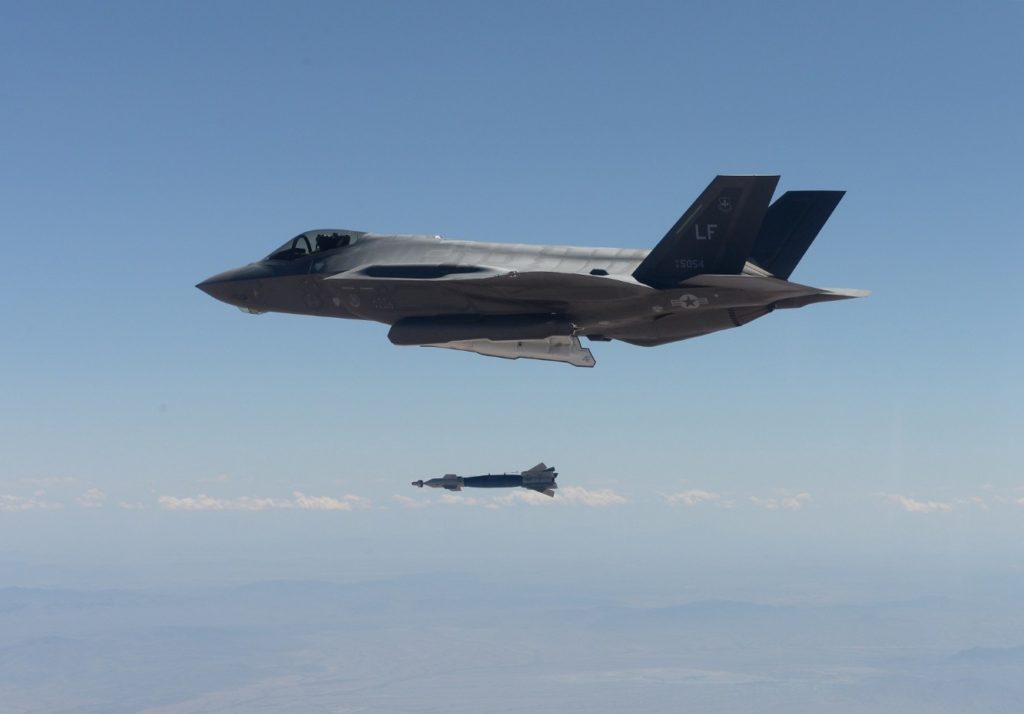
I have been an extremely harsh critic of the F-35, especially the VTOL version for the Marine Corps, for years. But it would appear that there is some reason to think that the F-35 might just come good after all – under a very, very specific set of mission parameters.
It turns out that back in June, Iran’s Supreme Leader Ayatollah Khamenei fired the head of the country’s air force, Brigadier General Farzad Ismaili, for hiding the fact that at least one Israeli F-35 had penetrated the country’s airspace.
According to the newspaper’s investigation, the IAF F-35 “Adir” planes penetrated Iran’s airspace, circled high above Tehran, Karajrak, Isfahan, Shiraz and Bandar Abbas – and photographed Iran’s air defense system.
One of the sources reported that Iran’s air defense system, including its Russian radar, did not detect the entry and exit of the fighter planes, and that Ismaili hid this information from the supreme leader to cover his corps’ failure. However, three weeks ago, Iranian intelligence discovered that the Israeli fighter jets had carried out this sortie as a test of the possibility of an undetected military attack on Iranian outposts and bases, during which they photographed those sensitive bases, evading the Russian S-300 missile system’s radar.
According to Al Jarida, Iranian intelligence received top secret information that the Israeli fighter planes even managed to photograph Iran’s underground bases. Khamenei, who received this information, now suspects a cooperation between Russia and Israel, and that the Russians gave Israel the secret code of the Russian radar in Iran – according to the Kuwaiti newspaper.
It is worth noting that Iran fields a large number of Russian-designed S-300 mobile radar detection and air defence platforms. If you’ve never seen one, the system looks a bit like this:
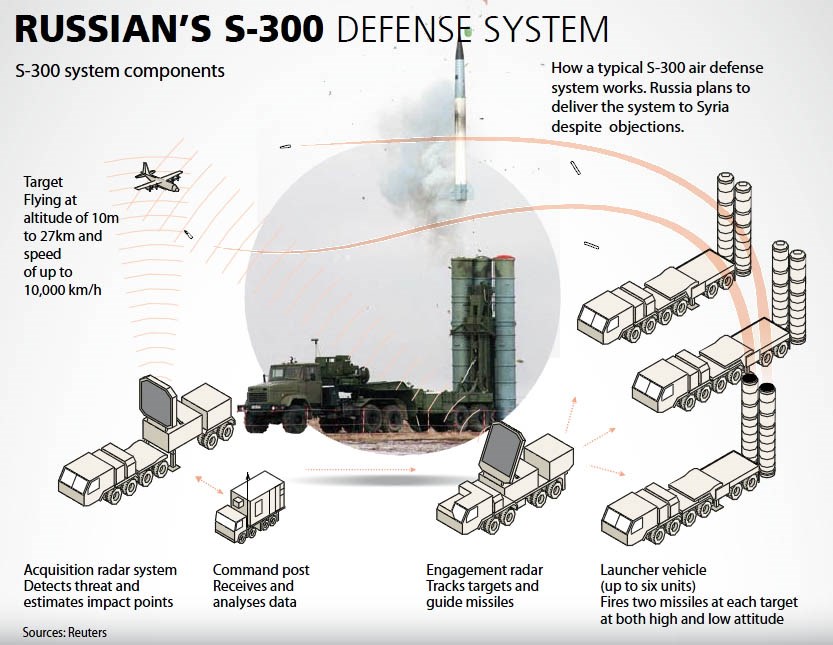
I have seen something similar to these, if not the actual S-300, up close on display. Last October I spent some time footling around in the big exhibition area in Moscow, ВДНХ, where they display some of their best military technology from the past for exhibition purposes.
The platform is really damned impressive. It’s huge, but the radar systems and missile platforms are truck-mounted and therefore pretty mobile, and can be setup in under an hour once they get to a particular defensive line. Those SAM cylinders are damned scary to look at when you’re staring down the business end of them.
There is further good news for the F-35 – for certain values of “good”, I suppose – as our friends over on Bill Whittle’s channel point out:
Right, so, job done then. US$1.4 TRILLION well spent.
The F-35 which got its ass kicked by the F-16 was piloted by someone who didn’t fully understand the capabilities of the new aircraft (even though that pilot was originally trained on the F-16), and didn’t have the full range of stealth features that make the thing such a genuinely formidable aircraft.
And when deployed into an actual live mission, with upgraded software and avionics suites and properly good engineering, maintenance, and training, along with the necessary stealthy surface composites and radar-absorbing paints, the F-35 can penetrate deep into enemy airspace without them even knowing it, even with their fancy-pants portable SAM launch systems.
All good.
Right?
Well…
Not so fast.
Let’s be a bit more sober about our assessments here.
First, the S-300 air defence system is not actually designed to operate in low-frequency, long-wavelength radar bands. It is actually designed to operate in precisely the kinds of high-frequency, short-wavelength parts of the radar bands that stealth fighters are meant to defeat.
Now that is not to say that the Iranians do not have some amount of long-wavelength radars. The Russians have designed radar systems specifically meant to detect pretty much every stealth aircraft ever made. There is considerable debate about whether or not those systems are actually effective in any way, shape, or form, but there is no debating the fact that it was a Russian-designed long-wavelength S-125 radar system that helped the Serbians detect and shoot down an F-117 Nighthawk stealth “fighter”.
(The F-117 is not a fighter, in reality. It’s actually a bomber, and a pretty damned good one. Another thing that it is not, is “invisible”. Never was. It is designed to be stealthy against high-frequency radar, and proved itself to be so repeatedly in the Gulf War against probably the highest concentration of SAM sites anywhere in the world, over the skies of Baghdad. Stealth does work, in the right applications and contexts. I am not anti-stealth. I am anti-stupidity.)
So, essentially, the F-35 was put up against a system that is not designed to take it on, and blew right past it. That is the good news, and it is highly encouraging for proponents of the F-35. That means that the Iranians are going to be extra jumpy, because now they know that both the Israelis and the Americans can operate in their own airspace pretty much with complete impunity.
This is not the first time that stealth fighters have taken on Iranian air defence systems and schooled the Persians. There was an incident back in 2013 where an old Iranian F-4 Phantom II got within 20 miles of an American drone flying over international airspace (or so the Americans claim), and was in a position to get a missile lock on it.
The pilot of that venerable old jet must have been rather surprised when he looked over to his left and saw an American F-22 simply sitting there next to him.
In fact, the F-22 had actually simply strolled up right behind the Iranians – there were at least two of the F-4s in that engagement – and ducked underneath them to check out their weapons loads, and then popped up off the lead F-4’s left wing and pinged the Persians to tell them, “You really ought to go home”.
Again – in the right situations and under the right circumstances, stealth DOES WORK. I have never argued against using stealth in those situations.
What I have a serious problem with is the way in which the F-35 was hyped up as some sort of whiz-bang silver bullet that would do everything and completely dominate the battlefield.
We already know that it cannot perform an adequate ground attack role – it isn’t properly designed for that, unlike the A-10 Warthog, which can absorb unbelievable amounts of damage and loiter over the battlefield for hours to give troops close support on the ground.
Whether it can actually perform an air superiority role is considerably less clear. This incident with the Iranians tells us that it probably could do a superb job – against an air force flying obsolete junkers with limited spare parts, like the old American-built F-4 Phantom IIs and F-14 Tomcats.
We simply do not know how the F-35 would perform against a truly advanced air force like those fielded by the Russians or Chinese, with proper mobile early-warning long-wavelength radar detection systems.
But then we come to the most egregious part of the F-35’s shortcomings, and it comes from that Red Flag exercise from back in 2017, from which emerged the highly sensationalist claim that the F-35 had a 15:1 kill ratio.
Fifteen enemy kills for every downed F-35 is an astonishing ratio. If true, it means that the F-35 is possibly the deadliest aerial weapon ever devised.
However… you need to look at the details behind the headlines, because you simply cannot trust the (((media))) to be anywhere close to objective anymore, about anything:
In other words, did one F-35 die per 15 enemy aircraft killed strictly by the F-35’s own hand, or did those enemy aircraft die while the F-35 was merely involved in the battle? The F-22As from the 27th FS were integrated into this Red Flag, as were APG-63V3 AESA radar toting F-15Cs from the 159th FS. The UK brought their highly capable Typhoon FGR4 to the exercise as well, and these are just the high-end air superiority players; other fighters, including F-16s, were also present. That’s a lot of counter-air capability in the air at one time, all with various advantages and disadvantages, feeding their data into one common fused data-link picture. In addition, they were assisted by an armada of support aircraft, including the most capable jamming and information, surveillance, and reconnaissance platforms in the world.
[…]
How can we really judge F-35A’s supposed kill ratio without knowing those of other platforms used in the exercise, or even historical numbers from other exercises? For instance, what was the F-15C’s kill ratio? Or the F-22’s? What about the Royal Air Force’s Typhoons? How about red air’s corresponding kill ratio? 15:1 sounds great, but it really is about the same as what the US Navy experienced with their Topgun graduates in Vietnam, a time when F-4s were taking on MiG-17s and MiG-21s. In the end we have nothing to compare this number to, and “lesser” platforms could have gotten as high a ratio or even higher, we just don’t know.
[…]
Statements like the this one from Lieutenant Colonel George Watkins, the commander of the 34th Fighter Squadron, offer a more credible view of how the F-35A performed in Red Flag as part of the total force:
“Before where we would have one advanced threat and we would put everything we had—F-16s, F-15s, F-18s, missiles, we would shoot everything we had at that one threat just to take it out—now we are seeing three or four of those threats at a time. Just between [the F-35] and the [F-22] Raptor we are able to geolocate them, precision-target them, and then we are able to bring the fourth-generation assets in behind us after those threats are neutralized. It’s a whole different world out there for us now…When you pair the F-22 and the F-35 like together with the fourth-generation strikers behind us, we’re really able to dominate the airspace over the Nellis test and training range.”
The F-35A also stayed around after their munitions were dropped to soak up electronic intelligence on the enemy, a role the aircraft is especially adept at.
The F-35 also had great availability, supposedly 92 percent, and did not miss a mission due to maintenance issues. But this metric can also be skewed as the parts supply chain is flooded and contractors are usually on hand to prop up these numbers during a modern combat aircraft’s operational debuts (see the MV-22). This is just how the industry works with the DoD to make their systems look great during high-profile deployments among the first operational squadrons. Case in point, the F-22 had a 97 percent mission-effective rate during exercise Northern Edge in 2007, completing 102 of 105 assigned sorties. What is the F-22 fleet’s readiness rate today? Around 67 percent, give or take a few points. Also, 13 F-35As from the 34th Fighter Squadron were present at Red Flag—that’s a large amount of aircraft from a single unit, with most squadrons historically deploying six to eight jets for the exercise. This larger amount of available aircraft would have bolstered the unit’s mission completion rate.
We already know that the F-35 has a tiny internal ordnance capacity – two air-to-air missiles, and two bombs or air-to-surface missiles with a maximum weight of 2,000lbs.
That’s it. Two missile shots and then it’s out, and is forced to engage with nothing more than its cannon – and remember that this is not a jet that is designed for proper dogfighting.
By comparison, the larger F-22 can accommodate six long-range and two shorter-range AAMs, and as such is considerably more heavily armed and capable of fighting off a lot more opponents.
So essentially, the best way to use the F-35 is to have it engage a big low-tech air force, like what the Chinese used to have, from Beyond Visual Range (BVR), and hope and pray that their long-range missiles hit their targets, and then stick around in the skies to provide electronic intelligence and information to lower-tech USAF and USN fighters like the F-15X, the remaining F-16s and F/A-18s, and others.
In other words… the F-35 is a small stealthy AWACS that just happens to be able to fire off two missiles and two bombs.
Well, that’s splendid and all, but what exactly is so terrible about current AWACS aircraft that the US military had to build out a trillion-dollar do-it-all fighter and attack jet that actually can’t do a whole lot of fighting or attacking, just to be an AWACS?
After all, the venerable Boeing E-3 Sentry AWACS aircraft, which is built on top of the old 707 airframe, used to cost $270 million in 1998 dollars, which is probably closer to $350 million today, per aircraft.
That’s expensive, yes – but bear in mind that every F-35 costs between $94 million and $120 million, depending on the variant.
Essentially, the F-35 is vastly more expensive than every aircraft that it is designed to replace, but its only real selling point when compared with those older systems and platforms is the fact that it provides that so-called “God’s-Eye View” of the battlefield and can direct previous generations of aircraft to do real battle with targets.
About the kindest thing that you can say about the F-35 is that it has utterly failed to meet almost every one of its original mission parameters, except in its ability to penetrate enemy airspace and provide intelligence to other aircraft.
And that is before getting to the fact that the F-35 still has not been tested against an air force that actually can stand up to the USA, and can target American aircraft carriers with hypersonic carrier-killing missiles.
Again, there is debate about whether or not those carrier-killers actually work. We know that the Chinese have been very hard at work developing a “system of systems” that will nullify and destroy all of the American Pacific Fleet’s abilities to deploy carriers against them, from ranges that the Americans simply will not be able to defend against.
And we know that the US Navy takes that work very seriously and is crash-developing a number of countermeasures designed to stop the Chinese threat from becoming so severe that the Pacific Fleet simply has to turn tail and run in order to avoid tens of thousands of casualties when – not if – China finally decides to retake Taiwan.
Once those carriers, packed full of F-35s, are removed from the equation, then every advantage that the F-35 provides, disappears instantly.
So we come back, yet again, to the very basic and simple question:
What, exactly, is the point of this flying turkey?
After more than four years of researching and writing on the subject of the F-35 – and I don’t know all that much, mind you – I am still as perplexed as ever. It just doesn’t make any sense.









1 Comment
What's the point of it? There are hundreds of points! They're just all bullet points on pentagon officers' OERs. You can tell who they are: they're the ones who keep trying to murder the A-10.
The F-35 may turn out to be okay in the end (I have my doubts — the software problems alone are insane), but we didn't freaking need it to begin with.
If it was up to me, I'd outright nix the entire Air Force and roll the relevant bits back into the Army where they belong. That's been necessary since the fighter fags took the branch over and lost sight of how wars are actually won: with boots on the ground. I'd nix the ground element of the USMC entirely too. Marines are for shipboard actions. If we need to seriously invade a country by ship, the Army is going to have to do most of it anyway because there just aren't that many Marines. So let's stop maintaining four different sets of materiel and simplify our logistics enormously.
I'm not gonna hold my breath on anything sensible happening in the military, though. There's a reason I've been advising people not to join since I got out.