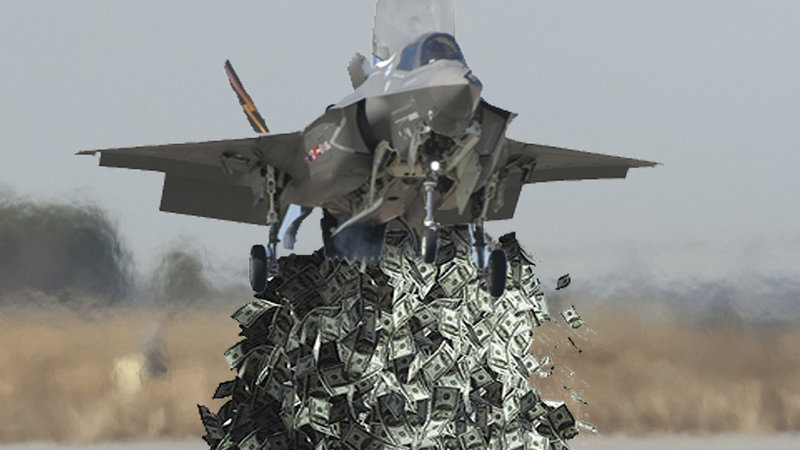
The F-35 Joint Strike Flying Piano is sort of like a slow-motion car crash: utterly horrifying as a whole, oddly fascinating in its little details, and you cannot stop yourself from staring at the awful spectacle of its self-inflicted demise, even though you know quite well that it is an utter tragedy.
Seeing as how it has been a whole TWO WEEKS since I last pointed out what a shitheap the entire thing is, perhaps it is time to rectify this by noting that, as of just a few days ago, news reports broke telling us that the Pentaloons are frantically running around trying to fix “a number of issues” with the F-35 in time for it to go into full-rate production (FRP).
What are these issues?
According to a June 2018 report by the Government Accountability Office, the program had 111 category 1 deficiencies on the books in January 2018. By May 24, 2018, that number had decreased to 64 open category 1 problems out of a total 913 deficiencies, according to one document obtained by Defense News.
Another document obtained by Defense News noted that at least 13 issues would need to be held as category 1 deficiencies going into operational tests in fall 2018.
The 13 deficiencies include [buckle up, these are doozies]:
- The F-35’s logistics system currently has no way for foreign F-35 operators to keep their secret data from being sent to the United States.
- The spare parts inventory shown by the F-35’s logistics system does not always reflect reality, causing occasional mission cancellations.
- Cabin pressure spikes in the cockpit of the F-35 have been known to cause barotrauma, the word given to extreme ear and sinus pain.
- In very cold conditions — defined as at or near minus 30 degrees Fahrenheit — the F-35 will erroneously report that one of its batteries have failed, sometimes prompting missions to be aborted.
- Supersonic flight in excess of Mach 1.2 can cause structural damage and blistering to the stealth coating of the F-35B and F-35C.
- After doing certain maneuvers, F-35B and F-35C pilots are not always able to completely control the aircraft’s pitch, roll and yaw.
- If the F-35A and F-35B blows a tire upon landing, the impact could also take out both hydraulic lines and pose a loss-of-aircraft risk.
- A “green glow” sometimes appears on the helmet-mounted display, washing out the imagery in the helmet and making it difficult to land the F-35C on an aircraft carrier.
- On nights with little starlight, the night vision camera sometimes displays green striations that make it difficult for all variants to see the horizon or to land on ships.
- The sea search mode of the F-35’s radar only illuminates a small slice of the sea’s surface.
- When the F-35B vertically lands on very hot days, older engines may be unable to produce the required thrust to keep the jet airborne, resulting in a hard landing.
I don’t know how to respond to that appropriately. All I can say is that seeing the problems in bullet points doesn’t even come close to underscoring the seriousness of the situation.
I mean, this is a plane that is actually a gigantic security threat to America’s own allies. It cannot perform the missions for which it was designed in the first place. It isn’t stealthy under combat conditions. It appears to be quite an unforgiving aircraft; you cannot even come close to pushing it to its performance limits, because if you do, you could die. And it is buggier than a damned roach motel.
Words alone fail to convey what an utter disaster this clown-car crash is.
So here are a bunch of videos that tackle each and every one of those points.
Now, defenders of the F-35 – and there are plenty of them – argue that any fighter that is new to the fleet of one service is always going to have bugs to iron out. See for example the many issues with early F-14 Tomcats with their variable-geometry “swing wings” and the massive new radar system that they used, or early issues with the F/A-18E Super Hornet.
My answer to that is that the previous generation of fighter planes got their bugs ironed out PDQ.
The F-15 Eagle was designed back in the late 1960s and entered service in 1976. By the 1980s, just a few years after it entered service, it was already the best air superiority fighter in the world. Today it possesses a kill-to-loss ratio of well over 100 to ZERO. The vast majority of those kills were made by Israeli pilots against exactly the kinds of Soviet-era aircraft that gave the Americans absolute fits over the skies of Vietnam, as well as the newer and much hotter MiG-25 Foxbats that were designed to intercept and destroy the legendary SR-71 Blackbird.
The F-16 Fighting Falcon was designed throughout the late 1960s and early 1970s by much of the same team that designed the F-15, because those men were fed up of all of the nonsense and stupid junk that got attached to the bigger plane and decided to launch an underground stealth campaign to introduce a new, small, vastly hotter and superior fighter that they believed would fly circles around the F-15. They largely succeeded, and the F-16 went into production in 1978 and has proven to be probably the most successful American fighter in modern history in terms of numbers produced, export sales, and combat record.
As you go down the list of fighters and attack aircraft that the F-35 is supposed to replace – the F-16, the F/A-18, the A-10, and so on – you see a pattern emerge over and over again. The older generation of aircraft were all designed for specific missions and purposes. They were surgical, precise, lethal, and superior to anything that anyone else had for the equivalent mission. They incorporated sensible ideas and revolutionary designs that made them absolutely lethal against even their contemporaries from allied nations like France or Britain.
And the problems that they had were solved quickly, efficiently, and effectively – by government standards, anyway.
The F-35, by contrast, started as an idea in 1992 with the Joint Strike Fighter program – which will likely go down in history as one of the most spectacularly stupid ideas in all of human history. The first prototype flew in 2000 and then the first production-ready fighter flew in 2006, but the first major variant of the fighter, the USMC B version, didn’t enter true active service duty until 2015.
That is TWENTY-THREE YEARS since the initial proposal, and more than 15 years after the original test flight.
So basically, we can conclude from this that the time taken to bring a fighter from concept to testing to operational use has more or less tripled, the time required to go from flight testing to operational deployment has almost quadrupled, and the time required to solve problems encountered during all phases has, very roughly, quintupled.
All of that, for a flying piano that costs – and I’m not making this up – at least $100 million per unit and whose total program cost thus far alone is over $1 TRILLION.
Ladies and gentlemen, your tax dollars at work.
Once again, we see the idiocy of trying to design one fighter for multiple roles and missions. It’s just plain stupid and if the magnificent and benevolent God-Emperor, Donaldus Triumphus Magnus, really wants his Astra Militarum to succeed, he should immediately announce that the three military branches will no longer buy any more of these flying turkeys after 2022 and then either restart procurement of all of the legacy aircraft that were supposed to be replaced by this shitheap, or start crash-development of three new tailor-made aircraft designs for each branch.
I mean, the entire reason why the F-35 looks the way it does is because the Marines insisted on vertical take-off capability. For that one reason, the F-35 has small wings and a stocky big fat wide body in order to accommodate the VTOL duct fan for the B variant – which means that the other two variants struggle to manoeuvre at low speeds and burn ridiculous quantities of fuel because of the extreme power needed to make a brick with wings fly in the first place.
Better by far simply to scrap them all, and start over again.
After more than a trillion dollars spent, the USAF, USN, and USMC pilots have an aircraft that literally cannot do what it was designed to do in the first place: fly fast, with stealth features, have good ground attack capabilities, be easy to handle for pilots, make life easier for combat controllers, be reliable, work in all weather conditions and across a wide range of airfields and runways, and be better at everything than any other aircraft anywhere.
… and when you see the design specs of the F-35 phrased like that, then it is no surprise whatsoever that the F-35 is such a colossally stupid dodo – in that it can’t climb, can’t turn, can’t run.
This is precisely the problem with big-budget expensive closed-source do-it-all programs in general.
I have seen this problem repeatedly in my career. People start off by arguing in favour of big complicated expensive solutions that do EVERYTHING, including singing and dancing, and then they are shocked and horrified when the costs go through the roof and the project deliverables never materialise.
It does not matter whether you are talking about software programs or logistical processes or fighter jets – trying to do everything all at once DOES NOT WORK.
What does work, in my experience, is the “UNIX Philosophy”.
This says, essentially, that “small is beautiful”, that you should re-use whatever you can whenever you can instead of rebuilding stuff from scratch, that you should always seek the shortest and most elegant way of solving a problem, that you should solve individual problems on their own merits instead of trying to solve multiple problems all at once and that resolute discipline in problem-solving and execution always beats brilliant but off-the-wall ideas in the end.
The merits of this philosophy are obvious when you look at the history of its usage.
I don’t particularly care whether you believe the Moon landings happened or not. Let’s take it as given that they did, for the sake of this argument. You want to know how Man got to the Moon with a guidance computer with far, far less computing power than the most rock-bottom basic modern smartphone? It was written out on a stack of papers damned near 5 feet high – by a tiny team of software engineers, led by a woman named Margaret Hamilton, who had to solve the most fiendishly challenging mathematical problems possible with less processing power than a modern pocket calculator.
(I do not believe for one moment the often-quoted line that Margaret Hamilton wrote ALL of the code for the AGC all by her own self. That smacks of absurdity, especially given the text of that link which states categorically that programmers from MIT wrote thousands of lines of code for the project. But I will certainly believe that Ms. Hamilton was, and is, a woman of remarkable intelligence, skill, and dedication – from an era when the impossible became real in an astonishingly short time.)
The entire Linux operating system is built along this philosophy, and as a result it is vastly superior to Microsoft’s proprietary, closed-source, buggy, slow, bloated, inefficient, stupid, useless [5,000-word rant about the horrors of using anything newer than Windows 7 deleted for sake of brevity and reader sanity] operating system.
The F-15, F-16, A-10 and to some extent F/A-18 were all built along similar design principles. They were tailor-made for specific missions. Yes, the F-15 and F/A-18 got burdened with a bunch of stupid shit that blunted their effectiveness in the end, but they were so good to begin with in the design phase that those shortcomings never really threatened the values and virtues of the aircraft themselves.
These are sensible, time-tested principles of good engineering – and “engineering” is the word for testable, repeatable, reliable science.
Pie-in-the-sky, big-bang, do-it-all “solutions” are what happens when you put a bunch of executives in a room and throw enormous piles of other people’s cocaine money at them. Ambition overrules sense and absurdity becomes the rule of the day.
The thing is that the philosophy of the Joint Strike Fighter is sort of understandable when you look back at the times that spawned it. The Cold War was over. America had won. There was no longer any need for huge armed forces with precisely designed tools built for specific missions. In the face of massive budget cutbacks, and without any foe anywhere in sight that could pose any kind of threat to American hegemony, there was enormous pressure on the American defence establishment to reduce the total number of weapons platforms in service, standardise everything as much as possible, and cut costs.
The JSF was a bad idea conceived at a good time in American history by thinkers who were severely limited in their strategic thinking and in their understanding of the future trends of warfare – because they were very poorly informed of history and the realities of empires.
Empires always fall apart, no matter how strong they are. And the American empire is falling apart at breathtaking speed, by historical standards. The JSF program was conceived at a time when military planners implicitly assumed that the American empire would last forever – or at least for the next 100 years or so. And they built a fighter that would “do everything” under the assumptions that stealth technology really made aircraft totally undetectable, that all three aviation services could share common platforms and tactics and weapons, that Russia and especially China would never catch up to America, and that it really was possible to build a Swiss Army Knife of a fighter that could do everything.
Every single one of those four assumptions was wrong from the outset. And that wasn’t exactly secret knowledge at the time either.
My prediction is that the F-35 will ultimately go down in history as the greatest failed weapons program in military history. This crapshoot is dangerous to pilots, useless for the troops that it was meant to support, utterly unreliable, ridiculously expensive, and at this point basically obsolete anyway, given the very sensible countermeasures that we know the Russians and Chinese have developed using long-wave radar systems that detect pretty much every stealth aircraft ever built.
Only when this stupid thing is deployed against an air force that can actually fight back, and suffers truly horrendous losses in the process, will the Pentaloons realise the enormity of their error. And by then, it will be far too late.









3 Comments
I think your conclusion is correct. At least the old way of specialized aircraft meant the prospective enemy had to come up with counter-measures for all of them.
If the US reverts to a single platform for everything that makes the enemy's job a lot simpler. Like the duel between the Flying Fortresses and the Luftwaffe – the US would have lost without long-range escort fighters.
I wonder if there are any women and feminists on the design team. I'm sure it will all work out as well as that feminist engineered and designed bridge that collapsed in Florida.
I'm not so worried about the teething problems. We've had worse aircraft – the F111, for example – that turned out well. Oh, no, the really horrifying thing about F35 and F22 is the unit cost. They're simply insupportable.