
Living as a Christian – albeit an unbaptised one, so technically you could lawyer around things and claim that I’m not a real Christian – in a pagan country provides some interesting perspectives on paganism that may be useful for those who don’t live in majority-pagan lands to see.
Here in the old country, there are four seasons, of a sort, and each one is marked by a pagan festival of some kind. This land is home to many millions of people who by and large subscribe to the “one God, many gods” philosophy of life. Each pagan idol that is worshiped around here is essentially a manifestation of some aspect of their own version of the Triune Godhead, in which the Universe and everything in it was created by three main deities and all of the gods are ruled over by one chief or king.
Each god is responsible for different aspects of life. One god controls the rains. Another is responsible for fortune, or the lack thereof. Another represents the wanton sexuality and destructiveness of uncontrolled femininity, and is worshiped by practitioners of black magic. Yet another is responsible for the ordering of the Universe and the creation of all. Another is responsible for the preservation of that Universe. And a third still is responsible for unleashing world-destroying assbeat upon Creation if his third eye opens – or something like that.
In a pagan land, good things do not happen when people try to establish profound and deep personal connections with their chosen avatar of God. No, good things happen when people propitiate their gods with sacrifices and strictly conducted rituals.
Whether or not something good actually happens as a result of performing a specific ritual or prayer is chalked up to whether said god was in a good mood at the time when the prayer was made, or whether the prayer itself was done correctly. If the answer to either of these questions is “no”, well, you’re boned.
In such a culture, evil is the result of malign outside forces, or of the gods themselves acting up. In this particular culture, for instance, depending on which specific set of scriptures you read (yes, there is more than one widely accepted basis for their faith), adultery was introduced into the world when the king of all of the gods cheated on his wife by banging someone else’s wife, because reasons. Or it was introduced because one avatar of the god of preservation decided that he didn’t much like having his baser urges stifled by something as boring and conventional as “marriage”.
I realise that I am being a bit uncharitable to the tenets of their faith, and I am being deliberately quite vague as to which faith that is, but that is more or less the essence of it.
The point is that, in a pagan culture, the nature of sin, free will, and Divine intervention are all radically different than they are in a monotheistic culture, especially a Christian one.
The impact that this has on people’s mindsets is pretty profound.
This country has one of the world’s highest rates of automobile accidents and deaths. People here tend to have a very fatalistic mindset about such things. As Jeremy Clarkson, that wisest and most bombastic of automotive sages, once noted in an interview with a guest whose family was originally from this country, you can have a conversation with someone whose brakes are not working, and it will go something like this:
“Mate, your brakes are not working, you should not be driving!”
“Oh, do not be concerned, I have said a prayer to my god. If he is pleased with my prayer, then all will be well.”
“Uh… Yes, but your brake line has literally been cut. They will not function no matter how much you pray!”
“Again, I am not concerned. If my god sees fit to protect me, he will intervene.”
“Umm… Right, that’s all well and good… But YOUR BRAKES ARE NOT WORKING!!!”
“Why are you so upset? If it is my time, then it is my time! If my god is displeased with me, then that is the price to be paid.”
I exaggerate, but only very slightly.
Now, the reason why I bring all of this up is to address the resurgence in popularity of pagan culture, and the romanticisation of the same, in parts of the West that were once thoroughly Christianised. It might be useful and helpful for those folks to get a bit of a reality check as to the nature of the cultures that they so readily embrace.
Let’s take Norse culture, for instance.
Now, this is one of the most badass ancient pagan cultures out there. I LOVE listening to old-school Viking metal bands – AMON AMARTH is a particular favourite of mine – that tell the stories of that culture in song. Their histories are replete with stories of the legendary brutality, courage, and raw power of the Viking Berserkers, whose prowess and insanity in battle has fired the imaginations of all those who understand the ways in which the song of war calls to a man.
Viking culture is resurgent all over Scandinavia, where Christianity was introduced in large parts of the region not peacefully but at the point of a sword. It is common to hear of Odinists and Satanists burning down churches and attacking Christians and calling for the restoration of the ancient gods of Valhalla to their rightful places.
Now, on the surface, that does sound pretty solid. I know my Viking lore quite well, and I can tell you that nobody does a great end-of-the-Universe story quite like the Vikings do. The prophecies of Ragnarok are the most eschatologically complex and fascinating ones this side of the Book of Revelation. And if you know anything about the shenanigans that the gods of Asaheim and Vanaheim got up to – that is, if you are up to date on your poetic and prose Edda – then you know that the Vikings really knew how to tell great stories.
But… what about the less savoury aspects of Viking society? Like, say, the fact that their entire culture sanctioned the ritualised rape and murder of female servants of a slain clan lord?
Meanwhile, the slave-girl who wished to be killed was coming and going, entering one pavilion after another. The owner of the pavilion would have intercourse with her and say to her, “Tell your master that I have done this purely out of love for you.”
At the time of the evening prayer on Friday they brought the slave-girl to a thing that they had constructed, like a door-frame. She placed her feet on the hands of the men and was raised above that door-frame. She said something and they brought her down. Then they lifted her up a second time and she did what she had done the first time. They brought her down and then lifted her up a third time and she did what she had done on the first two occasions. They next handed her a hen. She cut off its head and threw it away. They took the hen and threw it on board the ship.
I quizzed the interpreter about her actions and he said, “The first time they lifted her, she said, ‘Behold, I see my father and my mother.’ The second time she said, ‘Behold, I see all of my dead kindred, seated.’ The third time she said, ‘Behold, I see my master, seated in Paradise. Paradise is beautiful and verdant. He is accompanied by his men and his male-slaves. He summons me, so bring me to him.’”
So they brought her to the ship and she removed two bracelets that she was wearing, handing them to the woman called the “Angel of Death,” the one who was to kill her. She also removed two anklets that she was wearing, handing them to the two slave-girls who had waited upon her: they were the daughters of the crone known as the “Angel of Death.” Then they lifted her onto the ship but did not bring her into the pavilion. The men came with their shields and sticks and handed her a cup of alcohol over which she chanted and then drank. The interpreter said to me, “Thereby she bids her female companions farewell.” She was handed another cup, which she took and chanted for a long time, while the crone urged her to drink it and to enter the pavilion in which her master lay.
I saw that she was befuddled and wanted to enter the pavilion but she had
Six men entered the pavilion and all had intercourse with the slave-girl. They laid her down beside her master and two of them took hold of her feet, two her hands. The crone called the “Angel of Death” placed a rope around her neck in such a way that the ends crossed one another (mukhālafan) and handed it to two
Then the deceased’s next of kin approached and took hold of a piece of wood and set fire to it. He walked backwards, with the back of his neck to the ship, his face to the people, with the lighted piece of wood in one hand and the other hand on his anus, being completely naked.He ignited the wood that had been set up under the ship after they had placed the slave-girl whom they had killed beside her master. Then the people came forward with sticks and firewood. Each one carried a stick the end of which he had set fire to and which he threw on top of the wood. The wood caught fire, and then the ship, the pavilion, the man, the slave-girl and all it contained. A dreadful wind arose and the flames leapt higher and blazed fiercely.
Does that sound like the kind of civilisation that you want your wives, sisters, and daughters to live in?
Or how about the southern border states of the USA, which are currently being flooded by hordes of Dirt Worlders who are heir to the traditions of the Aztecs and the Incas?
Those would be the same Aztecs who ritually slaughtered their enemies and would routinely cannibalise them after making captured warriors and slaves play a crude early version of soccer, where the penalty for losing was… well, getting killed and eaten. And where they would regularly offer up blood sacrifices to their heathen gods. And where they would flay victims alive, and the priests would then dance around in their skins before tossing the bleeding and screaming victims into a fire to be burned to death. And where they would toss a young couple into a fire, still alive, and then eat their still-smoking limbs with chilies, lime, and salt.
Fun bunch. Just don’t ask them over for a chili cook-off, you might get a nasty surprise.
Why did the Aztecs do this? Because their chief Big Cheese, some god with a completely unpronounceable name, was waging constant war against the darkness and needed a constant supply of fresh hearts and blood to keep the Sun moving.
It’s not like the Incas, Mayans, Toltecs, Olmecs, or any other pre-European cultures of the region were any better, either. The Incas, in particular, had a tradition of sacrificing young children to their heathen gods.
The plain and hard fact is that human sacrifice was at the heart (no pun intended) of pagan cultures. It does not matter when you look, it does not matter where you go – human sacrifice of some kind was a heavy and central feature of each of those cultures.
The Celts. The Woads. The Druids. The Gauls. The Goths. The Carthaginians. The Iroquois. Every single one of them performed some kind of human sacrifice.
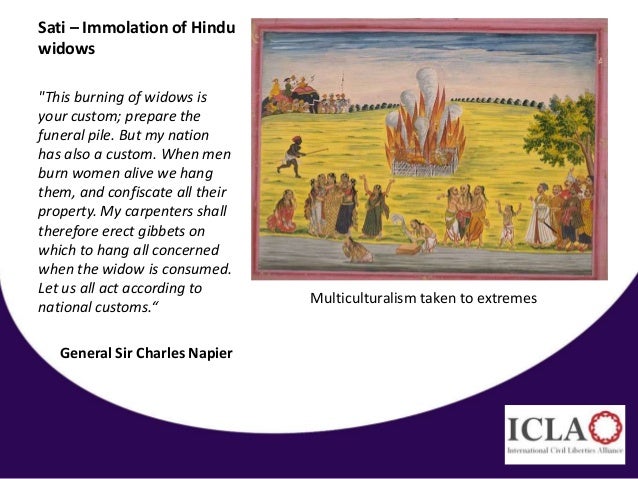
And then of course there is the infamous practice of “widow-burning” in India. Basically, it used to be fairly commonplace there for widows to leap upon (read: be forced onto) the funeral pyres of their husbands. I am probably wrong about the origins, but I think it has something to do with what Rama’s wife Sita did in order to prove her purity in Ramayana.
The real-world justification for this was that the life of a widow in Hindu culture was really quite unbearable. That certainly is true. Widows were not allowed to wear colours of any kind and had to dress in white at all times. They were forced to be vegetarians – no meat, no fish, not even any eggs were permitted into their diet. They were not allowed into polite society because they were considered to bring extremely bad luck. They were not allowed to wear jewelry or cut their hair.
I know, all of this sounds downright stupid to us Christians. But that is what was considered acceptable back in the day.
You want to know what ended all of that craziness and bloodshed and degradation of women?
Christianity.
Sometimes it had to be done at the point of a sword or the barrel of a gun, as in the case of the conquistadores in Spain, who were so horrified by what they found that they believed that the pagans of the New World were soulless beasts and often slaughtered them wholesale.
You know what stopped that?
Also Christianity. Specifically, a Papal Bull called Sublimus Dei, issued by Pope Bl. Paul III in 1537, which established quite firmly that the people of the New World had souls and were therefore to be treated respectfully and carefully as potential future converts to the Faith.
And sometimes, those ritual sacrifices ended thanks to an enlightened, Christian, administrator saying, “Thou Shalt Not”.
One of my absolutely favourite quotes about multiculturalism comes via General Sir Charles Napier, Viceroy of India and the man who ended that absurd practice of sati (widow burning):
And that brings us neatly back to the reason why I wrote this post.
I understand quite well why it is that the neo-pagan LARPers who get dressed up in badass Viking outfits and go into the fields swinging foam broadswords and battle-axes at each other on the weekends love that culture and not their contemporary Christian-influenced one.
That is because their weak, decadent, supine Christian culture has completely lost its balls.
There is nothing manly about a culture that tries to be tolerant, inclusive, and accepting of all forms of sin, perversion, and madness.
The Vikings did not simply open their borders and let their enemies in; rather, they went reaving up and down the coasts of Europe and gained such a fearsome reputation for warcraft that they were hired by Byzantine emperors in later ages to make up their elite Varangian bodyguard.
The Aztecs, Incas, and other Mesoamerican peoples fought, sometimes right down to the last man, against the white European invaders of their lands.
Hindus and Sikhs fought valiantly, though ultimately in vain, against far superior British military technology and discipline before succumbing to the colonisation of their country.
The Zulus did the same, and drew real blood from the British Empire at Isandlhwana, but ultimately fell in battle before the Brits, notably thanks to the very British invention of the Gatling gun.
And so the story goes throughout history. Pagans fought well, died gloriously, and are therefore honoured by their neo-pagan descendants who want to emulate their bravery and skill in battle.
Good for them. But the darker side of the pagan ethos is a marked lack of respect and tolerance for the weakest and most sidelined members of their own societies.
The Vikings, for instance, treated their women pretty abominably overall, as that funeral scene shows – and that is just one example, there are plenty of others. They regarded homosexuals as utter abominations deserving only of a very public execution. They had little respect for old men, for they believed that the greatest honour of all was to die gloriously in battle with sword and shield in hand. And they had absolutely no tolerance for those dying of disease and plague, shunning them and condemning them to the tender mercies of Hel, the guardian of Niflheim, home of the damned.
Contrast this with the way that Christians view women.
We look upon women as the weaker vessel, deserving of love, compassion, protection, and mercy. We are exhorted by Our Lord to be gentle with them, forgive them their sins, hold them to a high standard of fidelity and chastity, and be absolutely loyal to them until death.
Or compare our attitude to homosexuality with that of many pagan societies.
Yeah, we hate it and find it disgusting, because it is a sin and an utter abomination. But we do not want homosexuals to be publicly humiliated and executed. We would simply rather that they cease their sins and beg forgiveness from the Lord. And, if they do continue to sin, let them do so behind closed doors, away from the public eye, and especially away from our children, given the known and documented homosexual inclination toward child abuse and pederasty.
And, unlike a lot of pagan societies, we absolutely hate child molesters and child-killers – whereas quite a few pagan cultures not only tolerated pederasty, but encouraged it. The Spartans are a particularly notable example of that sickness, and that is a pagan culture that I otherwise quite admire. And I have written before about how the manner in which the Carthaginians sacrificed their children to their god Molech, so infuriated the Romans – also pagans at the time, by the way – that they utterly destroyed the empire of their rivals, root and branch.
In conclusion, it is all very well for neo-pagans to celebrate the masculine and virile aspects of their ancient traditions and cultures. But if they refuse to acknowledge the backwardness, stupidity, and utterly inhuman attitudes of those same cultures, then they are nothing but barbarian losers who want all of the benefits that come from Christian civilisation and refinement, while simply overlooking or ignoring outright the less palatable aspects of their own cultures.
They want the good stuff of modernity without all of the filth and degeneracy. But they ignore the filth and degeneracy of an earlier age, and refuse to acknowledge the fact that they enjoy clean air, clean water, indoor plumbing, good dentistry and health care, and good food, because of Christian hands and Christian minds.
They are, in a word, losers.









1 Comment
In my observation, they want the "masculinity" without the evil theology that goes with it. LARPing is the perfect description.