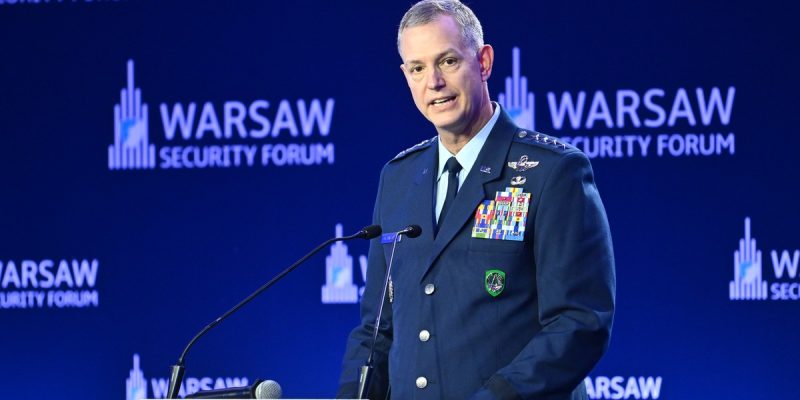
Alexus Grynkewich is not exactly a household name for most people. Nor should he be. He is the Supreme Allied Commander Europe, effectively the second highest-ranking military officer in the entire NATO structure. That is a post once held by no less a person than General (and eventual President) Dwight D. Eisenhower.
Gen. Grynkewich recently gave a detailed run-down of NATO’s “new strategy” to stop an attack by its enemies – vaguely defined, or even undefined, but very obviously meaning Russia, Iran, and China – through a three-level approach: “block, blunt, break”, while delivering a keynote address at the Warsaw Security Forum.
You kind of have to listen to this to understand just how remarkably out of date the entire set of ideas really is:
I am not a soldier. I do not even pretend that I understand the first thing about soldiering. I am simply capable of reading a few books here and there, and on occasion, I try to apply the lessons from those books (usually very badly).
But I also have the benefit of reasonably well-trained pattern recognition – most of my readers do, too, thanks to the last 25 years of psyops foisted upon us, ever since 9/11, all the way through the GFC, Convid, the Banderastan War, and now the Iran War.
Because of that combination of having read a few books – and, of course, having listened to men VASTLY more intelligent and well-informed on the subject of war than I am – I can point to what Grynkewich is saying, and yell “BULLSHIT!!!”
Don’t take my word for it, though – here is what an ACTUAL soldier, who has ACTUALLY FOUGHT against an enemy that was, at least on paper, capable of shooting back, has to say about Gen. Grynkewich’s “new theory of victory”:
The verdict is absolutely clear: Gen. Grynkewich’s “new theory of victory” is not new, at all. It actually comes directly from the “trinitarian” framework of warfare, as legendary Israeli military historian Martin Van Creveld would call it. That theory of war goes back to the kind of manoeuvre warfare that the Germans carefully honed and crafted into a genuinely lethal approach, back in the last years of WWI, and which the Wehrmacht demonstrated to its full effect in WWII against the French and British.
That theory of warfare, which focuses on manoeuvre, coordination, and tightly integrated formations operating under a unified and streamlined command structure, is about as relevant to modern warfare, as the horse-drawn cart is to everyday transportation.
To understand why this theory of victory fails, one has to have at least a coherent framework of previous generations of military thought and doctrine.
Martin Van Creveld and William S. Lind have both outlined such a framework. Mr. Lind uses a generational theory of warfare, in which there are at least 4 generations of warfare, and draws upon Dr. Van Creveld’s own ideas about trinitarian warfare, in which the people, the government, and the military work together for a unified and singular objective in war.
The first generation consisted of massed infantry clashing along a frontal line; war amounted to slaughter along a front line of contact, but with relatively little damage to the rear areas. Many innovations improved the ability of armies to fight these kinds of wars – cavalry, chariots, siege towers, elephants, archers, spearmen, rifles, and so on and so forth – but the primary form of warfare was linear, head-on. War was something that happened “out there”, in distant lands, away from the centre of government and society. And that was the paradigm of war that persisted throughout most of human history.
The second generation consisted of massed artillery, which gave opposing forces the ability to kill people far away from the front lines through remote means. The incorporation of air and naval power further enhanced the capability of armies to kill at long distances – thereby making war a home-front reality. War moved away from head-on battles where opposing armies smashed against each other, to grinding attritional struggles in which the quality and quantity of infantry counted for nothing against the quality and quantity of artillery, machine guns, and mortars. The French came up with the aphorism, “the artillery invades, the infantry occupies”, to describe this kind of warfare.
That reached its apotheosis in the slaughter-pens of WWI, which lasted far longer than anyone expected, and which destroyed the flower of European civlisation in blood, gore, gas, and utter horror.
The Germans were the first to break out of that box. The Prussians led the way – they had to rebuild their entire military theory, command structure, force composition, and everything else, after they were completely routed by Napoleon Bonaparte, one of the greatest practitioners in history of 1GW. (The Russians would argue that Suvorov was better – and HE WAS, given that he lost to Napoleon at the tactical level at Borodino, but crushed him utterly on the strategic one.) As such, the Prussians studied war intensively, and they came up with an idea of warfare that emphasised a singularity of purpose, an appreciation for logistics, and a focus on manoeuvre and adaptability to exploit enemy weak points, punch through them, and roll the enemy up from the rear.
It is from the Prussians that we get the works of Carl von Clausewitz – Vom Kriege being the most famous, with that legendary misquote about “war is politics by another means”, which I referenced in one of my post popular poasts.
This resulted in the third generation of war, which abandoned static attritional battles for position, and focused instead on using combined-arms warfare to its greatest effect. Generals became coordinators, conducting a symphony of destruction and slaughter from headquarters, while giving their subordinates in the field substantial leeway to act as they saw fit.
The Russians, by the way, took a very different series of lessons from WWI. They saw the potential for “deep battle” and the power of attrition, and they crystallised it into the ideas that their greatest writers on strategy, Svechin and Isserson, later turned into the Red Army’s entire doctrine of “operational art”. The Russian way of war is radically different from the Western one, and we will come back to that shortly.
The third generation of war relied on a unity of purpose and command between civilian, military, and political authorities to succeed, while giving governments alone the power, authority, and legitimacy to use military force. This changed in the second half of the 20th Century, in which non-state actors began to utilise military force, operations, and tactics, in ways that governments could no longer anticipate or control.
This was the “non-trinitarian warfare” that Martin Van Creveld wrote about at length in his superb book, The Transformation of War. He foresaw all the problems that the American superstate would encounter in Afghanistan and Iraq, all the way back in 1991.
There are legitimate criticisms of and problems with the works of Van Creveld and Lind, of course. Here is but one of them. But, on balance, I think they get the overall sweep and scope of the evolution of warfare about right.
The entire paradigm of warfare shifted and changed, starting in 2022. As with all such paradigm shifts, the evidence for the changes was there for many years in the background. When the Russians invaded Ukraine – which, we must always remember, they were PROVOKED into doing by the West – in February 2022, they went in with a small expeditionary force from a military that still, to a large extent, exhibited Cold War thinking and operational doctrines. They learned, very quickly and at considerable cost, that those old ways of war did not apply. They could have spared themselves enormous trouble, if only they had incorporated the lessons of the long and vicious Nagorno-Karabakh War between Armenia and Azerbaijan, which exhibited new ways of using drones to pin down and destroy enemy forces.
Today’s Russian army is completely and totally different to the one that went in 4.5 years ago. It is lean, well-equipped, battle-hardened, technologically advanced, and capable of doing things that would leave American generals gasping with incredulity – if only they could ever get over their “’MURICA! F*** YEAH!!!” way of thinking. The Russians have incorporated drones, decentralised command and control structures, and autonomous warfare, to a degree and at a scale that no other country can match – including China, because the Chinks have never fought a modern war.
The Russians have demonstrated new concepts on the battlefield, such as their РУК/РОК – recon and fire complexes, basically – that allow them to respond almost instantaneously to any incoming fire. They have the world’s best air defence complexes. They have the world’s most operationally high-tempo air force. And they have the sustainment, logistics, supply chains, and industrial base to sustain war indefinitely.
This is the true transformation of warfare – away from the high-intensity police actions that Americans and Westerners are used to fighting, on foreign shores using small numbers of highly trained special forces, and back to a grinding, attritional, industrial, calculated form of slaughter, enhanced greatly through new digital tools and decentralised command tools.
Indeed, the Russians appear to have cracked the puzzle of combining decentralised and autonomous command structures, with centralised industrial planning. Their Rubikon unit of drone commanders operates under the Russian General Staff’s command, but it is, as far as I can tell, a separate command that has a unique level of structural flexibility and capability. Russian soldiers talk about how drone war has changed throughout the course of the SMO; originally, every platoon, company, and battalion in their army had different drone units, with a multiplex of parts, drone types, and capabilities. There was little standardisation and not much by way of an industrial-scale production to support them; they made do with whatever they had.
Drone warfare among the Russians is completely different now. They are capable of producing, entirely on their own, FIFTEEN THOUSAND drones, of all kinds, every single day. Their military units understand how to integrate drones into their warfighting. They have separate drone warfare schools now. Every unit of the Russian military – including their air forces, and their paratroopers – learns how to use drones to maximum effect.
Through all of this, the Russians have never forgotten the lessons they learned from Svechin and Isserson – as I mentioned earlier. The former wrote about how to use attrition to blunt and destroy manoeuvre; the latter wrote about using “deep operations” to strike the enemy’s rear, disrupting logistics and sustainment and preventing the enemy of gathering massed forces in any significant way.
We see the application of all of this in the Banderastan War today. Russia has the ability to destroy anything, anywhere, anytime in Ukraine – especially now that their Rassvet satellite constellation is active and capable of providing high-speed encrypted datalinks to Russian drones and missiles. The Russians have blurred the lines between cruise missiles and drones with their latest offerings. They are constantly innovating and changing, leveraging their gigantic industrial base to outproduce the combined West by multiple orders of magnitude.
Which brings us back to Gen. Grynkewich – whose family background, by the way, is Slavic. He was born into and raised by a family of Belorussian immigrants to the US.
When I listen to him talk, I am reminded of nothing quite so much as listening to a freshly minted MBA talking about how to run a business. It is that same combination of bravado, bluster, and buzzwords, that I find so intensely irritating in my daily life.
I am, by the way, in an unusually good position to criticise MBAs – because I have one. The reason I do not advertise the fact (much), is because I have other accomplishments, including two degrees in really-for-real MAFF, that give me a sense of perspective (and much-needed humility about my own, considerable, limitations). As such, I know how freshly minted MBAs talk, and I know how annoying it is to listen to a bunch of twenty-something kids who have no real experience with anything useful, telling people twice their age how to run their businesses.
That knock on “Grnych” and his education applies very well. Go lookup his background. He has a BS in Military History (*snorts*), and an MA in History.
Keep that in mind when you think about the fact that his Russian and Chinese counterparts all have 5-year degrees in engineering, mathematics, physics, computer science, and other really, really hard subjects.
You see the same sort of surface-level thinking in the good general’s presentation.
Gen. Grynkewich’s theory is entirely the product of “airhead thinking” – the dogmatic belief, so common among air force types, that you can win every war through overwhelming use of airborne firepower. This is ABSOLUTE NONSENSE, and it has NEVER worked in practice. Yet, for some reason, the Ameribros never learn from this failure – even though they had the chance to apply it for real during the NATO gang-rape of Yugoslavia in 1999. It failed then, too; Yuglosav President Slobodan Milosevic did not leave office because of that 79-day NATO bombing campaign, but because of an internal overthrow in Serbia, months after that campaign ended.
Airhead thinking cannot overcome the fact that America has no real air defence capabilities, no long-term sustainment, no operational depth, no serious industrial base, and no ability to regenerate its military in the event of a mass-casualty event (like a war). It has no operational hypersonic stand-off weapons, no serious autonomous warfare capabilities, and no ability to strike the enemy rear with anything beyond stealth bombers (which the Russians, and the Chinese, and probably the Iranians, can all detect and counteract).
The general’s theory revolves around the idea of blocking an initial offensive, then blunting it through manoeuvre warfare if that doesn’t work, and then breaking it entirely if that doesn’t work. The problem, as LTC Davis and his old boss, D-MAC, point out at length in the second video above, is that this implicitly assumes war is a one-and-done thing nowadays. It patently is not. The Russians encountered setback after setback in the first year of their war in Ukraine – and they are STILL learning, still fighting, still adapting. Ever since the autumn of 2023, they have never stopped moving forward; tactical defeats here and there have never amounted to anything serious. Meanwhile, they have total operational control over Ukraine, and are now systematically tearing apart the energy infrastructure of that tragic country.
The ONLY thing the US has going for it in a serious war, is its C4ISR structure – Command, Control, Communications Computers, Intelligence, Surveillance, Reconnaissance. It has, hands down, THE best satellite intelligence in the world – no one else comes anywhere close. And it has the world’s best AI models. Yet, for all of that, the US lacks operational depth and industrial strength. It CANNOT fight a war against a first-rate superpower – hell, the Ameribros cannot even fight and win a war at distance against a third-rate power like Iran. They cannot even force a tenth-rate power like the Houthis – a 4GW outfit if there ever was one.
What in the name of the Seven Hells makes Grynkewich think that he and NATO could ever win a war against the Russians or Chinese?!?!
Let us never forget one core fact:
The Russians have fought a SPECIAL MILITARY OPERATION for the last 4.5 years. That sharply limits the scale and scope of the violence they can unleash on Ukraine. They have progressively relaxed those rules over the last few years, in response to Ukrainian and Western provocations against their own infrastructure, but at its core, the SMO remains a LIMITED military operation that keeps the home front fully stocked with butter, while keeping the armed forces up to its eyeballs in guns.
The moment the Russians decide to fully mobilise and go full-on WAAGH!!, that’s it – Europe might as well roll. No serious American will die to save a degenerate, spineless, weak, and broken Europe from itself. If the Russians nuke Paris or Berlin or London, then Americans will not sacrifice Detroit or Los Angeles or New York to stop them. It really is that simple.
And that one fact, renders all of Grynkewich’s “theory of victory” completely useless. America is an air and naval power – and not much of either in those areas, anymore, either. Russia and China are continental land powers – with Russia having a substantial fleet and air force, and China having perhaps the world’s best air wing, on paper. Both have gigantic industrial bases and the ability to inflict vast amounts of violence at long ranges, while absorbing all the damage the Ameribros can dish out.
This is not a theory of victory in any meaningful sense. It is only “victory” in the way an MBA would understand it.
This brings me back to Gen. Eisenhower. He was a real soldier, who really understood war and what it means. The man who once held the post that “Grynch” does, must be rolling over in his grave, seeing what it has now become.









0 Comments