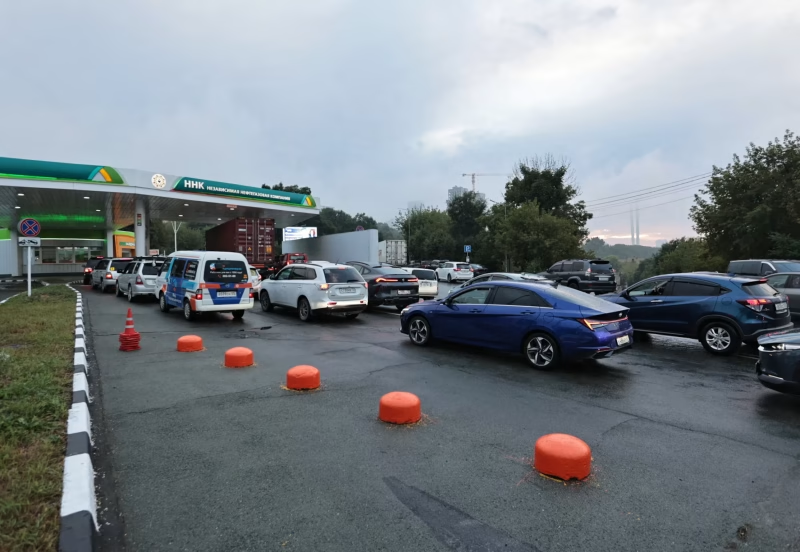
Longtime Readers will recall that I went on vacation back in mid-June for a couple of weeks, and I travelled specifically to Mordor, aka Russia, for that purpose. While I was there, I had the chance to observe Russia’s society, culture, and economy, in some detail, across both the capital region of Moscow, and the southern stretches of the Black Sea Coast.
This is the first of what will probably be around four poasts, compiling my thoughts and impressions of what I saw, and what that means for the Banderastan War and Russia’s relationship with the West.
I have been travelling to Russia since October 2017 – that is to say, almost 9 years now. I have visited it about a dozen times in that period, and, as I have often stated, I was “stranded” there during the Scamdemic. This was actually overall a very enjoyable period in my life, because the Russians, being a rather sensible bunch and not overly prone to the same idiotic hysteria as the West, unlocked their economy fully by May of 2020, which made for a glorious summer. And, unlike their Asian neighbours and friends – India was among the most egregiously stupid among them – they never locked down again.
Over the course of those visits, I have spent well over a year in total in Russia, and among Russians. I speak Russian to a roughly intermediate level and can get on pretty well in daily conversations; as is typical for people speaking second or third languages, I understand the language far better than I speak it.
It is precisely for these reasons that I consider myself to be far better qualified to opine on all things Russian, than people with actual degrees from prestigious universities in Russian history and politics. The principal reason why I am smarter, better informed, and simply more qualified, than the various numpties and knuckleheads commenting on Russia, is because I have actually BEEN THERE and lived among the people.
I point out all of this preamble, because everything I will write in this series of poasts will fly directly in the face of the conventional wisdom established by the Western lugenpresse. It is important, therefore, for you to understand why you can trust what I am saying, and why I am right when I say that the whorenalists of the West need to be flayed alive for the lies they spread. (And that is actually the kindest punishment they should suffer, in my view.)
Those who have kept up with the Fake Noose in the West, will know that in the days and weeks leading up to my arrival in Russia in mid-June, the Banderites launched a major wave of drone attacks on Russian oil refineries. These attacks were, and remain, unquestionably somewhat successful, as footage from Moscow, Perm, Tambov, Ust-Luga, Saint Petersburg, Samara, and other major industrial and commercial centres of Russia, shows very clearly:
Those videos range in release from about 5 weeks ago, to this very week. This is an ongoing problem and issue for the Russians, and there is no doubt or question about this. The attacks in Moscow were particularly violent, and particularly destructive; in the first video, you can literally see the top of a fuel tank, which weighs several tonnes, being hurled dozens of metres into the air by an extremely powerful explosion.
The attacks on Russia’s oil refineries absolutely did have an impact on the country, but that impact was never anywhere near as bad as the presstitutes want you to believe.
To understand why, you have to know some details about the structure of Russia’s economy, and the way it uses fuel. For this, the best resource to give you an overview, is of course Alexander Mercouris:
As he has pointed out in his various daily videos on his YouTube channel over the past month, Russia’s economy has a structural bias toward diesel production. The Russians produce far more heavy sour crude than they need – they are major exporters of the stuff. What they retain, they then turn primarily into diesel and kerosene.
However, Russia’s refineries do not produce sufficient amounts of petrol for domestic consumption. They never really did.
This is a direct legacy of the old Soviet industrialisation drive during the 1920s and 1930s, continuing on all the way through to the 1970s, which had a systemic bias toward providing fuel for farm equipment – tractors and the like – and heavy industry, as well as for military equipment.
All of that very heavy equipment, and I mean all of it,runs on diesel. This is the optimal fuel for that kind of equipment. Diesel engines take a while to warm up, but they can run for a VERY long time, and they produce tremendous amounts of torque and power at the low end, as anyone who has ever driven a diesel-engine car can tell you.
When you need vehicles to do heavy lifting and moving, then you want a diesel engine. It is the fuel of an industrial economy, and that is exactly what Russia has.
During the Soviet era, that systemic bias toward industry, meant that the consumer economy came second. Petrol was more of an afterthought, especially given how poorly developed the Russian domestic car industry was. Unlike the West, which specifically geared itself toward producing consumer-friendly cars, the Russians never got the hang of that – and they still have not. There is still, to this day, no world-class Russian car brand, not even Aurus.
All of this means that the USSR built its petrol refineries in other countries, outside of Russia, which prioritised heavy industry. Those petrol refineries were in Kazakhstan, Belarus, the Baltic states, and even to some extent in Ukraine.
When the USSR fell apart, those refineries were no longer under Russian control.
Moreover, the Russian government makes a priority of keeping the cost of living down as much as possible for its citizens, so it imposes quite significant caps on the price of petrol. This means that the big Russian fuel majors – Gazpromneft, Tatneft, Lukoil, and the like – all see petrol as a very low-margin product, that they cannot sell at a real profit. So, they do not build refineries geared specifically toward producing petrol.
The net result of all of this is that diesel is ALWAYS in plentiful supply in Russia. They never run out of the stuff. Yet, every single year, there are ALWAYS petrol shortages of one kind or another, somewhere in Russia.
This is because, ever since the fall of the USSR, the consumer economy has boomed, and petrol-powered cars have become commonplace. And, every summer, Russian families EVERYWHERE load up their cars, and head to the south, the coasts, and the borders of their colossal country, for their vacations.
The end result is of course that demand for petrol soars during the months of June, July, and especially August.
This is, to repeat, a well-known problem. The Russians have it every single year. And every year, the Russian government gets together and says, “we need to DO SOMETHING about it”, and every year, they end up doing dick. There are not many things the Russian government gets wrong on a regular basis, but this is assuredly one of them.
So when you put all of this together, with the unquestionably successful, albeit limited, strikes by the Ukrainian drones on Russian refineries, you end up with an inevitable shortage.
What you DO NOT end up with, is a crisis. There is a difference, which I will explain.
I saw the shortage personally during my time in Moscow. Here is a video from my Telegram channel, which I shared with my followers, showing the fuel situation at a station not far from where I was staying, in southern Moscow. There was no fuel, at all, at that station – it was closed.
Yet, traffic in the city seemed basically unaffected. The roads were still very busy. People were still driving.
After a week or so in Moscow, I travelled to Sochi. To get there, I had to take a flight from Sheremetyevo Airport. Geographically speaking, this meant taking a taxi from the south of Moscow, to the northwest, near the Khimki region. As the taxi made its way on the hour-long journey using the MKAD (Московская Кольцевная Автомобильная Дорога – quite literally, “Moscow Ring Automobile Highway”, or just plain “Moscow Ring Road”), I carefully observed the lines and queues outside of petrol stations along the way.
Keep in mind, this was on the 28th or so of June, about 2 weeks into the Ukrainian strikes on Russian refineries. I could see at that time that there were long queues outside of some stations, and others had no fuel whatsoever. Yet, this was NOT a uniform situation by any means. Some petrol stations had very small queues, others had very long ones.
Prices for petrol, specifically, ranged from 65 – 110 RUB per litre, which is something like US$3.14 to US$5.33 per stupid useless nonsensical ‘Murkin gallon, aka “Freedom Units”. So this is directly comparable to the prices Americans pay at the pumps, particularly in Florida, and significantly cheaper than in continental Europe – but quite expensive, actually, by Russian standards.
Diesel, however, was plentiful. I personally saw fuel stations that were clean out of petrol – but had diesel.
So, clearly, there was a situation of shortages, but not crisis.
I confirmed the same situation when I was in Sochi. Again, some fuel stations had long queues – others had almost no queues at all. Interestingly, though, unlike in Moscow, I did not see any stations that were actually completely out of fuel entirely. I only saw queues.
By the time I left Russia a couple of weeks ago, the shortage seemed to be easing. The Russian government had imposed diesel and petrol export bans, and had purchased 400,000 tonnes of petrol from their friends in India – which is richly ironic at one level, because that is Russian oil the Indians are refining into petrol.
The Western lugenpresse, incidentally, crowed about that fact, saying it showed a fundamental structural weakness in Russia’s economy that the West could exploit. What those utter fatuous morons completely failed to realise, though, is that the Russians told the Indians, “you WILL sell us that petrol, because if you don’t, we won’t sell you our oil” – and then took 400,000 tonnes of petrol OFF THE MARKET for the YURPEENS.
Moreover, the Russians have now banned diesel and petrol exports, at precisely the time when Ornj Boi has started the second round of idiotically stupid bombing runs against Iran. Which means that petrol and diesel prices worldwide are now spiking upwards again. And that means the YURPEENS are competing with the Asian economies for oil and refined products.
The problem is that the European economies suffer from deep structural weaknesses and heavy debt burdens. The Asian economies do not have anything like the same problems. They have deeper pockets, and they can outbid the Europeans.
So the Europeans, being idiots, are basically cheering their own suicide.
And all of that is on top of the fact that, at this point in time, despite continued drone attacks by the Ukrainians, the Russian refinery system is basically back up and running. Queues at petrol stations have generally eased. Fuel is now readily available, pretty much everywhere except Crimea – and even there, the situation is getting better.
Here are videos from Moscow and southern Russia, and then out all the way to the Far East, by Russians, showing how things are at fuel filling stations:
The bottom line is:
The Ukrainian drone strikes have singularly FAILED to cripple the Russian economy. All they did was to annoy the Russians with temporary shortages and a bit of inconvenience. Fuel prices in Russia spiked temporarily, because of shortages, hoarding, panic-buying, and speculation. The government got on top of things fast, and now the situation is rapidly stabilising and normalising.
Meanwhile, the Russian military has started using drones to pummel the Ukrainian fuel supply chain – destroying Ukrainian petrol stations, refineries, storage tanks, and depots. The Ukrainian supply chain is far more fragile than the Russian one; as a direct result of Russian strikes, over SIX HUNDRED Ukrainian petrol stations from Kharkov to Kiev and beyond, have been wiped off the map.
As usual, whatever the Ukrainians try to do to the Russians, the latter do to the former tenfold.
This is not a winning strategy. It is simply desperation clothed in terrorism.









3 Comments
Really enjoy your commentary, especially this on Russia. Here in the Democratic People’s Republic of Cuomoland , or is it People’s Democratic Republic? (New York State) it is especially Ukraine, Ukraine, Ukraine. Looking forward to all the segments. Please let us know what price on diesel and what are the octane levels on gasoline? Much appreciated. Darrell Freeman
Hi Darrell, that is a good question. From what I saw, it was around 65-70 rubles per litre for “regular”, somewhere around 80 rubles per litre for “mid-grade”, and 90-110 rubles for “premium”. Diesel was around 60-70 rubles per litre.
In “freedom” units, this comes out to something around US$3.10 per gallon at the low end, to US$5.40 per gallon at the high end, for petrol. For diesel, it is closer to US$3.10-3.30 per gallon.
Their petrol grades are typically 92, 95, and 98 MON (not RON), as far as I can tell, but that pretty much corresponds to “standard”, “mid”, and “premium”, by Western standards.
Euro-weenies use “Research Octane Number” to grade fuel, Wikipedia says the Rooskies are likewise using RON numbers.
Nord America ( Can-Am-Mex ) uses the Anti-Knock Index number which is the average of RON and MON ( R + M / 2 ) and usually indicates 4-6 octane lower for the same fuel mix compared to a pure RON number.