
I am very pleased to present a guest poast from LRFotS Randale6 – he of the long and persistent Domain Query requests. He has taken the time to write an article about Linux gaming, somewhat in the style of the old Reaxxion articles, if anyone remembers those. This provides a nice balance of technical geekery and general consumer advice (insofar as Linux users are consumers, that is). I have edited it slightly for cosmetic and stylistic purposes, but otherwise, this is an “as-is” post. Enjoy.
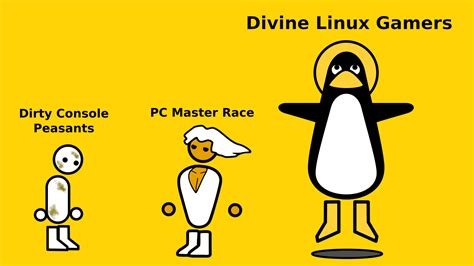
Once upon a time the great gamer civil war was between the console peasants humping their toys and the PC master race with their hardware wizardry. Now a third faction has entered the playing field, this being the Linux gamers. Once scoffed at, Linux is now capable of going toe to toe with the big boys.
The reason being that while gaming on Linux has improved gaming on consoles (in particular Microsoft’s tarbaby known as the Xbox) and windows PC has not. With Microsoft the Pajeets has overrun the place, bringing with them the horrors of Indian customer service…but so much more capable of f***ing things up.
But there is light at the end of the tunnel, the Microsoft minivan can now be ditched for the Linux Ferrari. As the great penguin said, “let there be light!” Even console peasants can get in on the action, through the miracle of Steam hardware and software known as the “Steam deck”.
Retrospective Experience of the Miracle
Approximately three years ago I had to quit Linux gaming, this unhappy occasion heralded by dying hardware and the need for the Windows office suite for school. Once I have rest of my education dealt with (the joys of a Master’s in education + teaching license…not) I will yet again partake of the miracle. Until then I must live with Windows.
[If you have the willpower and disk space, you can always use a dual-boot system, like I do, but it is less than optimal – Didact]
Now onto the topic at hand – this was my setup. A gaming laptop with an AMD graphics card (AMD and Linux are best buds, NVIDIA…not so much) with a Manjaro Linux distribution. For its time this was a good setup, I could easily enjoy my favourite titles such as Fallout 4, Skyrim, Total War: Warhammer II, and Borderlands I/II/Pre-sequel with minimal effort.
Battlefleet Gothic Armada 2, however, didn’t like Linux one bit owing to anticheat software. Now I must warn you, my gaming is done entirely through the Steam platform. The following meme will explain why, a picture is worth a thousand words after all.

As for how Steam supports Linux – they have two means, the first is the best gaming WINE (windows emulator) [WINE = WINE Is Not an Emulator, the creators of it prefer to call it a “compatibility layer” that essentially tries to reverse-engineer the WinDOZE API – Didact] software in the business, the Proton compatibility layer. The second is the Steam OS, Valve’s very own Linux distribution. As for the DRM issue, let’s be honest… Steam is better about it than any other platform. Don’t believe me? Support the EA parasite then and buy some games on Origin, the aborted child of Electronic Arts and the Devil.
Using the Proton layer, I could play many games that were never native to Windows to begin with, with only mild tinkering required at worst. All of this while enjoying the fact that Linux can go 100 miles an hour with a slight squeeze of the pedal. Windows meanwhile gets to 100 miles an hour with great labour and much bitching from the engine compartment, the brakes also suck harder than Monica Lewinsky on speed.
[That last one is a great line, I am definitely stealing it – Didact]
The Joys of Linux
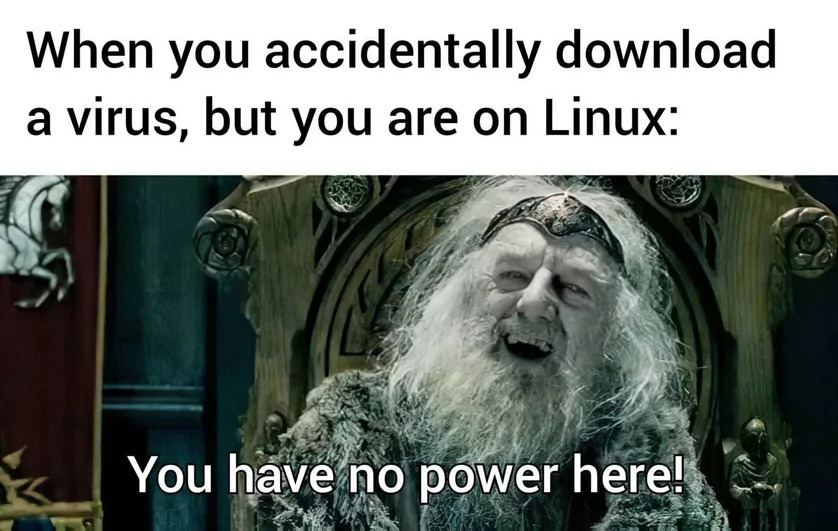
The above meme is no joke, let me sum up the biggest difference between Windows and Linux in biological terms: they are two separate species. Your garden variety malware is mostly designed to go after Windows given that is what the easy targets (Boomers, rubes, idiots, and so on) use.
While malware aimed at Linux does exist, it is rare as hen’s teeth, the profit factor just isn’t there for the developers. This may change as Microsoft and Apple continue to rot from within, but for now we Linux penguins are safe for the most part.
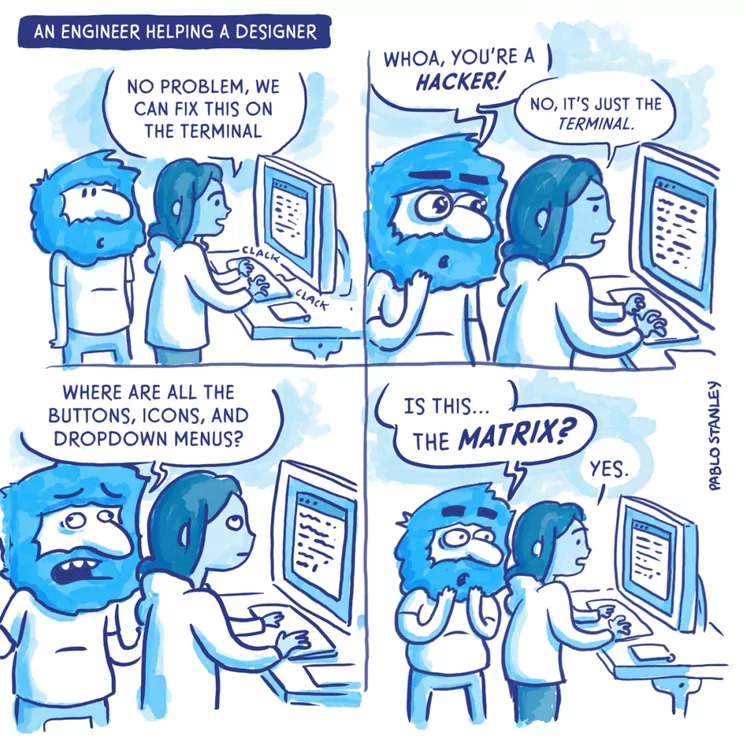
That isn’t the only joy of the Linux family of operating systems, boys. Linux also benefits you with its easy updates and quick turnaround time. Remember how Windows makes you download this tiny little update at gunpoint and then forces you to reboot the computer? That doesn’t happen in Linux, even when using a GUI (graphical user interface). For those willing to learn the Dark Arts (aka the command line), the update process is even faster. Other “benefits” include becoming technological Gandalf to the retarded Hobbits that surround you (be warned, they do badger you for help).
Becoming One with Proton
Now for more good news, becoming one with Proton isn’t difficult. Thanks to the good folks at Proton database, much of the work of figuring out how to use proton to play games has been figured out for you. To keep this short, Proton database has four tiers to rank games, platinum, gold, silver, and bronze. The less valuable the metal the more tinkering required to get it operating, check the comments and you will often find that someone has figured it out before you.
Remember when I said I couldn’t get Battlefleet: Gothic Armada 2 to work? That was then, this is now.
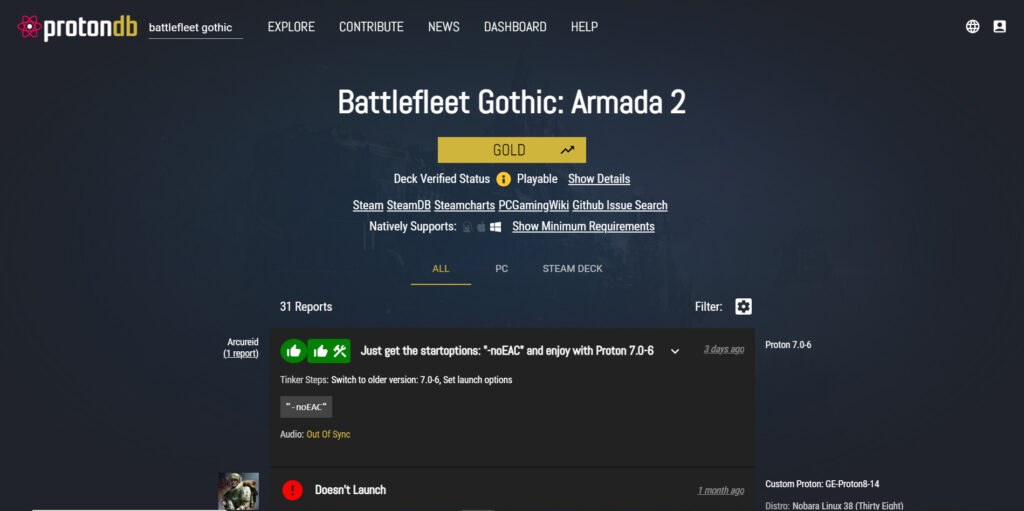
In just two years titles that didn’t even get the bronze rating now appear to be fully playable. Other examples of this that I’ve seen include Red Dead Redemption 2, Middle Earth: Shadow of War, and Greedfall. Valve truly wants to make this the best WINE tool for gaming, and it shows.
And There Was Much Rejoicing by the Peasants
Now we move onto a product I can only go judge by the reviews of others – the Steam Deck. Here is a picture of someone using it so you see it compared to human hands.
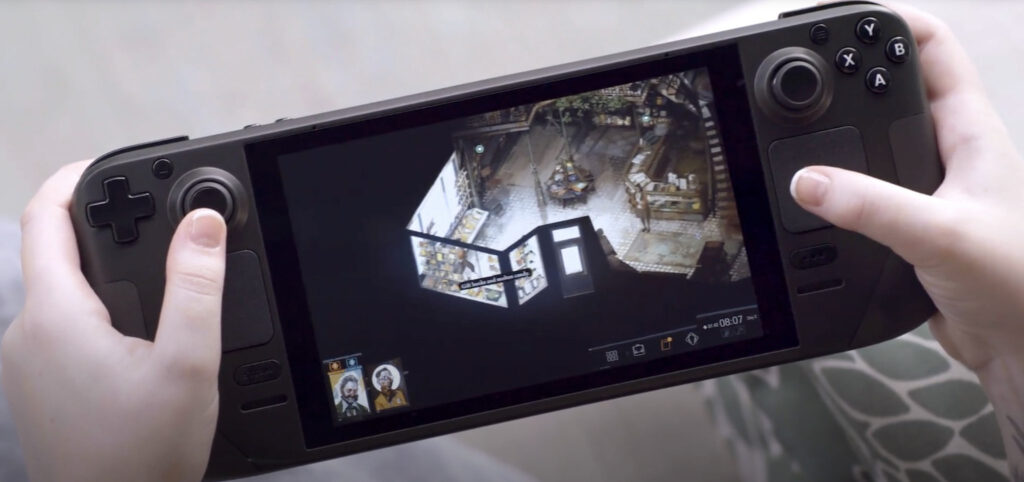
These are the basics of the handheld itself. First the graphic card and CPU are combined into one unit known as the AMD APU, it has 16 gigs of RAM, a battery life of 2-8 hours, a 1280 x 800 resolution (16:10 aspect ratio), and a 7-inch screen. It comes in three options, each of which has the same graphics power, the main difference between the models being the size of their SSD card. All models also come equipped with a microSD slot to provide more game storage.
As for software, the deck runs on the aforementioned Steam OS, their own Linux distro based off Arch Linux [i.e. one of the most highly configurable and flexible Linux distributions – Didact]. I would not change this part of the deck if I were you, part of the reason Valve chose to use Arch as their base for Steam OS is the ease of updating it. Another distribution will screw with this process.
Now to show you something…
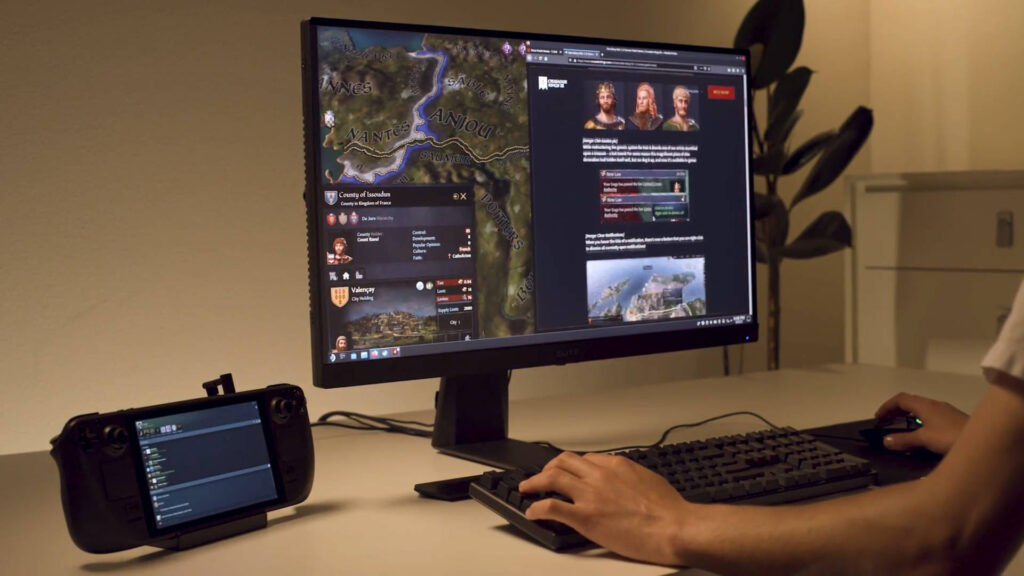
Notice something? This isn’t just a handheld console; this sucker is a full-blown PC. If it weren’t for the business world’s preference for the Windows office suite, you could even take care of work simply by installing a LibreOffice suite onto the deck and hooking it up to a monitor, mouse, and keyboard. And yes, Steam also sells a docking station for the deck.
This setup option is also wonderful for games like Crusader Kings III (the game in the screenshot) where a mouse and keyboard setup is absolutely the way to go. Graphically the game is also translating well to the bigger screen, is it say PC god level “I spent 5000 bucks to build this thing” graphics? No, but from what I can see it’s good enough.
Once my laptop expires the Steam Deck is what I am getting, hopefully I can nurse it along long enough to get the Steam Deck 1.5/2 which judging from Valve’s own admission will occur somewhere within the 2025-2026 timeline.
Didact Speaks

First, many thanks again to Randale6 for this poast. I have not kept up with Steam and its Proton layer for a while – I tried installing HALO: The Master Chief Collection on my previous Linux Mint-based Lenovo Thinkpad T470p sometime, i think, last year. It did not work very well, so I gave up on the experiment and have not given it another thought since.
However, it appears as though HALO: MCC is now ranked GOLD for compatibility on ProtonDB. Of course, everyone running it seems to be using AMD GPUs, and most of them seem to be using SteamOS rather than Manjaro or Mint, as I am, so it remains to be seen whether this actually works. I might give it another shot on my old machine to see if it actually works.
Overall, the trend is clear: we no longer need WinDOZE, the operating system, to run much of anything. We DO still need MS Office, because frankly there is simply NOTHING out there better than MS Excel – and probably never will be. But everything else in the Office suite is largely redundant.
We are rapidly moving toward a world in which Microsoft’s power will come from its investments in cloud-based applications, which is where the money really is. But those of us who prefer to be free and run Linux on our own home PCs, are increasingly spoiled for choice. And that is a wonderful thing.









2 Comments
See, 20-year old me would have relished the prospect of spending hours tweaking settings and messing with command lines to get a game working the best it could. 40-year old me wants nothing to do with that nonsense. Prime example: I was trying to play MechWarrior 2: Ghost Bear’s Legacy the other day. Despite running on the same engine as MW2 and having the exact same settings as it, my joystick’s axes just refused to work. I spent around an hour screwing with it until I eventually figured out that copying certain config files from the MW2 folder to the GBL folder fixed the problem. I would rather have spent that time gaming.
The XBOX might just be a PC in a fancy case, but I can turn it on and be playing a game in around 20 seconds. I also don’t have to screw around with any settings other than storage management every now and then since most games run on the internal SSD and it’s only 1 TB. Finally, building a PC with its same 4K60FPS output would easily cost me 3 grand, with at least a third of that going to the GPU.
I know PC gamers will say “console peasants don’t have mods,” but that’s not true either. Most consoles are trivially easy to jailbreak these days, and certain game communities have made tons of mods available. Check out Project M, CTGP-R, or Newer Super Mario Bros. on the Wii, for example. I was just last night playing a heavily modified version of Smash Bros. Ultimate that had everything from new characters to gameplay and physics changes to make it more like Melee.
I love PC gaming, but at this “plenty of money and energy but no time” point in my life, it’s just not for me!
I feel your pain, bro. Even on my WinDOZE partition, virtually every single time Billzebub updates WinDOZE, or there is a HALO MCC update, I lose the ability to sign into Xbox Live. This is due to some sort of longstanding bug within HMCC, which they have of course never bothered to fix. So I have to go in and manually back up my old config folders, start up the game again, let it log into XBL, regenerate the relevant system folders, delete out the new versions, restore the old versions to get my hotkey configurations back, and THEN slaughter my way through the Covies and Prometheans.
That is when I see the Red Mist come down, and I find myself uttering the usual, “I’m too old for this shit!” line.