A couple of weeks ago, I came across a video on EWCHOOB that purported to show Prof. Jiang Xueqin talking about how Russia has managed to endure the SANKSHUNS FROM HELLE!!! over the past 4.5 years, and continues to fight a war against the entire collective West. I cannot find that video now in my watch history – and when I went looking for it, I quickly realised that there are quite a lot of AI-slop channels that use his likeness and voice to produce “geopolitainment”, so to speak.
The result is a lot of midwit-level content that is not actually particularly factual, informative, or useful, and I personally find that sort of thing really irritating. But I am not immune to being taken in by it – the fact is, I clicked on that video, and watched at least halfway through it, before I realised that “Prof. Jiang” had no idea what “he” was talking about when it came to Russia.
The real Prof. Xueqin is a very intelligent man, but I have no idea whether he holds to the ideas expressed in that video. Again, I cannot find it, so I will have to summarise what I heard, based on memory. As such, what follows should not be taken as a knock on him, specifically, because I have no reason to think that the man himself actually believes what is attributed to him.
The essential thrust of whatever it was that I watched, came down to the notion that Russia has survived Western SANKSHUNS pressure, primarily by turning itself into a war economy. This, according to the accepted and conventional wisdom in the West, is creating substantial and severe imbalances in the Russian economy, along with critical labour shortages, and the contraction of the consumer economy, in favour of devoting industrial output and production to war materiel. The Russian economy, according to this reading, has become heavily militarised, with a critical dependency on energy revenues from China and from Russia’s Eurasian allies.
The primary problem with all of this is, of course, that THE ENTIRE PREMISE IS COMPLETELY WRONG.
I was in Russia less than two months ago. I can personally report that there is no such thing as a “war economy” in operation.
Nor is this the first time I have pointed this out. A few months ago, I did a detailed breakdown of the economic data from Russia itself. I pointed out that Russia’s fundamentals are, in fact, extraordinarily healthy and resilient.
The latest data bear out these facts. Russia’s economy comes to about US$2.66T in nominal terms, with an unemployment rate of 2.4%, a debt-to-GDP ratio of under 15% as of early 2026, an inflation rate of around 6%, and a real interest rate of 8% or so. Using Russia’s own Ministry of Finance, Rosstat, Central Bank, and Ministry of Economics figures, we get to a budget deficit throughout all of 2026 thus far of around 2.6% of GDP – bad by Russian standards, but positively tame by Western ones. Oil and gas revenues at the end of 2025 accounted for around US$100B, or roughly 23% of Russia’s overall Federal budget.
None of these statistics points to an economy overly dependent on energy sales. If all of Russia’s energy sales to China, India, and the rest of the world suddenly ground to a halt tomorrow, this would cause serious pain in Russia, to be sure – but it would not destroy the economy, because quite a bit of that oil and gas goes to domestic production and manufacturing.
Indeed, if anything, that would destroy numerous other economies around the world, including many Western ones, due to the sudden loss of critical energy resources supplied to those markets.
Russia’s foreign exchange reserves stand at around US$755.6B, according to the CBR, as of August 14 – that includes the roughly US$300B of frozen sovereign assets sitting in various Western accounts, as far as I am aware. Even so, given Russia’s total public debt of US$370B or thereabouts – which comes to about 14% of 2025 GDP – that means the Russian government could literally pay down the ENTIRE public debt, TOMORROW, ONLY by using its foreign exchange and gold reserves, and still have plenty of monetary firepower to play with.
I worked in and around financial markets for years. I know damned well that, when evaluating a company’s credit-worthiness, there is a concept of treating the equity (shares) of a company as an option on its assets. (For those interested in the technicalities, go look up the “Merton Model” of assessing credit risk.) In other words, if the company itself has a large asset base and very little debt relative to that base, then it has very little credit risk and is extremely unlikely to go under.
If you think about this intuitively, it is not difficult to figure out why. A company that is asset-rich, can always sell its assets to pay off its debts – especially if those assets are liquid, like cash or Treasury bonds or gold.
The same exact logic applies to countries. If a country has the ability to rapidly convert its physical assets into liquid currency, then it is extremely unlikely to default on its debt – especially if most of that debt is held not by foreign creditors, but by domestic ones. As ugly as the solution is, a government can always print its own domestic currency to inflate away its debt to its own people.
In simple English, this is a country that presents basically zero default risk – whereas the US just surpassed a total public debt of US$40 TRILLION, and is now in the process of “pushing down the yield curve”, by selling short-term Treasury bills, and buying back long-dated debt. This is literal fiscal insanity.
Yet we are all supposed to believe that Russia poses a financial and economic risk?!?!
Moreover, there is the oft-touted trope of Russia as a war economy. It is true that Russia’s spending on its military is likely to be over US$160B in 2026 – very nearly 30% of the total Russian Federal budget, and roughly 6% of GDP.
However – and this really needs to be repeated as often as possible –THIS IS NOT A WAR ECONOMY!!!!
The useful idiots in the Western whore-media really need to have this beaten into what passes for their brains – preferably using a piledriver and a railroad spike. A “war economy” is when your military takes up 30% or more of your total GDP. During WWII, the Allied nations typically spent well over that on their militaries. The latter years of the war saw Germany spend over 40% of its GDP on its military.
According to Perplexity, using a database of comparable indicators from a historian named Mark Harrison, the USSR spent on average about 51% of its national income across 1941-45 on the military. The United Kingdom spent 53%. The US spent 33%. Germany topped out at nearly 75% of its entire economic output, spent on the military, in 1944.
By comparison with all of that, Russia’s military spending is tame, and is not at the point where it is distorting the local economy.
I can confirm all of these points from my time there, across multiple visits.
During my most recent trip, I spent a fair amount of time in both the centre of Moscow and the outlying suburbs. I was able to see how people live and work. Despite the SANKSHUNS, you can still quite easily get Western brands – whether consumer ones like Coca-Cola and Pepsi at the supermarkets, or luxury items like Ray-Ban sunglasses and iPhones in the fancy malls. You do, of course, have to pay a significant premium for these items – of between 20% and 100%. This is because of the system of parallel imports that now exist in Russia, where these items first go through places like Turkey, Kazakhstan, and China, and then come over the border, shipped by firms that are quite happy to do business with the Russians, and have no exposure to American CAATSA and OFAC lists, because they get paid entirely in local currency or rubles.
All of this translates into the local economy. When I was in Moscow, I saw brand new apartment blocks of stunning quality and luxury, popping up all over the south and west of the city. By European standards, these are nice places – yet they are, relatively speaking, within the reach of average Muscovites. These are not the “Krushchyovkas” and “Brezhnevkas” of old – the crappy Soviet-era apartments that came about as well-equipped as a jail cell. Rather, these are high-quality buildings with all the mod-cons.
The pace of construction is not quite what it was during my first post-2022 visit, when I saw construction going at nearly unbelievable rates all over the city. At that time, in mid-2023, the Russian economy was very clearly overheating – I could see there were the signs of a potential real estate bubble. The Central Bank stepped in to deflate that bubble, HARD, by putting interest rates up past 20%, and by significantly curtailing the rate of credit expansion. This then resulted in a significant overcorrection, which tipped the economy into a contraction by the first quarter of 2026. But now, the Russian economy has returned to growth.
Again, the whore-media in the West wants you to believe that this has resulted in a two-track economy, where the consumer sector is in recession, but the military and industrial sectors are expanding rapidly. This is, as far as I am concerned, total nonsense. While I was there, I saw ordinary Russians eating out regularly, spending on simple things like clothes and shoes at local stores, and generally enjoying life.
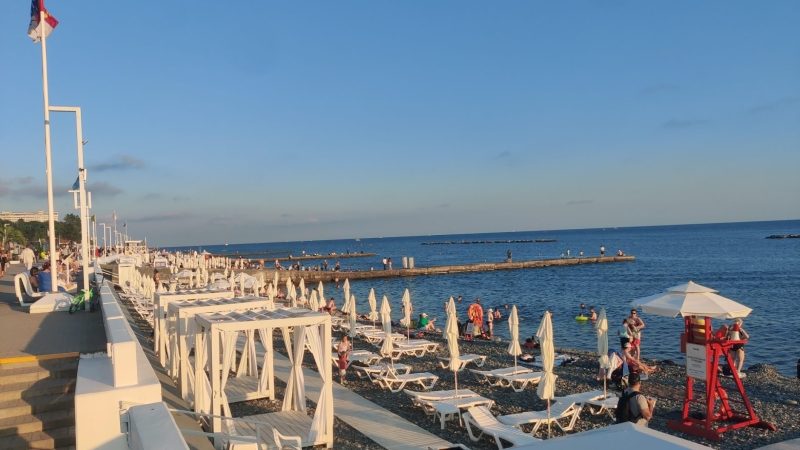
The picture that you see above is from the beach at Sochi, where I went during my second week of my holiday. The beaches were PACKED throughout my trip – you are looking at the beach right off the main boulevard of Sochi itself, and it was quite crowded along the boardwalk where I was when I snapped that photo. It is not even a particularly good picture – it does not convey the sheer numbers of people out and about enjoying their summer vacations.
Sochi as a region gets very crowded during the summers. Everyone goes to the south of Russia to enjoy the beaches and the wildlife. Whether they go to Krasnodar, Sochi, Anapa, Tuapse, or any of the other various southern Black Sea coastal towns and cities, depends very much on their budgets and means, but I saw every indication that the holiday apartments and hotels in the hills above the city centre were packed out.
More importantly, they were full of ordinary Russian families – not wealthy by any means, simply those with a bit of disposable income from the middle classes who drove down to Sochi from other cities. In fact, this is part of the reason why there was a major fuel shortage during the summer. The Ukrainian strikes on Russian refineries absolutely had an impact, but the overall net reduction in fuel output was less than 10% of the total – NOT the 40% touted by the Ukies and the Western lugenpresse.
In short, and in simple terms, the consumer economy in Russia was (and remains) highly robust. If anything, it has improved significantly since about a year ago, when I was there previously. Back then, I could see and feel a significant slowdown in economic activity. People were more cautious about spending on things like restaurants. Near where I was staying at the time, a big Asian fusion chain called Yakitoriya had closed down their branch in that area – which was a bit of a shock, as it had been doing very well for a long time. But other restaurants sprang up to take its place by the time I returned this year.
I can also state with absolute conviction that, based on what I am seeing, I have NEVER witnessed Russians living as well as they do now.
I am not joking about that. I have been going to Russia since October 2017. As I have pointed out many times, I was “stranded” in Russia during the Scamdemic for 8 months – it turned out to be a great summer, precisely because the Russians were not stupid about Convid, and reopened their economy after a brief shutdown in April and early May. By June, everything was back to normal.
I have visited Russia 5 times since then, staying every time in the same part of southern Moscow, and on occasion travelling outside of Moscow to other cities. I can state with complete certainty that the place where I regularly stay, has transformed into a truly wonderful place to live and bring up a family. It is genuinely a lovely place – not wealthy by any means, yet everything you could possibly want or need for a family is in the area, including stunningly well-maintained and completely safe landscaped parks, exercise areas, gyms and fitness centres, restaurants, family-sized shopping malls, bookshops, schools, cafes, pharmacies, and countless little stores selling all the usual knick-knacks that you would expect to see in “suburbia”.
This is, to repeat, a part of Moscow that is FULL of the hideous old Soviet-era carbuncles that constituted their idea of apartment blocks. But interspersed through all of them, you will find plenty of brand spanking new developments that rival anything you will find in metropolitan Europe.
Now, none of this is to say that the Russian economy has ZERO problems. It absolutely does, and some of them are considerable. Russia faces a significant skilled labour shortage. Its unemployment rate of 2.4% or so, is a direct result of the fact that the military pays better than the private sector in many instances for contract soldiers. There is a real and serious shortage of machinists, engineers, and people with real hard IT skills. Many of the latter fled Russia during the early months of the SMO – they are very much part of the liberal intelligentsia, and they have proven very hard to replace.
Quite a significant chunk of them have returned to Russia, but many still stay and live in western Europe and the US – where, it must be said, they are not actually particularly welcome. Europeans have a near genetic-level hatred and racism toward Russians, and that manifests itself these days in very ugly ways.
Speaking of Europe, it is important to note that the YURPEENS are getting colder and poorer by the day. The extremely hot summer has significantly damaged crop yields across Europe, to the point that we are looking at severe shortages of basic foodstuffs starting this autumn. To my knowledge – and I could easily be wrong – Russia’s harvests, by contrast, are doing just fine.
Now, it is precisely at this time that the Europeans should be on their knees, begging Russia for food, fuel, and fertiliser. But, because of the sheer evil and stupidity of their elites, they have sanctioned Russia (and Belarus) to the point where no European company can legally do business with Russian exporters. And now that Russia has implemented a full-scale blockade of Ukraine’s ports, there is no real prospect of solving that food crisis, which absolutely is coming.
My European and British readers had better be prepared to see their food bills go up a solid 20-50%, at minimum, by the end of the year, because that is what happens when you have complete f***ing MORONS in charge of your economic policy.
The last point I will raise, is that, compared to Europe, Russia is doing very well indeed – and has been since late 2022. Over the last couple of years, I have had the opportunity to travel into the UK, Portugal (twice), and Italy, and each trip has shown that the Europeans are getting poorer, hungrier, and angrier almost by the day. They hate and fear Russia, as a whole – there are of course numerous individual exceptions – and their whorenalists keep feeding them truly absurd propaganda about Russia and its supposed failings. Yet, the hard reality is that Europeans who go to Russia, often find themselves feeling more free, and more happy, than they do in their own countries.
That is for a very simple set of reasons, and they start with freedom of speech. Now, there absolutely are restrictions on what you can and cannot say in Russia – you cannot criticise the military, for instance, and you cannot, under any circumstances, disrespect national symbols, like the Russian flag, or any memorial that contains an Eternal Flame. But, overall, you can express a much wider range of opinions in Russia, than you can in the West. If you do not like President Putin – you can say so, and generally you can do it openly.
In fact, for all that Westerners think he is a tyrant and a megalomaniac, if you actually go to Russia, you will find far more posters with the faces of Lenin and Stalin on them, than you will of Putin. Remarkably, for such a supposedly “tyrannical” ruler, there are almost no posters or pictures of him in public.
This is not the sign of a country under tyranny. In fact, there is a fierce internal debate going on within Russia right now – going all the way up to the highest levels of the Kremlin itself – about how hard and how far to go in Ukraine. And that debate starts at the grassroots, where the ordinary people are getting angrier by the day – not at Putin, but at Ukraine and the collective West.
On the whole, then, Russia is not the dystopian hellhole that the West thinks it is. However, and importantly, I have to point out that it is not a paradise, either. Life there is good, if you are Russian, and getting better – but it is still not easy, and people’s incomes there are still low. The cost of living, especially food, is high for the locals, on local salaries and pensions. And the way they do things there is… profoundly alien to anyone from the West. I cannot really explain it easily, you literally have to go there to experience what it is like to deal with local bureaucracy.
In summary – you have been lied to about Russia. Take it from someone who has been there many times, and who hopes to go there again either later this year or sometime next year: it is a powerful, prosperous, stable, and extraordinarily resilient country.








0 Comments