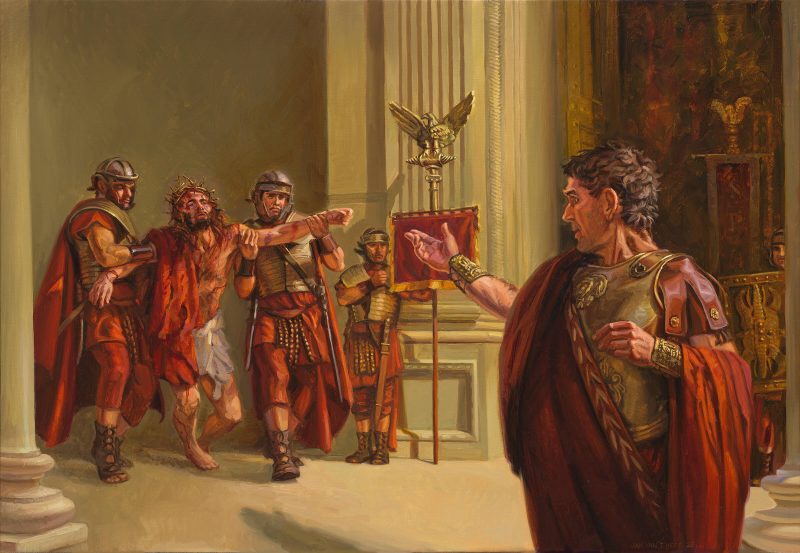
33 So Pilate entered his headquarters again and called Jesus and said to him, “Are you the King of the Jews?” 34 Jesus answered, “Do you say this of your own accord, or did others say it to you about me?” 35 Pilate answered, “Am I a Jew? Your own nation and the chief priests have delivered you over to me. What have you done?” 36 Jesus answered, “My kingdom is not of this world. If my kingdom were of this world, my servants would have been fighting, that I might not be delivered over to the Jews. But my kingdom is not from the world.” 37 Then Pilate said to him, “So you are a king?” Jesus answered, “You say that I am a king. For this purpose I was born and for this purpose I have come into the world—to bear witness to the truth. Everyone who is of the truth listens to my voice.” 38 Pilate said to him, “What is truth?”
– John 18:33-38, English Standard Version
The scene is one of the most iconic in history. An itinerant Jewish rabbi stands in front of the local governor, the representative of the Roman Empire’s absolute power and authority in Palestine. He is beaten and bleeding, and stands accused of grave and terrible crimes. The scene plays out as we all know quite well – and it ends in horror and tragedy.
The contrast between the two principal actors could not be greater or more stark. One man represents the greatest empire the world has ever seen. He holds the power of literal life and death over the people of his governate. The other is merely one of many members of a conquered but rebellious people, the latest in a depressingly long line of supposed “messiahs” preaching doomsday and damnation, and upon whom the people of the region have pinned their hopes for liberation from a hated foreign oppressor.
It is in their words and deeds, however, that the contrast becomes the most clear and obvious. When Pilate demands to know what Jesus has done, the latter answers him in what seems to be an evasive manner, which Pilate himself does not understand. (By the way, given that Greek was the lingua franca of the world at that time, and given Pilate himself was a Roman, it is quite likely that both he and Jesus spoke either in Greek, or in Latin – which tells you something about just how well-read and learned Jesus Himself was.)
Yet, when you actually read Jesus’s words, as recorded by all four of the Gospel writers, you see quickly that He actually responded clearly, if not directly. When asked by Pilate directly if He is King of the Jews, Jesus responded, “You have said so”. He did not deny His kingship – He simply said that His Kingdom is not of this world. At no point did He lie. He simply spoke the truth – and those who could hear it, understood that.
It is Pilate’s response that is the most telling.
Jesus was clear about His purpose on Earth – to bring forth and speak the truth. Pilate’s response is characteristic of all those who are of the world, and not of God: “what is truth?”. This is moral relativism, shown for what it is – the refusal to confront and accept what is true.
The moral relativist insists that there are multiple versions of the truth, and that each man has the right to interpret and believe in his own version of what is true. Jesus, by contrast, stands before us and tells us we are wrong – just as He did before Pilate. He tells us that there is only ONE truth – the objective, hard reality of our own failures, our sins, our refusal to reconcile ourselves to God.
Even so, Pilate could find no true guilt in Jesus. He knew that the man standing before him was innocent of the charges the Jews had laid upon His head. Pilate knew that he could not condemn an innocent man to death, under Roman law. He had a choice – he could do what he knew to be right, or he could do what was easy.
Pilate chose the latter, because he felt and heard the pressure upon him from the Jews.
It is not difficult to see why. Consider his position. Pilate was governor over a region of the Roman Empire that was restive and angry – but which also happened to be the crossroads for much of the overland commerce from Rome’s richest and most important provinces. Through Palestine came the food and produce of Egypt to the west, Persia to the east, and the Silk Road farther out than that, going all the way to China, of which Rome was dimly aware at the time.
It is quite likely that Pilate was an ambitious man, who aspired to bigger and better things than the governorship of a restive and grumbling population of – from the Roman perspective – religious whack-jobs in territory sandwiched between Rome and its great Asian rivals and competitors. He knew that his position depended on keeping the province quiet and the trade flowing.
So when the Jewish religious authorities confronted him, and demanded that he kill this upstart preacher who had caused them so much embarrassment and trouble, Pilate had to make a deeply unpleasant choice.
To his credit, Pilate did his best to avoid having to make that choice. He tried to satisfy the crowd by scourging Jesus instead. That Jesus did not die in the process is, in and of itself, a miracle. The Biblical accounts are quite vague as to what this means, but we know from the facts of history just how horrific a Roman scourging truly was.
Most of you will know by now that the Romans used a multi-corded whip of leather strands, with bits of metal and sharp pieces of bone attached at the end. The Roman flagrum, or Scorpio, was a diabolically clever weapon, designed to inflict maximum pain and suffering on its victim. The metal ball-bearings or pieces at the end of some of the flails were designed to dilate the blood vessels, increasing blood flow to the struck regions of the body and increasing the sensations of pain. The bone shards were designed to catch on human flesh and tear it away.
The result was that a man subjected to forty lashes of Roman scourging, could easily have the flesh flensed from his back. He could have his internal organs spill through his thorax, because the muscles in the region would be so weakened, and the skin so broken, that the guts would simply pour through. It was quite common for strong men to die simply from the trauma and blood loss involved in a scourging.
I repeat, the fact that Jesus survived at all, is incredible.
On top of that, the Roman soldiers twisted together a crown of thorns, and jammed that on Jesus’s head. These were not small or minor thorns, like you might find on a rose-bush. These were long, wickedly sharp thorns, larger and thicker than stitching needles. The Roman soldiers were not at all gentle when they jammed that onto His head; there is good reason to think that they might have blinded His right eye when they did so.
Even this horror, this abomination, was not enough to satisfy the Jews. They demanded that Jesus be put to death, and that a criminal be released in His place. Barabbas was not merely any criminal; the Gospel of Mark states that he was an insurrectionist and a murderer, not just a thief.
Pilate, apparently still trying to cling to some sense of morality, again tried to release Jesus – especially when the Lord said to him that those above him in authority bore the greater responsibility for the capturing, torturing, and ultimately the execution of an innocent man.
But the crowd would not be satisfied. They took the blood of Jesus – who was, as even Pilate knew perfectly well, an innocent man – upon themselves and their descendants.
It is for this reason, by the way, that it is right and correct for Christians to point out that Jews killed Christ. They may not have performed the act themselves – the Roman soldiers under Pilate’s orders did that. But they took the responsibility upon themselves. So let us have none of this nonsense about how it is a “blood libel” to claim the Jews killed Jesus. They did, and they accepted His blood upon themselves. They bear the guilt of His death, by their own admission.
Pilate chose what was easy, over what was right, and gave Jesus over to be crucified – because, to him, there was his truth, and then there was Jesus’s truth. He failed to recognise that Jesus was THE truth.
He failed the test, and has been condemned by history and at least a part of the church ever since. (The Eastern Orthodox tradition apparently regards Pilate rather differently than the Western tradition, or so I am told.)
This is the test we must all face, every single day, and on no day more than today. The test is simple, but profound in its consequences:
We must stand with the Truth against the world – or we must fall with the world in the face of the Truth.
Our Lord is the Way, the Truth, and the Life, by His own words. He took on human form to understand our frailties, temptations, and limitations, and He learned what true obedience to the will of the Father means, as He died on the Cross.
He did it to set us free. He paid the ultimate price, as a ransom for all of us.
These are central tenets of our faith, as they should be. But within all of them lies the most powerful lesson of all.
We think of Truth as cold, objective, unyielding, uncaring. Jesus proved the Truth is love in its most profound form. It is a love that welcomes us, even when we refuse to embrace it. It is a love that heals us, even if we do not recognise or accept that we are hurting. It is a love that reconciles us to itself, even when we do not recognise the estrangement.
Fundamentally, the power of Truth lies in its simplicity. That is one of the core lessons of Good Friday – that, no matter how you try to scheme or justify or contort your actions, the truth is what it is. It does not require lofty rhetoric or philosophy; it simply exists.
And, as Jesus showed us, if anything is worth dying for, it IS the Truth.









4 Comments
i had known that the Talmudic Jews considered Jesus to have been cast into hell to be boiled in feces.
what i had not known is that Kabbalah considers all words to have opposing meanings.
IF all good words also have evil meanings AND all evil words have good meanings
THEN of necessity, Kabbalah is the practice of Blasphemy.
for if you say that something is Good, but the words which you use also mean that it is Evil, you functionally and logically CANNOT do otherwise than to “call evil good, and good evil”.
Isaiah 5:20
as i have pointed out before, Tikkun Olam is the usurpation of God’s / Christ’s role in redemption. which would make rabbinic Judaism the religion of the Serpent, thinking they shall be like God.
Did you know that there was a man named Lucius Aelius Sejanus, who was the head of the Praetorian Guard, and was essentially the number 2 to Tiberius Caesar? When Tiberius withdrew to the Isle of Capri in ARSH 26 (some of you may have been to Capri as tourists, apparently it is very beautiful), Sejanus was left to essentially administer the entire Roman Empire. Sejanus, not Tiberius Caesar, APPOINTED PONTIUS PILATE the governor of Judea. So Pilate was Sejanus’ boy, not Tiberius’. Sejanus was executed by Tiberius in AD 31 because pretty much everyone suspected Sejanus of plotting to take over. SO, when the Jews, led by the High Priest and Sanhedrin in Pilate’s Court yelled out to Pilate…
“If thou release this man, thou art not Caesar’s friend. For whosoever maketh himself a king, speaketh against Caesar.” — John 19: 12
…what they were doing was threatening Pilate’s life – they were threatening to have Pilate and his entire family “canceled” and “Arkancided” by denouncing him as not loyal to Tiberius, and rather loyal to the Sejanus faction. “Not Caesar’s friend,” but rather “Sejanus’ friend.” Which would have meant torture and execution for Pilate, and his family.
And now you know…the rest of the story.
My dad is one of the good boomers (he’s young enough to have missed the worst parts of the 60’s), but he used to drive me nuts with the “Judeo-Christian” nonsense until I explained to him why I despise that term, through the magic of the transitive property.
What’s the most important thing in the Jewish religion, the thing where if you don’t believe it, you’re not a Jew? The rejection of Jesus Christ as the Son of God and Messiah.
What did Jesus say in the gospels? “I am the way and the truth and the life. No one comes to the Father except through me.” So by rejecting Jesus, the Jews have therefore rejected God.
Can you think of any other historical figures who rejected God? One of them is quite infamously the ruler of this world and of Hell below. Jesus even tells the Pharisees (who are the people modern Jews descend from, NOT the Hebrews of the Old Testament, the fact that everyone thinks they are is just an extremely clever branding and marketing exercise) to go back to “your father,” this being, many times in the Gospels.
So by rejecting God, the Jews have put themselves on the same side as the Devil. So when you say “Judeo-Christianity,” it’s exactly the same as saying “Satano-Christianity.” A total oxymoron and hideous blasphemy at the same time.
He doesn’t say it anymore. 🙂
I look forward to reading your Good Friday post every year and am never disappointed