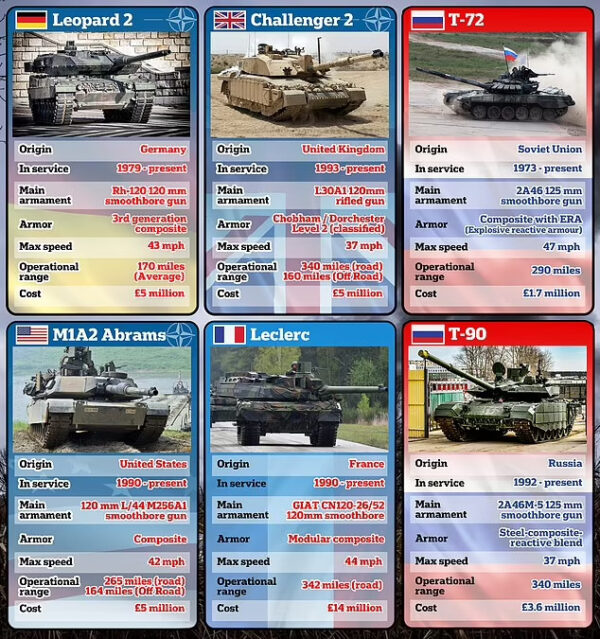
Anyone following the latest developments in the 404th UkReich, cannot help but be struck by the speed at which the narrative has dramatically unravelled over the past couple of weeks. Less than 8 weeks ago, NATO insisted that it would not send modern main battle tanks (MBTs) to the Banderites. Now, here we are, with PommieBastardLande agreeing to send some 12-14 Challenger 2 MBTs, the Germans and other NATO nations agreeing to send roughly 139 Leopard 2 models of various kinds, and Uncle Shmuel being willing to send a full company of its own much-vaunted M1 Abrams MBTs.
A naive observer, who believes the utter garbage and nonsense peddled by the Western whore (((media))))))))), would argue this is because the Banderites are winning. A better informed observer would note the fact that there appears to be a substantial gulf between the notion that Ukraine is “winning”, and the observable realities on the battlefield.
Think about it: if Ukraine were actually “winning”, why would it need MORE Western arms and equipment to launch an offensive to cut off the Russian land bridge to Crimea?
Moreover, what difference are the MBTs actually going to make?
If you listen to Western shills, they will tell you the West’s steel monsters will provide Ukraine the key to final victory. But if you actually take a moment to think about the numbers – they won’t amount to much of anything.
The West is going to provide Ukraine with something on the order of about 150-odd tanks, spread out over months. The first Leopards will not arrive in Banderastan until at least March. The first Abrams will not get there until probably September. The Challenger 2, Leopard 2, and Abrams all require radically different and higher levels of training, because they are completely different from the older T-64, T-80, and T-72 tank classes the Ukrainians are used to – the few of them that are left with any real experience in tank warfare, anyway.
Western tanks are substantially heavier than Russian ones – only the French Leclerc clocks in at under 60 tonnes, whereas Russian tanks range in weight between 48 and 55 tonnes. That doesn’t sound like a big difference – until you sit down and think about the amount of maintenance that Western tanks require, which is immense – as a rule, maintenance requirements do not scale linearly with weight, so the need for upkeep for a tank 40% heavier than its Russian counterpart is not necessarily 40% greater, but even higher than that.
What, exactly, will all of this do?
Not much more than a bucket of spit.
Here is why:
Tanks have an undoubtedly powerful and profound psychological effect. Anyone who has ever watched – or stood in front of – a tank charge, knows just what that is like. Imagine the psychological impact of armoured men on horses charging straight at you with pikes and swords at the ready. It looks a lot like this:
Now imagine that, but with 70-tonne steel monsters charging straight at you at roughly 40mph. That is shit-your-pants stuff.
However, in reality, such armoured charges across flat terrain do not happen all that often. And in the killing fields of the Donbass, they hardly ever happen at all. Tanks are not invincible wunderwaffen that shrug off artillery, air strikes, and anti-tank weapons. They are, in fact, a tool that needs to be used properly in the hands of skilled and experienced crews, under the watchful eye of a senior battlefield commander.
Tanks are, in fact, highly vulnerable to infantry-launched anti-tank weapons. There are stories of Russian tanks, used by the LDNR militias back during the really hard fighting in 2014-15, being literally chased around the vast expanses of Donetsk Airport – only recently liberated by the Donetsk militia and Chechens – by Ukrainian infantry armed with old-school RPGs and ATGMs. When unprotected by infantry, artillery, and anti-air defences, tanks are highly vulnerable and can be stopped – not necessarily easily, not cheaply, but they CAN be stopped.
On top of this, tanks require training to operate and use correctly. Putting together a real and well-trained tank army is not a trivial exercise. LTC Daniel Davis had quite a lot to say about the nature of tank warfare in Operation: DESERT STORM, and the reasons why the US Army, under the effective command of Col. Douglas Macgregor, simply wiped out their Iraqi opponents:
In Desert Storm, U.S. M1A1 Abrams tanks wiped out Saddam Hussein’s fleets of Soviet-made T-72s, and again the American Abrams-led invasion in 2003 revealed the T-72 was no match for U.S. tanks. And truly the American tanks were witheringly successful. During Desert Storm, for example, the U.S. and its coalition partners destroyed more than 3,000 Iraqi tanks. Saddam’s armored force, however, did not destroy even a single Abrams tank. It’s understandable, then, why anyone would want to have an Abrams or equivalent tank, especially when it has proven so effective against exactly the type of tanks Russia has.
The problem, though, is in understanding why the Abrams were so successful and the T-72s so poor. The tank is only as good as the individuals operating it, and as good as the units that employ it. I fought with Eagle Troop of the 2nd Squadron, 2nd Armored Cavalry Regiment at the Battle of 73 Easting, in which we destroyed scores of Soviet-era tanks and other armored vehicles, while not losing a single tank or Bradley Fighting Vehicle on our side. The reasons, as was broadly true throughout that war, were two-fold.
First, the U.S. crewmen were highly trained as individuals. In my unit, tank drivers, loaders, gunners, and vehicle commanders had all mastered their individual jobs, then for more than a year before battle, had conducted considerable time training as platoons, then at company-level, and later we trained in squadron and eventually regimental levels. No one could have been more ready to fight than we were.
Second, Iraq had done virtually none of those things, we later discovered. Their crewmembers had minimal training, had rarely if ever, fired their main guns in training, did very little unit-level training, and their maintenance programs – far more important in tank operations than commonly understood – was virtually non-existent. In short, the T-72 operators were poorly trained while our side was highly trained.
In tank fights, the side that accurately fires first almost always wins. In Desert Storm, we almost always fired first, and because of our training, almost never missed. But even when the Iraqi gunners got off a shot, it was rarely on target. The results were fatal for them.
[…]
Here is a little-known truth: if the Iraqis had had the same M1A1s that we had, or if we had been outfitted with the same T72s Iraq had, we still would have won, because ultimately, it is the man operating the tools of war that wins, not the tools themselves. Without question, the Abrams is superior in every way to any Soviet-era tank. But without proper training and maintenance, even an M1 can be defeated.
Anyone paying attention will quickly realise the Russians ARE NOT using “Soviet-era” tanks anymore. They have heavily modernised their T-72s to include technologies found on the T-90M Proryv – itself a modernisation of the T-90 platform. And the Russians are producing 40-50 T-90Ms every month now, along with a proper fleet of T-14 Armata tanks. The latter is a clean-sheet design that incorporates the very latest Russian defensive innovations against projectiles, ATGMs, RPGs, and the latest generation of Russian reactive armour.
More than this, the Russians are training their troops hard on armoured tactics and techniques. They are taking their time to prepare their mobilised reserves to fight in entirely new corps, divisions, and army formations. They are being methodical and precise in their work.
This is how you win wars – through thorough preparation and training, as LTC Davis states in another recent piece:
When I fought in the tank battle of 73 Easting in 1991, our unit had conducted more than a year of intense training at the platoon, troop, and squadron level; that was augmented by another month of regimental-scale field training in Saudi Arabia before crossing the border to attack Iraqi armored units. We had every advantage, we had the most high-tech army on the planet at that time, and a virtual limitless amount of ammunition, fuel, and spare parts.
The Iraqi enemy we were fighting had effectively no navy, no air force, and antiquated and poorly maintained Soviet equipment. They had been demoralized by the inept military leadership of Saddam Hussein, led in the field by poorly trained commanders, and whose crewmembers had abysmal gunnery skills – not to mention they had been subjected to virtual round-the-clock bombing by our allied air forces for over a month.
Combined with the fact the battlefields were wide open and offered virtually nothing to hide behind, the outcome was ordained before the first shot was fired. Ukraine, on the other hand, has none of the advantages we had.
The Ukrainians will train on these Western tanks for a matter of weeks, not months, with barely any live-fire training. And, as other captured soldiers who have undergone Western-style “combined arms” training have pointed out, that training was basically useless:
Finally, as LTC Davis points out, there is simply no logistics tail capable of maintaining the finicky Western, and especially American, tanks in the high-intensity combat of Banderastan:
Understandably, there are no logistics and maintenance systems for BFVs, Marders or other NATO vehicles in the Ukrainian Army. This means that even basic repairs will require evacuating the vehicle, likely to Poland (as is currently the case for repairing artillery that is damaged in Ukraine). This state of affairs negatively affects a unit’s combat potential.
I fought in the tank battle of 73 Easting during Operation Desert Storm, and I observed how our armored vehicles frequently broke down, needed basic repairs. My own vehicle suffered a blown engine. We had mobile repair shops that deployed with us, staffed by men with many years of training on our tanks, Bradleys and other armored vehicles, and stocked with significant quantities of the most commonly needed repair parts.
Often our vehicles would go down for relatively minor issues and be brought back online within hours. Even the blown engine on my armored fire support vehicle was replaced within 24 hours. Making such repairs under combat conditions is very difficult, but for the U.S. Army it is doable, because it is a built-in part of our unit organization and staffing. But for Ukraine, even a minor mechanical problem could deadline the tank or IFV, requiring it to be towed back to Poland for repairs – and there certainly won’t be spare engines available. The UAF will have real difficulty keeping these new fleets operational, even if they get fully trained.
The nature and fierceness of combat in Ukraine is substantially more difficult than anything I encountered in the Middle East or endured during training exercises in Germany. By all accounts, Ukraine suffers significant casualties. If the UAF goes on the offensive, casualties rates will spike, especially during key battles. What happens when the few crewmen who are trained on the Bradley are wounded in battle and need to be evacuated?
Who will operate the equipment then? Who will fire – without prior training – the BFV’s complex 25mm main gun, its missile launcher, or its onboard machine guns? The benefit of having modern NATO gear is that it is sophisticated and lethal – but the downside is that it also requires considerable training to operate and dedicated maintenance to keep it in the fight. Many of the systems are not intuitive and cannot simply be “picked up” by the next man in line.
The bottom line is that these Western tanks are going to turn into scrap metal in very short order, and this will be a HUGELY embarrassing affair for the entire Western MIC. That humiliation is necessary, but it is also going to make the West seek to escalate even further, with fighter jets, boots on the ground, and eventually, outright open war with Russia.
This war ends with an outright Russian victory – of that, I am absolutely certain. But a very great many good men are going to die before that happens. I wish to God it were not so, but the West, ruled as it is by pure Pharisatanic evil, wishes the exact opposite.









2 Comments
Two predictions:
First, maybe half of the NATO tanks will even get a shot off in combat, due to maintenance issues and Kalibr intercepts.
Second, the Russians will permit one duel between T-90M or T-14 and Abrams or Leopard 2, mostly for export market advertisements. This duel will be suspiciously well filmed.
Given that the Abrams tanks are made to order for Ukraine and are not expected until next year, I don’t see how they’ll ever engage in combat with Russians. The war will be over by then and Russia will have de-militarized what’s left of Ukraine.
Good write up and data points, thank you!