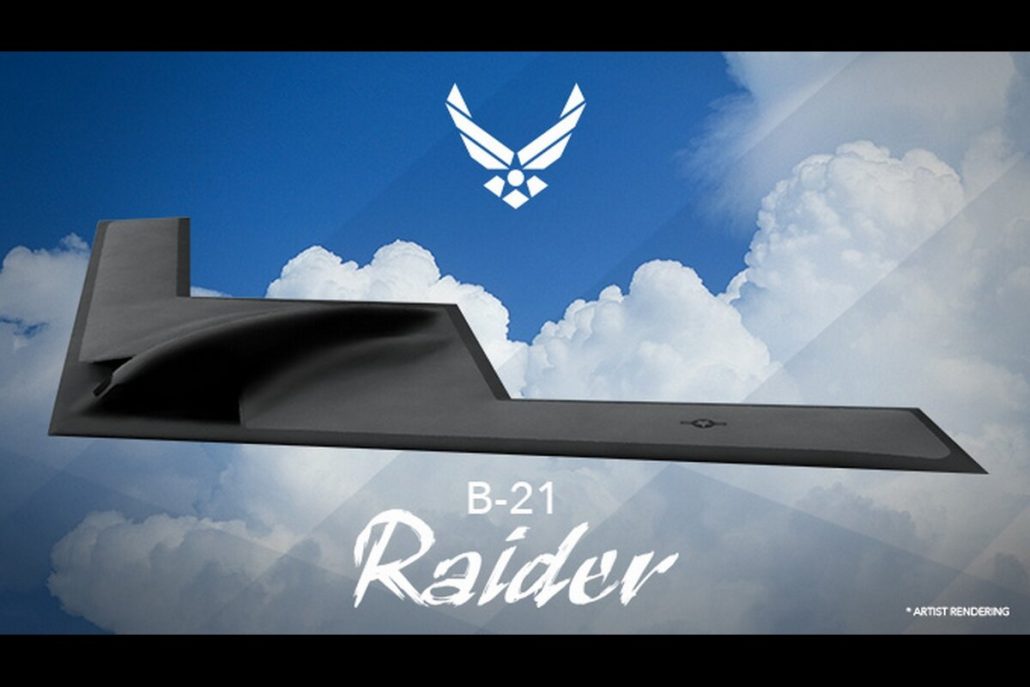
Northrop Grumman unveiled the B-21 Raider just over a week ago. Based on what I have seen of it thus far, it is likely to be the latest entry in the American Military-Industrial Complex’s very lengthy catalogue of hugely expensive and largely ineffective weapons systems:
Why do I say that, given the plane hasn’t even done a test flight yet?
The Voice of Stupidity
Well, let us begin with a rundown of what the B-21 is supposed to do:
On December 2 Northrop Grumman unveiled the first prototype of the B-21 Raider intercontinental range strategic bomber, an aircraft which is expected to replace the U.S. Air Force’s fleets of B-1B and B-2 aircraft and potentially form entirely new bomber units. The bomber is the first to be unveiled in the United States or any Western country since 1988 when the B-2, also developed by Northrop Grumman, was first shown publicly at Air Force Plant 42 in Palmdale, California. The Raider was initially intended to make its first flight in 2021, although multiple delays have meant that this will not occur in 2023 possibly the same year as China’s rival next generation bomber, the H-20, makes its own first flight. While only 20 B-2 bombers were ever acquired by the U.S. Air Force, in part due to their serious performance issues particularly pertaining to maintenance requirements, at least 100 B-21s are expected to be purchased with some sources having indicated that over 200 may eventually join the fleet to also replace the B-52H bombers currently in service. The possibility of multiple variants of the aircraft being developed, including some dedicated to airborne early warning or even aerial refuelling operations, has also been raised.
Speaking at the unveiling Defence Secretary Loyd Austin stressed that the aircraft was “carefully designed to be the most maintainable bomber ever built,” which may have indicated that the Raider was designed with remedying the B-2’s notoriously high maintenance needs firmly in mind. These have forced B-2s to be housed in specialised weather controller hangers, limiting basing opportunities, seriously restricted sortie rates and imposed a high operational cost burden on the Air Force. The Raider, it was highlighted, was built with an open system architecture that makes it straightforward to modernise, with Secretary Austin adding that “the B-21’s edge will last for decades to come.” Regarding how it will operate in roles beyond delivering payloads, he added that: “The B-21 is multifunctional. I can handle anything from gathering intel to battle management… it will work seamlessly across domains and theatres and across the joint force.”
Whenever Darth Stupidous – that’s a nickname for SecDef Lloyd Austin that comes from an enterprising wag on my Telegram channel – speaks, I honestly do feel myself losing brain cells, because he is amazingly retarded. The guy is clearly a diversity hire picked out because of his links to Raytheon and other MIC contractors, not for his actual abilities and talents. There is a lot to unpack about the B-21, so let’s start with the notion of it being a “multifunctional” aircraft.
Note, this is EXACTLY the same argument used to justify the F-35 Joint Strike Flying Piano. I have spent YEARS excoriating that flying shitheap of a programme, and with VERY good reason. Even to this day, the F-35 is utterly incapable of fulfilling ANY of its original mission parameters, and it has proven to be the single most costly weapons programme in human history.
That gives us a clue as to what the B-21 is supposed to be. Each one of these giant flying Doritos will cost – and I’m not making this up – at least US$700 MILLION. This might seem like a bargain compared to the staggering US$2.2 BILLION unit cost of the B-2 Spirit stealth bomber, but it is entirely typical of American weapons programmes these days – staggeringly expensive platinum-plated whiz-bang toys that turn out to be very fragile and useless at actually fulfilling their original mission parameters.
Another Giant Jobs Bank
This begs the question: what exactly are those mission parameters? For that, let us turn to Brian Berletic of The New Atlas, who heaps scorn on the ideas behind the B-21 Raider and the very outdated tactical and strategic thinking behind it:
Just as I originally suspected, this is just yet another giant MIC grift project, nothing more. Already, the B-21 has blown WAY through its originally budgeted cost limits, and will continue to do so. I confidently predict it will cost easily US$1B per plane before the Air Farce finally realises its mistake and Congress, or a future POTUS, cancels the programme due to horrendous cost overruns.
A Failed Concept Based on Outdated Thinking
More than that, the entire idea of a stealthy deep-penetration bomber is idiotic on its face in a world of integrated, layered, highly mobile air defence complexes like Russia and increasingly China now have. This sort of thing would have worked against the Soviets in the 1980s, before they figured out how to counter stealth technologies using long-wave radar and modern high-speed signal processing. But today, the Russians can spot and shoot down every stealth aircraft ever made – including their own Su-57 and the Chinese J-20, as well as the F-35 and F-22.
And that is before we get to the realities of hypersonic missiles and stand-off precision weapons, which the Russians have in abundance and are at least a full generation, perhaps two, ahead of the USSA in designing and manufacturing. The Russians already have high-supersonic and even hypersonic weapons with ranges of between 2,000Km and 8,000Km that can be fired from their strategic bombers, like the Tu-160 and Tu-95. Both designs date back to the Cold War – the Tu-95 is very nearly as old as the American B-52. Yet both have a greater ability to hit distant targets with high-precision weapons than their equivalent American platforms.
Precisely what use is such an expensive stealth aircraft, when the realities of modern networked air defences dictate stand-off strikes at very long ranges, OUTSIDE of the radar and missile engagement umbrella that a real modernised opponent can muster?
Cost Comparisons
Let me play my own devil’s advocate for a moment and assume that perhaps the design ideas behind the B-21 are appropriate and rooted in a correct and fitting understanding of global geopolitical and military trends. Perhaps there IS, in fact, a need for a bomber that can penetrate Russian and Chinese layered radar systems, using stealthy technologies, and drop a handful of precision-guided “smart” weapons, OR a hell of a lot of dumb gravity bombs, on people’s heads.
Immediately, however, we run into a substantial problem with this logic. And that is the cost-benefit ratio involved.
I reiterate, this flying pancake will almost certainly cost US$1 BILLION per aircraft by the time it actually enters active service. This means the destruction of a single B-21 will be a financial catastrophe for the US military. Meanwhile, the Russians and Chinese are both fully capable of mass-producing cheap, effective, highly capable, subsonic suicide drones that NO Western power can intercept.
I am not joking about the last part. Depending on whom you believe, the Russians are either importing vast quantities of cheap Shahed suicide UAVs from Iran, or producing thousands of Geran-2 (“Geranium”) drones themselves. (I personally think both are true, because the Shahed looks very similar to a design that the Russians produce on their own without any issues whatsoever, using a similar and very simple two-stroke engine.) All the Russians need to do, in a military crisis, is to bring such weapons up to the front lines and deploy them in substantial quantities – thereby hammering enemy tanks, infantry positions, bases, and forward operating points in ways that a B-21 cannot do easily.
The key point is that a single B-21 Raider will cost more than THOUSANDS of Shaheds/Geraniums, in unit costs alone, never mind maintenance and ordnance and flight time – but cannot do anything like the cumulative damage of those same thousands of drones.
Conclusion – the Wrong Bomber for the Wrong Time
What, then, are we to make of the B-21, in the final analysis?
It is simply another bloated weapons programme, designed along outdated and highly flawed lines of thinking, for a world that no longer exists. The Banderastan War has shown us very clearly that mass production, economic power, and strategic depth all determine the outcomes of wars between near-peer rivals – NOT fancy weapons with gazillion-dollar price tags and BIBLICAL levels of unreliability.
The US continues to put its faith in stealth technology, in an era when the Russians and Chinese already have the ability to detect stealth aircraft and shoot them down – that was true all the way back in 1999, when the Serbs shot down an F-117 Nighthawk and then distributed flyers saying, more or less, “sorry, we didn’t know it was supposed to be invisible!”. It continues to believe in its deep-strike doctrine, but has made no effort to invest in the kind of mass production that would truly overwhelm enemies – it has strategic power, but zero strategic depth. It cannot sustain a war for long and would be unable to support a long-term military conflict at anything like the intensity that Russia or China can.
To my mind, the B-21 is simply going to be the latest in a series of colossally expensive, pointless, stupid, epic wastes of time and money, along the lines of the F-35 Turducken (US$1.6 TRILLION and counting, total), the Zumwalt-class destroyers (US$9 BILLION per ship), the Littoral Combat Ship (very roughly US$500M per hull, and each one apparently costs nearly as much to run as an Arleigh Burke-class destroyer), and on and on.
The US military can afford such gigantic boondoggles, FOR NOW, because the US still has the world’s most important currency and is the world’s premier destination for investment capital. But all of that power rests on precisely ONE arterial point – the petrodollar.
The moment the world switches away from dollars to pay for Saudi and Gulf oil, America’s entire standard of living, its whole economy, its very way of life, disappears. And suddenly, the US simply becomes a giant Ponzi scheme, a US$31 TRILLION (and counting) debt-based time-bomb that produces little despite its immense natural resources, and which holds together an increasingly fractious and broken empire through intimidation and brute force.
This is not sustainable. It will not last. And I suspect the B-21 will never see active combat duty – and will never be built in the numbers originally intended, because by the time we get anywhere near that point, the US will have ceased to exist as a united political entity.









0 Comments