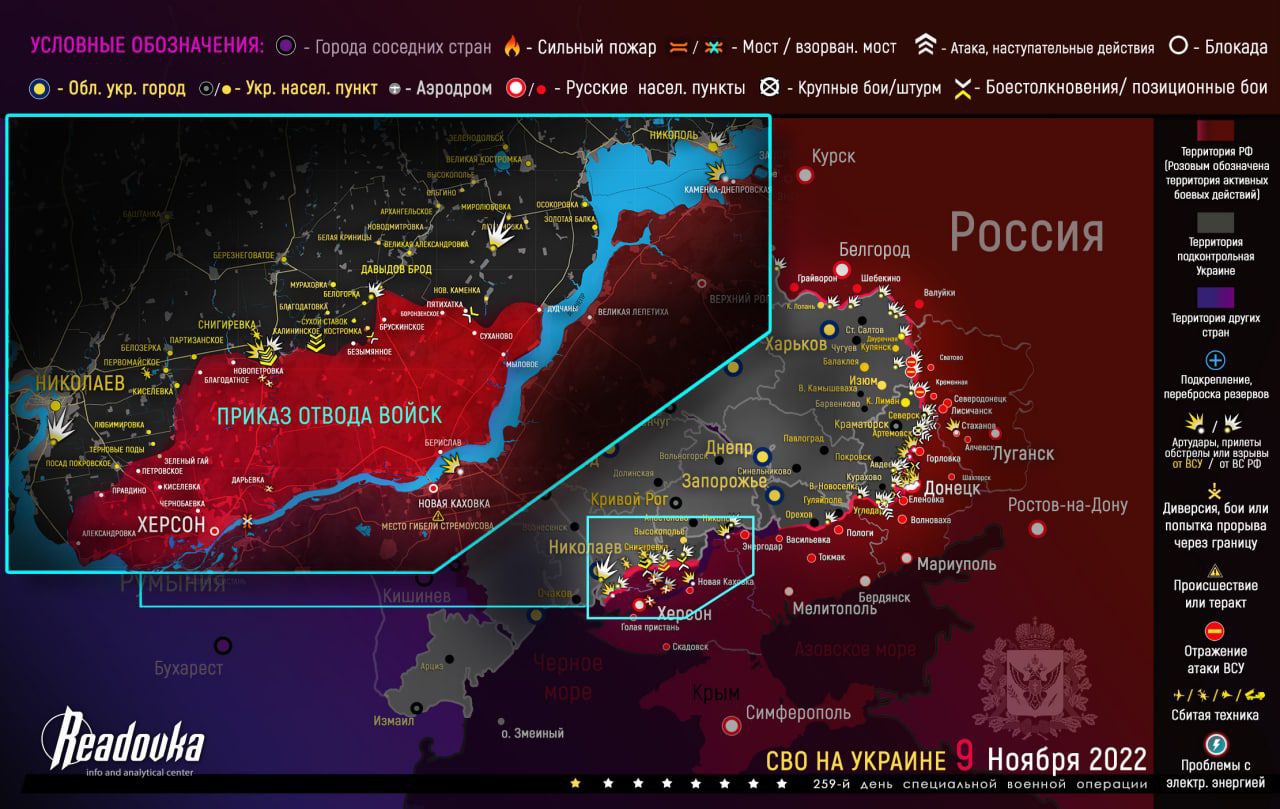
As of early this morning, Moscow time, roughly 30,000 Russian troops withdrew with virtually all of their equipment from Kherson City, located on the right (or west) bank of the Dnieper River, to the left (or east) bank. (The directions are immensely confusing – the left-right thing applies only if you orient yourself downstream toward the Black Sea, the east-west thing makes more sense, so I’ll stick to that for the time being.)
The Russian Ministry of Defence has, as usual, been quite tight-lipped about the whole thing. They are notorious for this pattern of behaviour – whenever anything goes wrong with the SMO, and quite a few things have gone wrong over the past 10 months, the Russian МО (Министерство Оборонны, Ministry of Defence) simply waltzes through it and carries on with Gen. Igor Konashenkov‘s super-dry and rather terse “clobber lists”. These briefings have really become much of a muchness these days, and nobody pays them much attention.
This sort of stiff-upper-lip approach is fine when the Russian war machine is cranking at full speed and conquering all before it. But, when the Russian Army straight-up abandons a strategically and historically vital city like Kherson City – well, the Russian people, and the rest of us, deserve some answers.
In analysing the situation, we have to pay attention to the context and the broader macroeconomic, geopolitical, and strategic situation. This is precisely what I will endeavour to do. I am not going to pull punches or try to defend Russian mistakes here – it is important that the Russians be honest with themselves, and it is even more important for all of us, whether on the Ukrainian side, on the Russian side, or merely a neutral observer, to keep the big picture in mind.
A Short History Lesson

The port city of Kherson was founded in 1778 by Prince Grigoriy Aleksandrovich Potyomkin Tavrichevskiy (you Westerners spell it as “Potemkin”, but I have written it the way it is actually pronounced), the top general, statesman, lover, and possible husband, of Empress Catherine the Great of Russia (who was actually German herself – long story). He did so after conquering the territory of Kherson itself from the Crimean Khanate – and the roots of the territory actually extend back some 2,500 years to Greek times, to the days of the ancient colony of Chersonesos.
In Soviet times, the city functioned as a major port on the Black Sea, providing Russia with merchant shipping, cotton export, ship repair, shipbuilding, and grain-shipping capabilities. The city was among the trio of mainland Black Sea ports, along with the aircraft carrier yards at Nikolaev and the main port of Odessa, that gave the USSR power and prominence in the Black Sea and therefore the Mediterranean.
In other words, this is an important city with a LOT of history. The bones of Prince Potyomkin himself are interred there – or rather, they were, the Russians excavated them with great care and reverence and took his remains with them when they left.
This is not just some average piddling little city – it is Russian territory by right and by founding. The Russians feel it belongs to them, and with good reason. The city’s population before the war was something on the order of 280,000 or so – population data from Banderastan are notoriously unreliable, given their last actual census was back in 2004 and they have never been able to sort out arse from elbow long enough to conduct another one since then.
So, for the Russians to withdraw entirely from Kherson is nothing short of…
A Tactical Disaster
Let’s not dick about here. The fact of the matter is that the Russian withdrawal from Kherson City is catastrophic for the Russians, in terms of optics alone. Pro-Russian types like me are spitting blood about this whole affair – and we don’t even have that much skin in the game. Talk to the average Russian, and you’ll get a long stream of expletives along the lines of ПИЗДЕЦ БЛЯТЬ НАХУЙ, ЁБ ТВОЮ МАТЬ, ВСЁ НАШИХ ГЕНЕРАЛОВ НА ХЕР КОРОЧЕ ГЛУПЫЕ ВООБЩЕ!!! (I paraphrase minutely.)
As anyone who follows my Telegram channel will know, I in turn follow the Russian-language and English-language Telegram channels from the pro-Russian side quite closely. And I can assure you that the Russian-language channels, and their English-language equivalents, have been full of such epithets for the past couple of days, ever since the Russians announced their pull-out.
This is not merely a case of the Russians abandoning a position because it is operationally expedient. They are abandoning a part of Russia itself – let us not forget that Kherson Oblast’ voted to join the Russian Federation in September, and on September 30th, the Neo-Tsar himself welcomed the entire region into the Motherland.
Emotionally, for the Russians, this is a gut-punch of the worst kind. They feel absolutely outraged, and they are hopping mad – wondering why the hell their government and their military so blithely abandoned a piece of territory as psychologically significant as Kherson City.
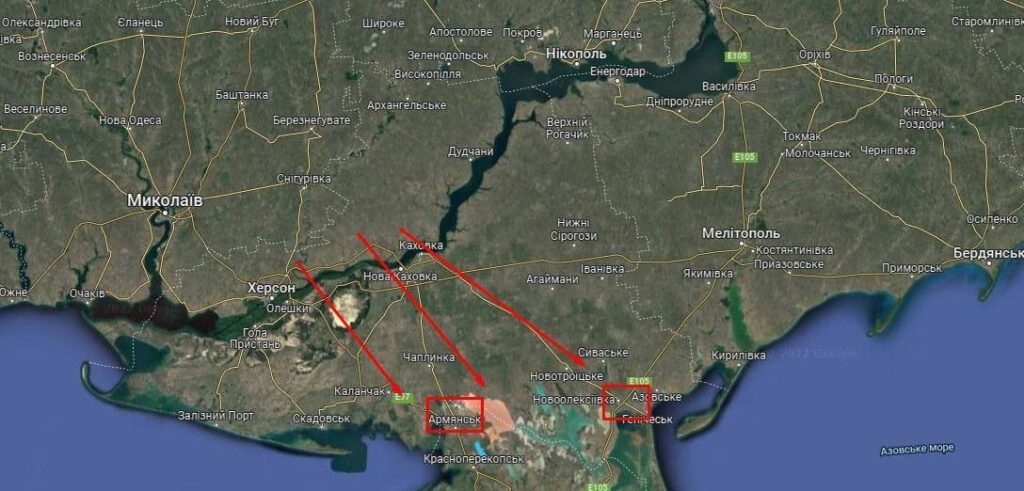
Worse than that, the capture of Kherson City and the entire west bank of the Dnieper River also opens up the main arterial road and rail links from Crimea to the rest of southern Ukraine, to attacks from American HIMARS rockets, as the map above shows.
And as if that were not bad enough, the loss of the Russian beachhead on the western bank of the Dnieper now delays, perhaps by many months, the ultimate Russian prizes in this war – the ports of Nikolaev and Odessa. When captured, these would lock up the entire Black Sea and turn it effectively into a Russian lake, while turning Banderastan into the backwater shithole that it richly deserves to become at this point.
Kherson City will now become a fortified Banderite stronghold. The Russians will have to conquer it all over again – but now they will have to pay a VASTLY higher price. And this will set back the Russian plan to conquer the south of Ukraine by AT LEAST six months – which means that the SMO will not last one year, but probably at least TWO, with a VERY high price paid in Russian blood, and a CATASTROPHIC price paid in hohol blood.
No matter how you look at it, this loss is nothing less than a disaster, at least in the short term. And that is precisely how the Russian people are treating it – I do not doubt the Russian military is also treating it that way at the highest levels.
What about the medium-to-long-term? There, the picture is far less definite.
An Operational Success
The first thing to note here is that the caption of that post is completely wrong. The Russians were not defeated in Kherson region. They have suffered no military defeats whatsoever. They simply assessed the supply situation and concluded that it was too difficult and dangerous to keep the entire city, with roughly 200,000 people left over, plus another 30,000 Russian troops, fed and watered.
Why?
Because up the river from this city is the Novaya Kakhovka Dam, a hydroelectric power plant. Behind that is a gigantic reservoir that contains billions of litres of water. That reservoir, in turn, supplies the Zaporozh’ye Nuclear Power Plant, located further upriver still, with the water that runs through the reactor coolant pipes.
And that dam is precisely where the hohols have been attacking with their American-supplied HIMARS rockets for the past several months, in an apparent effort to destroy the dam and flood the entire Kherson basin.
The results of that flooding would be catastrophic for the Russians and would result in tens of thousands of lives lost.
This is on top of the simple reality that the supply lines to Russia’s troops were under very serious threat. The fact is that the Russians could only keep their troops supplied using the railway and road bridges across the Novaya Kakhovka dam, and the Antonovskiy Bridge. And those supply lines were under constant assault from Ukrainian artillery and American HIMARS rockets. Pontoon bridges are not sufficient to keep 10,000 troops sustained – never mind the original set of 50,000 or so that the Russians had on that side.
Also, it is worth remembering that many of the troops on the west bank of the Dnieper were paratroopers. These are the roughest, toughest, most on-the-bounce soldiers that the Russians have – Americans can think of them as basically the Army Rangers or the 101st Airborne. They are also nothing more than light infantry – it is no disservice or disrespect to these men, brave, tough, and capable though they are, to point this fact out. This mean they are essentially useless in a grinding war of attrition, where artillery and armour determine victory.
Those troops are better off deployed elsewhere. And now Surovikin has done precisely that.
Let us also give “General Armageddon” considerable credit for achieving a rapid fighting withdrawal of a large army – two to three divisions’ worth – in three weeks with minimal loss of life and very little loss of equipment. He befooled the hohols properly – and, let’s face it, the rest of us too, including my own good self – by making it look like he was actually reinforcing the Russian positions on the west bank, when in fact he was withdrawing his troops.
This is operational artistry. None of it changes the scale and scope of the disaster that Russia has suffered. It simply puts things into a bit of perspective.
A Strategic Certainty
What about the strategic picture?
The strategic picture remains basically unchanged at this point: Ukraine is BONED. So is the collective West. They are losing this war. Russia is winning it.
It’s just that simple. Ukraine’s power grid is failing under punishing Russian air and drone attacks – though quite why the Russians insist on going so slowly is both mystifying and maddening. Its most economically valuable territories are now under Russian control – the port of Kherson is actually a severely depreciated asset, with very little economic value left after decades of neglect and underinvestment, and that is before we get to the reality that the Banderites will not be able to keep the city supplied with food, money, and medicine to anything like the degree that the Russians did when they captured it.
It is imperative to understand that Russians do not fight wars the way Westerners do. The Russian way of war is not, and has never really been, about taking territory first. It is about destroying armies and wiping out the enemy’s ability and will to fight. This is what Russians do better than literally anyone else. This is what they have been doing for the past 8 months, against the combined weight of the entire Western world. And it is working – slowly but surely.
The European Union is losing any stomach for this war at the popular level, though its pigheaded and evil elites insist on fighting to the last Ukrainian – they, after all, do not feel the pain of the losses, or the cold of winter, or the hunger and misery of the people as inflation skyrockets and food prices soar.
America – or, more precisely, the Evil Empire that rules it – is the problem. The American government under the zombified Fake President figurehead continues to pour weapons and bullshit into Ukraine, though the amount and quality of the aid continues to diminish by the day.
Yet the situation for Ukraine is unchanged. It lost one army when the Russians smashed it into bloody pulp over the summer. It is in the process of losing another – large parts of which are staffed up to 70% these days with Polish, Romanian, British, and American mercenaries. (That fact is woefully underreported in the West too – but I would imagine that thousands of families are grieving the deaths of their loved ones in a war that they were never told about. Exactly how many “training accidents” can we have in the Western world before people realise that men are being sent to die for money in the black soil of Ukraine?)
The economic picture globally remains extremely dire. The UK and EU are certainly in recession, and that recession is almost certain to be a depression. The USSA, despite its heavily manipulated statistics, is almost certainly in the same boat. Inflation has risen to the point where central banks around the world have no choice but to raise rates.
And that is before we get to the reality that numerous nations are now breaking away from Western hegemony and building new alliances and systems that bypass Western financial and economic power. The BRICS and SCO are working to create a new global settlement currency that will severely undermine the dollar’s power. The Saudis are looking to work with China to settle oil in yuan, rather than dollars – and when that happens, American power and prestige collapses almost overnight. (Which means that Crown Prince and Prime Minister Muhammad bin Salman had better watch his back – American governments do not take kindly to attempts to buck the petrodollar.)
The West is collapsing and buckling economically. Russia is doing just fine. Oil and natural gas prices are very high and will stay that way for the foreseeable future. Europe has perhaps enough natural gas to stay warm this winter – but it has NO plan whatsoever for next winter. And that winter will be bitterly cold without Russian natural gas and oil – because the Americans (ALLEGEDLY!) destroyed the Nord Stream pipelines, (ALLEGEDLY!) using the Limeys as their lapdog proxies to blow up the actual pipelines.
Lessons Learned
No matter where you look, the Russians are winning. They preserved their manpower and fighting strength, withdrew in good order, and are ready and able to redeploy their forces into other theatres of Banderastan to continue destroying Ukraine.
None of this changes the fact that the Russians have made very serious and severe mistakes. What are they, and how does Russia move forward?
1. The West Cannot Be Trusted
The Russians need no real lessons here, perhaps. But we have learned recently that Jake Sullivan, the man-child pretending to be the American National Security Adviser, secretly met with Nikolay Patrushev, the rather forbidding head of Russia’s Security Council and one of the most powerful men in the country. Apparently, he threatened Russia with terrible consequences if the Russian military advances further into Nikolaev and Odessa, up to and including American intervention. He then demanded that Russia freeze the current lines in place, with Ukraine potentially giving up all of Donbass, Zaporozh’ye, and Kherson regions that they have already lost, and the restoration of Ukraine’s power links, with the removal of sanctions as the carrot dangled in front of Russia as an incentive.
I would like to think that Patrushev, being the experienced strongman that he is, simply laughed at Sullivan and provided vague “agreements” that can be misinterpreted as compliance. Sullivan was essentially proposing a “Minsk-3” format, wherein Russia would get some concessions on paper, that the West would never deliver.
I suspect the Russians understand this principle by now. But you never know. The Russians under the Neo-Tsar have shown a repeated preference for getting to the negotiating table, even if the results are against their own present best interests. They play the long game, it is true, but they tend to give far too much in the process.
Any settlement with the West will simply give the US, UK, and EU time to supply yet more useless weapons to the Ukrainians, and yet more excuses to build up a massive force that the Russians will then have to grind to pieces.
2. The Syrian Model Does Not Work
The Russians went in light to Ukraine. That fact is inescapable. The Neo-Tsar took Clausewitz’s dictum to heart, that war is nothing more than the continuation of politics with another means, and tried to force Ukraine and the West to the negotiating table. But that only works when you have completely crushed and destroyed the enemy’s army. The Russians still have not managed to do this – for quite good reasons. They are outnumbered, for now, and despite their vast military superiority, they have to fight a war on the moral level as well as the physical one. They are not merely looking to secure the support of their own people – they are seeking the support of the entire Global South.
They have done so. But this means that a limited expeditionary force model, of the kind that the Russians used in Syria, is no longer appropriate. It is time for the Russians to push through with massive, overwhelming force, and destroy the Ukrainian army and its poxy proxy Western divisions outright.
Russia appears to be learning this lesson, which is why the Russian government recreated a council that dates back to Soviet times – the State Defence Committee, if memory serves – in the form of the Special Coordinating Council for Security Enhancement. This has been interpreted by a number of commentators, including Alexander Mercouris, as a method of preparing the Russian economy for further wartime mobilisation – and that is very much to the good. The faster this war ends with an undeniable Russian victory, the better for everyone.
3. Manpower Matters
On a related point to the one above, the Russians made a HUGE mistake in the summer when they let tens of thousands of their contract soldiers return home. They did so for entirely understandable reasons – those soldiers had already had their contracts extended by 6 months, they were weary of war, and they wanted to go home and resume civilian life.
Russia’s military model is a bit weird – it consists of vast numbers of conscripts of relatively poor quality, drafted every year among Russia’s youth, plus a hardened and very skilled core of professional contract soldiers. They don’t have anywhere near enough of the latter, despite their million-man military. They need a lot more, and every last one of those professional soldiers is worth his weight in gold.
But they didn’t retain those soldiers.
And this was a colossal error. That lapse is why the hohols were able to punch through very thinly defended Russian lines in September and roll the Russians back out of Kharkov. The Russians lost very few troops in that Khreat Khokholite Khounteroffensive, while the Banderites lost roughly TWO DIVISIONS’ worth of men. But the losses in territory were appalling for the Russian people, and they were, rightly, furious. They are even more angry now, given that the Russians are in the midst of mobilising 300,000 troops to deploy into the front lines.
Those men will make a big difference. But this should have happened MONTHS ago. Yes, this is very much a case of “coulda, shoulda, woulda”, but the fact remains that the Russian military and civilian leadership fooled themselves into thinking that a small expeditionary force would be sufficient to keep the gains that Russia had secured.
This was a mistake, and a very costly one. And look at the results.
4. Russia Needs to Get Serious
The plain fact is that the “special military operation” is over, and the sooner the Russian leadership stops deluding itself about this, the better. This is a proper war now. The Russian people have already figured this out, more or less, by and large. The Russian leadership – to include the Neo-Tsar – seem to be highly reluctant to embrace this fact.
The seriousness of the situation really needs to be understood. Crimea is now under threat. The Ukrainians are buoyed up by a big dopamine rush from their “great victory” – in reality, it is nothing of the sort, but they will likely use this as an excuse to launch a big push in the Zaporozh’ye direction to cut the land bridge to Crimea in two and thereby isolate and then destroy the Russian groupings in Kherson and Zaporozh’ye regions.
They will not succeed. Every single time the Ukrainians have faced entrenched Russian positions, even with vastly superior numbers on their side, they have been wiped out. They cannot fight effectively against the Russians in a defensive war. They will waste thousands of lives for no reason.
But the Russian military needs to show that it is serious about smashing the Ukrainian military to pieces. This has so far been the worst and most serious failing of the Russian strategy so far. They have been far too gentle – mostly because they feel as though they are dealing with fellow Slavic “brothers”. The Russian leadership continues to say that Russians and Ukrainians are one people – they are not, certainly not anymore. Three decades of Ukronazi ultranationalism has created a toxic culture that prides itself on killing Russians and destroying one of the world’s great ancient cultures.
The Russian people increasingly recognise this, and increasingly are calling for their generals and leaders to figure out the same thing. The question is, will the top brass listen?
What Next?

This is the most difficult question to answer. It is difficult even to to answer. At this precise moment, the Russians are busy training and deploying 300,000 reservists into the operational areas of the Ukrainian theatre. They are busy pulling equipment out of storage – even to the point of refitting and refurbishing old T-62s at the gigantic Uralvagonzavod tank factory in the Urals, not far from Chelyabinsk, to form a new armoured corps for the LDNR militias – and transferring that equipment to the front.
Yet… where IS all of that lovely terrifying equipment? Where ARE all of the brand-spanking-new T-90Ms and T-14s and all the rest? We’ve seen precious little evidence of that equipment being deployed to the front lines so far. Nor have we seen any strong evidence of big Russian pushes, however incremental, in any area of the front line except for Donbass.
More than that, how are the Russians going to repair the very real and very severe damage done to their reputations? I’m not discussing the world stage – the Russians couldn’t care less about how their military “looks” to the rest of the world. I write here about the fact that, when the Russians came to the four new regions of Novorossiya and to Kharkov, they essentially told the locals, “we are here to stay. The locals trusted them – thousands of them signed up for Russian passports in Izyum and Balakleya and other parts of Kharkov Oblast’, for instance.
And then the Russians abandoned those people, breaking their trust and leaving them to the tender “mercies” of the hohols, who promptly proceeded to shoot anyone they suspected of being a “Moskal”.
Trust is hard to earn and easy to lose. Twice now, the Russians have made promises that they did not keep. This cannot continue, and Surovikin has an almighty task on his hands to fix this gaping problem. The Russians are winning on the physical level of war, but if they lose on the moral level, either locally or at home, then they will lose outright.
The truth is that we simply do not know what General Surovikin plans for the winter campaign. He has dropped a big hint about moving relieved troops into “further offensive operations”, or some such, and that is good – clearly, the general is a man of his word, given that he hinted he would not shy away from taking hard decisions three weeks ago when he assumed command of the operation.
Reports of massive Russian groupings gathering in Belarus, Crimea, and now Novorossiya, are welcome. But it is unlikely, given Surovikin’s statements, that they would be used in big, broad-stroke movements across the battlefield to smash through Ukrainian formations. We are instead looking at another 6 months or so of grinding attrition war. The Russians are the best in the world at that sort of thing – but the fact remains that this war needs to end, NOW.
And it needs to end with a decisive, complete, and total Ukrainian defeat.
Conclusion – Ceterum Autem Censeo Ucraina Esse Delendam
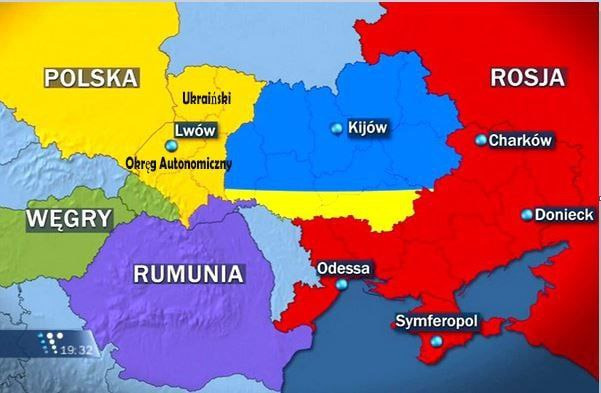
Ukraine has already forfeited its right to exist as an independent state. If that sounds harsh, keep in mind that Ukraine is no longer a sovereign state – and has not been since February 2014, when the Ukrainian people willingly, for the most part, participated in the violent overthrow of a legitimately elected and mildly pro-Russian government. The USSA sponsored that overthrow – the proof is right there, all you have to do is search for the audio of Victoria Nuland discussing the coup that overthrew Yanukovych.
Ever since then, the country has prostituted itself in the most debased fashion imaginable. It is a whore, and a particularly scabrous one at that. It has done so under the illusion that it can get EU and NATO membership. In reality, Ukraine’s leaders have strung along its people and sold them lies.
Yet there are always two parties to a lie – the liar, and the one who believes the lie. Ukrainians have long believed the most outrageous lies imaginable – right down to the idea that they dug out the Black Sea, that the dirt from that excavation forms the modern Caucasus mountains, that they are the most ancient civilisation on Earth, and that the Buddha and Hercules and Achilles were actually Ukrainians. They believe this crap, because they have no sense of real national identity.
They have sold their souls to the likes of Stepan Bandera, a lunatic so radical that the Nazis jailed him, because he was so crazy that even they feared him. And they have done so for cash and prizes that will never come to them.
At this point, the Russian occupation of all of eastern and southern Ukraine would be a great blessing for all concerned. Western Ukraine would be left a broken and impoverished hinterland, a festering pus-filled toxic wound on Europe’s rump, while the actually useful and productive bits of Ukraine would go to Russia, which has already shown clearly that it will invest in those regions and rebuild them.
Ukraine is a black hole that sucks in weapons, money, and energy from the whole of the civilised world. It needs to be cleansed, with fire and blood and steel at this point.
The question is, do the Russians have the balls and the guts to do what is clearly necessary, and put Ukraine out of its and the world’s misery?
Based on the evidence from the past few days, we simply do not know any longer.









2 Comments
I see all this water on the map and I think ‘Can you not use barges as your supply line? Why are you restricted only to railways and highways?’
Is it an air superiority problem? Are barges on the water a vulnerable to NATO-sponsored air and helicopter strikes, and the Russians cannot maintain air superiority in a theater? What an opportunity to show off your vaunted fighter craft in an active theater…or is it like the Turkducken of the west, the supply chain can’t sustain the front line work load of these craft?
Excellent write-up, as usual. Thank you.
I think that, operationally, Surovikin had little choice. He absolutely cannot afford to lose the dam and then the nuclear plant. Yes, they had to pull back from Kherson; they evacked a bunch of citizens and I presume they are being fed and house in relative safety. I, too, hated to see this happen but the alternative would be a real disaster not some negative, temporary optics.
So, the Russian peoples are unhappy. Would they have been more happy with a destroyed dam, a flooded nuclear power plant and widespread damage and loss of water supply for the whole region?
Lets be even more realistic. I think the theater commander came into his new mission with Kherson already in trouble with the west and its idiots already threatening to do major damage. He had no choice. Yes, it was a great job of deception, removing endangered civilians, and a fighting retreat. Although, the fighting part of it was minimized as I see it by Ukraine forces that have be systematically destroyed, often in detail.
Putin is lucky to have such a general. And, eventually, even the uninformed critics will have to admit that. It is refreshing to see a people and army that keep their eye on the prize and, seemingly, are not affected by media focus on shallow optics and lack of knowledge of the operational art [stole that from Swartzcroft and another war].
I’m liking this Russian general more and more.