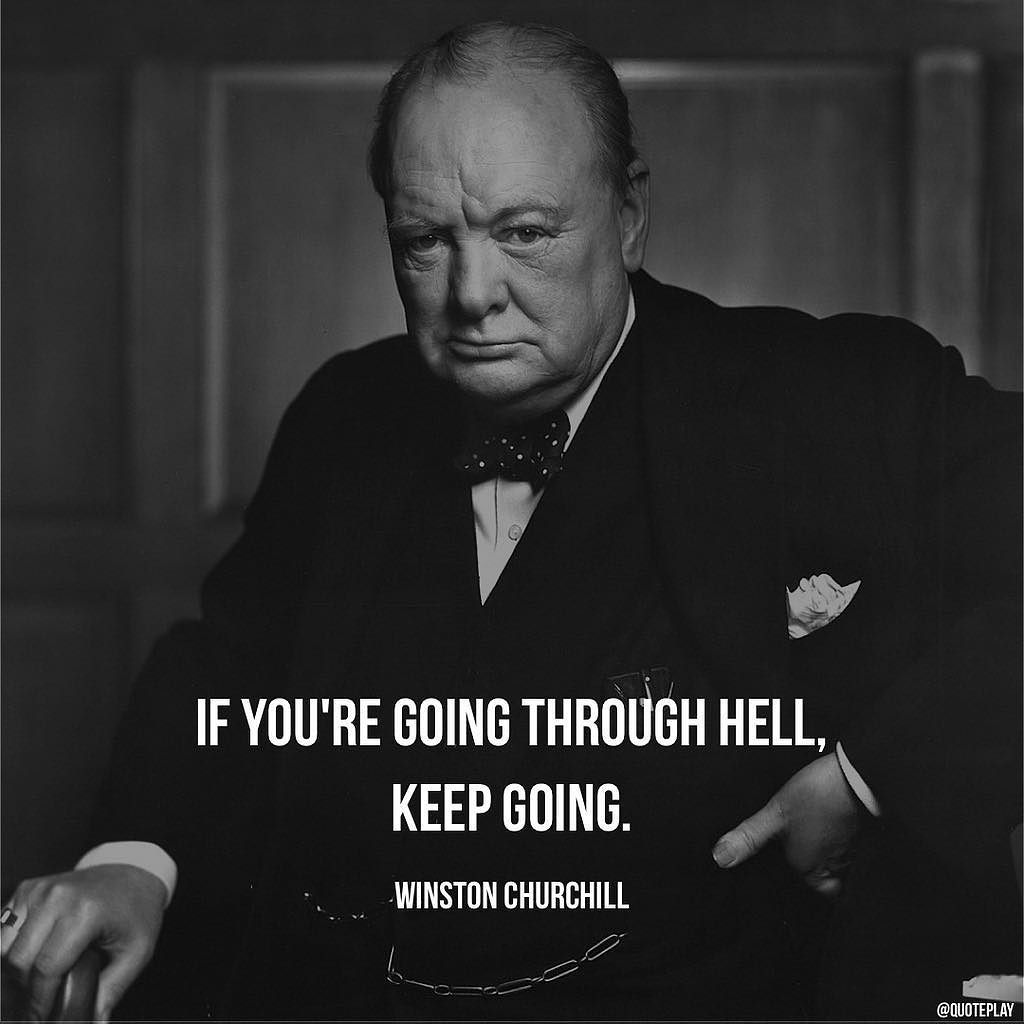
If you seek truth, if you believe in standing up for what is right, or even if you want nothing more than to be left alone, you are the enemy. Now, to be clear, you are not MY enemy, at all – you are the exact opposite, in fact. And you are no enemy of anyone who seeks to be a good person. But you ARE an enemy to the Prince of this world, the one who seeks to make us all bow before lies. You are at war, and that war will test you in ways that will threaten to break you. In such times, the strength to get back up after being beaten down will save you. Resilience is your key to victory.
I am not writing this advice to make you feel good or happy about yourself. In war, you will lose certain battles – maybe even every battle. But, if you simply refuse to give up, and if you learn from your beatings at the hands of a cruel and uncaring world, you will win the war.
The Death Guard

If you are as familiar with Warhammer 40,000 lore as I am, you will no doubt have heard of the Death Guard legion of Chaos Space Marines. If you are not a giant nerd and/or have real-life hobbies… well, I’ll just have to ask you to bear with me for a little bit.
In WH40K, the Death Guard legion of Space Marines is the epitome of unbreakable resilience in combat. Their (pre-Horus Heresy) combat doctrine can best be summed up as follows:
With the coming of Mortarion, the Legion’s combat doctrines changed as the Death Guard became a single instrument of his will. The Death Guard came to believe that victory came through sheer relentlessness. Their weapons, while not ornate, functioned without flaw. They did not manoeuvre in fanciful patterns to confuse the enemy, instead they stood their ground and waited for the enemy assaults to falter before striking back with fatal force.
Any environment or situation Mortarion and his advisors could not compensate for, the Death Guard would overcome through sheer stubborn resilience and painful endurance.
[…]
The Death Guard were arguably the most remorseless and among the most feared of the Space Marine Legions. This was not simply because of their power in battle or force of arms, but also because there seemed to be no loss they would not accept to ensure eventual victory and no hell they would not endure to reach their foe.
This fiction contains an important kernel of truth:
Dogged stubborn resilience in the face of insurmountable odds is itself a weapon.
Valley Forge

Few men understood the importance of refusing to give up, back down, or break in the face of overwhelming pressure, better than the Father of the Nation. (Well, that’s if you are American – which most of my readers are.) It may surprise even my American readers, though, to learn that General George Washington was not considered a particularly good military tactician or strategist. And the fact is that HE WASN’T.
General, and later President, George Washington was merely 22-year-old stripling of a lieutenant-colonel in the Virginia militia in 1754. He ordered an attack on a French military encampment in what is today southwestern Pennsylvania on May 28th. The problem was that France and England were NOT at war, at the time. Nobody knows exactly who shot first. But we know exactly what the results of that battle were – the 9-year-long French-and-Indian Wars that ended in the French expulsion from the continental United States.
For George Washington, that war was a personal as well as professional disaster. He was an international disgrace. His actions had caused a freakin’ WORLD WAR. And when it came time for the colonies to declare their independence from the quite mad King George III, he seemed a rather poor choice to lead America’s raw and untested Continental Army to war. Seemingly better men, such as Benedict Arnold – yes, that one – waited in the wings.
Yet General Washington’s personal defeats did not break him. He learned a very great deal from his time within the British military machine. He gained a real appreciation for the power of training, logistics, and organisation.
And when the redcoats came knocking… it all proved largely useless.
As any true American patriot knows, the early battles of the Revolutionary War were utter disasters. Failure followed by retreat by calamity by catastrophe – that was the order of things. Bunker Hill. Falmouth. Block Island. Kip’s Bay. White Plains. Fort Cumberland. Second Trenton. Fort Ticonderoga. Staten Island. Brandywine. The list of British victories over the Patriots, in the early years of the war, is as long as my arm.
Those horrendous losses and brutal setbacks, which started well before the Declaration of Independence, should have and absolutely WOULD HAVE broken a lesser man. General Washington, however, took the opportunity afforded him to winter in Valley Forge, rest, rearm, and train his troops.
He still lost thousands to cold, disease, and starvation. But the winter respite gave him the chance to begin building a true army. He found the means and the time to equip them at least sort of properly. His actions helped secure the good graces of the French, who promised arms and aid.
And by the time the spring turned in 1778, he was ready to fight the redcoats in open combat. Which is exactly what he did. He fought back, and fought hard, and won.
Cage Rage

Of the great many enduring lessons that martial arts taught me in the five years that I spent at Grandmaster Rhon Mizrachi’s school, I remember one from a conversation with (now-former) instructor David Weintraub, Dan 2. He was talking about how conditioning and strength make a huge difference in cage fighting, and I was simply listening to him. He said something that has stayed with me ever since:
I became convinced of the value of conditioning when I started doing conditioning exercises. I found that I could often beat opponents just by outlasting them.
That is actually the true secret to success in much of sports today. Take a look at the top athletes in just about any field.
Michael Schumacher changed F-1 forever with his relentless, nearly robotic focus on fitness and strength. Talent alone did not win him 7 F-1 championships – conditioning did. And that is merely another word for resilience.
Roger Federer, Rafael Nadal, and Novak Djokovic are absolute cardio beasts. Of the three, Federer is by far the most talented – his playing style is the epitome of pure talent on the court. But he is also incredibly fit. When talent alone is not enough to defeat an opponent, he digs deep and outlasts them. Watch what he did to Rafael Nadal deep in the fifth set of their epic Australian Open final match in 2017:
And of course, look at Khabib Nurmagomedov, the man that you see in the picture above. That’s him trying to pop Conor McGregor’s head right off his neck. The Eagle of Dagestan is NOT the most talented striker in the world. His wrestling style is direct, brutal, straightforward, and EXTREMELY effective. There is no stylishness to his method of fighting. His technique is very simple:
He grabs you, takes you down, and BEATS THE EVER-LIVING F**K OUT OF YOU.
Applying the Lesson
So now that you have seen what resilience can do – how do you apply the lesson?
1. Accept Responsibility
I write as someone who has repeatedly experienced dreadful disappointments in life. I have been laid off three times, parted ways with a fourth employer due to a lack of any viable path forward, and been rejected from, roughly speaking, 200 job applications. Four business schools, maybe more, have rejected my applications. At least eight companies rejected my internship applications in the last 4 months.
None of this was anyone else’s fault. It was MINE. And MINE ALONE.
Yeah, certain factors out of my control resulted in at least two of those layoffs. But I should have done something to get out of that industry. And I should have done more to make myself antifragile. I did not, and suffered terribly for my lack of foresight. But that was MY FAULT.
When calamity befalls you, do not bitch and moan about how it is anyone else’s fault. Take extreme ownership and accept your mistakes.
2. Maintain Perspective
When you fail – and you WILL fail – you will be tempted to think that nothing will ever get better. This is the way a loser thinks. A single loss is not the end of the world. A hundred losses are not the end either. In fact, “the end” only comes when you die. And even then, you don’t actually die – your spirit simply changes location.
Instead of seeing a failure as a crushing defeat, look at it as information. You have been provided with clear feedback from the world, telling you that you f***ed up. If you are really lucky, you will be told how and where you f***ed up. So now you know how to stop f***ing up.
If you are a child, you will think of nothing beyond your failure and brood upon it and grow angry and resentful. But if you are a man and seek to act like one, then you will maintain that perspective and…
3. Learn From Your Mistakes
Every winner that I know, got to where he was by making sometimes catastrophic errors of judgement. Winning is highly costly. Nobody knows this better or more thoroughly than His Most Illustrious, Noble, August, Benevolent, and Legendary Celestial Majesty, the God-Emperor of Mankind, Donaldus Triumphus Magnus Astra, the First of His Name, the Lion of Midnight, the Chaddest of Chads, may the Lord bless him and preserve him.
Or, as we know him today, simply Donald Trump – because he failed to cross the Potomac and protect the Republic. That, though, is a discussion for another day.
Trump did not become President by mistake. He got there by being a great salesman and a skilled negotiator. He was, and remains, incredibly dogged in the face of unbelievable opposition. You only need to read his book, The Art of the Deal, to realise that the man’s character did not fundamentally change between the late 1980s and 2021.
He has made some colossal mistakes in his life that resulted in multiple bankruptcies. But he has come back stronger from every single one of them. His critics deride him for being long on rhetoric and short on substance – yet, how many of those same critics can boast of a talent for winning like he can?
He learned from his errors of judgement and decision-making. So too must you. And when all is said and done, remember…
4. Be Grateful for Your Tests
This is perhaps the hardest lesson of all to learn. When God Himself is testing you, it will feel like you are going through Hell. But that is NOT Hell.
The doors to Hell are locked from the inside. People who go to Hell choose to be there. They wilfully and willingly separate themselves from God.
They do so because they cannot handle the tests that God has given them. And here’s the thing: God never gives us tests that He thinks we cannot handle. The manner in which we handle them, however, is up to us. And that is where most of us fail, repeatedly.
God is patient, kind, and loving in ways that you, as a mere man, cannot comprehend. But He also knows when He isn’t wanted. And when He leaves your life, that is when the true misery begins. Hell awaits those who refuse His outstretched hand voluntarily, and from then onward refuse to obey His laws. Do not make this mistake, and be thankful to Him for putting you back on the right path.
Conclusion – Carry On Regardless
When you are being pounded into the dirt by events and your enemies are stomping on your face with hobnailed boots, you will be sorely tempted to just give up and stay down. Don’t do it. Get back up, swinging all the way if you have to. Fight on. Beat your enemies through sheer bloody-minded stubbornness if you must. Refuse to back down in the face of intimidation and threats. Do not let the Prince of this world have the satisfaction of knowing that he can break you. Instead, spit your defiance into his face, and into the faces of your enemies.
You might lose the battle. But you will make them pay a terrible price in the process. And when they come back to attack you again, they will think very hard about the wisdom of that choice.









2 Comments
To win, revolution must succeed or fail.
In contrast, an insurgency only needs to persist to be successful.
Quite right.