I am well aware that the title of this post is extremely inflammatory – or at least it is to neo-Palestinians, Churchians, and cuckservatives – but before y’all decide to grab your flamethrowers and torch me for insulting Jesus, the Christ and Messiah, let’s be very clear about one thing:
Yeshua, known to us today by the Romanised name of Jesus, Earthly son of Joseph, descended from King David through the bloodlines of both His mother and Earthly father, was, and is, the resurrected and living Son of God, King and Saviour.
I humbly bow my knee before Him and witness Him as such to all who have eyes to see.
And one day, all peoples of all nations will do the same. The only question is whether they will do so of their own free will before the Day of Judgement.
There is no place here for ad hominem slurs and attacks on Christians and Christianity. Nor is there place for irrational and emotive arguments against Jews and Judaism. I don’t like Alt-Retard Nazi LARPers, and they sure as hell don’t like me.
Several of my readers are Jewish. I warmly welcome them here, even when they criticise Christianity as a Jewish heresy (which, by the way, is objectively true).
But there is plenty of room here for legitimate, informed, thoughtful criticism of both Judaism and Christianity – the former, because modern Judaism is, as I have said several times before, basically an attempt to “lawyer around” the Word of God and therefore is and should be open to informed examination of itself for that very reason, and the latter, because Christianity has successfully defended itself for 2,000 years against any and every form of attack, and has proven to be true every time.
So when I say that there is no such thing as “Judeo-Christianity”, I mean one very specific thing:
There is no way that one can reasonably conflate “Judaic” and “Christian” values and morals. The two faiths are almost completely different.
Note, this is not my claim. Nor is it the claim of our beloved and dreaded Supreme Dark Lord (PBUH), Voxemort the Malevolent.
This is the claim of Jews themselves, who I think we can all agree have every right to tell us what their own faith actually claims:
Let’s be clear: Far from “sharing” one tradition, Orthodox Jews are prohibited from marrying Christians, setting foot inside a Christian church—and we can’t even drink from an open bottle of kosher wine that has been used by a Christian. We reject the Christian idea of salvation, we abhor Christian divine teachings on every subject, and we are repulsed and outraged by incessant attempts by Christian missionaries to bring us into their fold.
It is particularly disturbing when Klinghoffer makes statements which reveal his complete assumption of elements of New Testament Pauline ideology, for instance, the requirement that wives submit to their husband’s authority. There is no mandate on precisely how a woman should behave with her husband—Jews expect the happy couple to work it out for themselves. Also, while divorce may be a tragedy, and God cries, it is in no way banned—in Judaism, that is. The story in Christianity, and Klinghoffer’s “Judeo-Christian Biblical America,” is different.
Incidentally, we have more in common with Muslims than we do with Christians; Jewish law permits Jews to enter a mosque… but not a church.
To insist that we have some kind of bond with religious Christians because of similar core values, is to propagate a terrible lie. Christians who base their views on what they call the Old Testament, don’t view Mosaic law as an abiding legal text. The Church has abolished Torah law as part of its attempt to abolish the very idea of Jewish nationhood.
And more:
Jews and Christians differ on every single fundamental principle—even on the meaning of core Scriptural texts. More crucially, Christians rely on the Old Testament for legal delineation; whereas Jews rely solely upon our rabbinic tradition. We never, ever turn to our Bible for legal guidance, only to our rabbinic literature. To suggest that our Sages had anything at all in common with the likes of Jerry Falwell, Jimmy Carter or Pat Robertson is a slap in the face of 2500 years of scholarship.
“Judeo-Christian” is as valid a concept as happy-joylessness, or tall dwarves. Klinghoffer’s yearnings for this repugnant “ideal” is a deviant phenomenon without a trace of commonality in traditional Jewish thought, ancient or modern.
If nothing else, this should put paid to the illusion – and that is the correct term – that Judaism and Christianity have “basically the same roots”.
They don’t. They are very different faiths.
Modern Judaism is in fact a younger faith than Christianity. The Talmud – the massive set of rabbinical commentaries on the Torah and the canonical Law – comes in two parts, the Mishnah, which is the written version of the oral Torah (the laws, statutes, and legal interpretations not actually written down in the Pentateuch), and the Gemara, a massive compendium of commentaries and elucidations of the Law.
The Mishnah was apparently only finalised in around 200AD, while the Gemara was only finalised around 500AD or thereabouts.
These books are the basis of modern Judaism. They have nothing whatsoever in common with Christianity, beyond the fact that the Christian Bible contains the Old Testament.
Contrast this state of affairs with the first widely accepted canonical compilations of the New Testament, which date back to somewhere in the late 4th Century AD (though there is some dispute about exactly when we can say that we actually had a “New” Testament compiled in its entirety). By that point, Christianity was already the state-sponsored faith of the Roman Empire under Emperor Constantine, the seminal Council of Nicaea and the subsequent formation of the Nicene Creed, which established as clear doctrine the divinity of Christ and the Triune Godhead, had already taken place, and most of the foundations of what we would recognise as “Christianity” had already been laid down.
On top of this, the four canonical Gospels of the New Testament were all written down anywhere from 20 to 50 years after the Crucifixion itself, and the Pauline Epistles were, as far as I’m aware, written down somewhere toward the end of that time by St. Paul and widely disseminated to the rest of the nascent Christian world by the Saints Luke, Timothy, and others. (Readers can and certainly should correct my understanding of early Christian history if I got something wrong there.)
So basically, the essential Gospels, Epistles, revelations, and apocrypha of early Christendom all existed by the end of the 1st Century, and several different versions of the Christian faith had already begun to emerge by the beginning of the 2nd. By that time it was very clearly a recognisable, distinct faith that had evolved out of its roots as a Judaic heresy (of which, by the way, there were a fair few kicking around at the time; it was a rather tumultuous period in history).
Therefore one cannot get around the fact that Talmudic Judaism is younger than Christianity. Nor, by the way, is modern Talmudic Judaism the same religion as what is depicted in the Old Testament. Ancient Judaism was a highly aggressive, expansionist, imperialistic, proselytising way of life, not just a faith, and its laws and rituals encompassed every possible aspect of life.
(Tangentially, this is a big part of the reason why Islam bears so many striking similarities to ancient Judaism. For more information, read this.)
And there is no getting around the equally clear fact that Talmudic Judaism is outright hostile to Christianity. Talking about “Judeo-Christian” values is profoundly insulting to Jews, and downright stupid as well.
Here I must point out that I am myself guilty of using that phrase of “Judeo-Christian values” many times. Therefore it is entirely correct to subject myself to the same criticisms that I have for others. This, for instance, is a particularly inept example in an otherwise solidly worded post of mine, where I was calling for a renewed Crusade to take back Christendom. I used the phrase “Judeo-Christian” not once, not twice, but five times.
I was wrong, each and every time, to conflate the two. They are not the same thing.
Fortunately, I got wise eventually and started pointing out that the two religions are not even remotely the same.
How is it that two religions that both claim to follow the Ten Commandments, accept Moses and Samuel and Elijah and so many others as true prophets of God, and acknowledge plainly that the Messiah must be a descendant of the lineage of David and will perform many miracles as prophesied by Daniel, Isaiah, and Hosea, are so mutually exclusive?
Well, let’s start with the fact that the Book of Deuteronomy makes it perfectly clear that any attempts to add or subtract from Mosaic Law are absolutely forbidden.
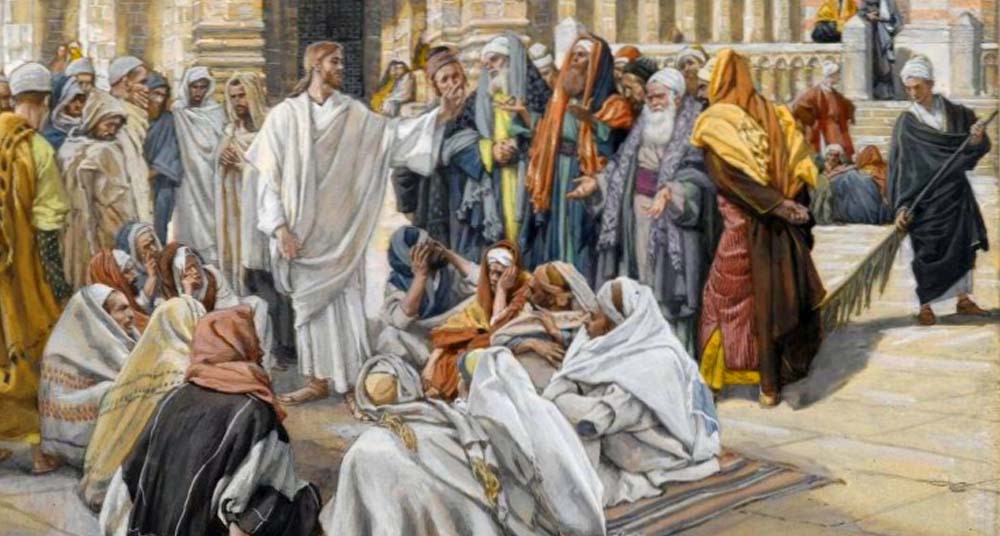
What did Jesus the Christ come along and do? He flatly ignored huge parts of Mosaic Law and told the Pharisees that they were “thieves and vipers” for adhering to law rather than truly having faith. That, after all, is why the Jews ultimately crucified Him.
Furthermore, as the article above notes quite correctly, for Christians, the Bible is the source and font of doctrine, ethics, morality, and spirituality. For Jews, though, it is the Rabbinical commentaries that matter.
This is precisely why the Jews viewed Jesus as an utter heretic and wanted Him discredited and killed. Read your Gospels and you will find that the Pharisees constantly tried to set rhetorical and legal puzzles for Him, to test His knowledge of the Law.
Why? Because, as noted in at least two separate Gospels with respect to the Sermon on the Mount, Jesus did not say, “It is so because Rabbi A said this, and he is backed up by an earlier Rabbi B’s comments, and he in turn by an even earlier Rabbi C”, and so on and so forth all the way back to Moses.
No, what Jesus said, essentially, was: “Ye have heard it said that [X], but I tell you now that [Y] is true”.
I am unfortunately rather mangling the Scriptures here and probably not putting things very elegantly, but there is the gist of it. Christ Jesus did not appeal to previous authorities to build His case. He simply tossed out what existed before, and established His own take on the Law, and added one commandment to take ultimate precedence over the original Ten.
That, in the eyes of any orthodox Jew, is heretical in the extreme, in direct violation of what Moses said.
In almost every way, Christianity is a radically different faith than Judaism. And it has to be, because unlike Jews, Christians know and understand that the world is ruled over by an immortal, prideful, psychopathic serial killer who delights in our misery and exists only to serve himself.
The Christian worldview is an extremely dark one – perhaps the darkest and bleakest of all faiths. More than any others, we Christians recognise that Man is flawed, Fallen, utterly broken, incapable of healing himself solely through his own tools and means.
Jews and Christians agree about the Fallen nature of Man, and about the truth of Original Sin. But they disagree completely about how to handle the problem.
In ages past, before the Lamb of God was brought before the world, humiliated, stripped bare, tortured, and ultimately crucified – and went willingly to His own death – the propitiation of sin could only take place through a sin offering. Animal blood was used to appease God and wash away the sins of men. And that sufficed, for a time – until the sins eventually became far too great. Something even more precious was needed: the blood of an innocent man, given up willingly.
And yet even that was not enough, for the Lord expressly forbade human sacrifices in His name. The blood that was to be shed, had to be Divine in nature as well. Then, and only then, could the sins of Man be washed clean.
When you understand these things about Christianity, and see the Crucifixion in all of its horror and glory through the eyes of the Lord – very poorly and dimly, because no righteous mortal man can see such things clearly without having a complete psychotic breakdown – then you understand the enormity of what was done.
The only thing in the Jewish canon that compares with this is probably the story of the Flood, in which an enraged God scours the Earth clean of all life. And that, too, was something that the Lord promised He would never do again – whereas He made it clear, many times in the Old Testament, that someday a far greater atonement for Man’s sins would be needed than anything that had ever come before.
This very dark view of the world and of human nature is tempered, however, by a very different kind of relationship between God and Man than exists in the Old Testament. And that, too, is plain to see for anyone who reads the Scriptures.
The God of the Old Testament is often called fickle, vain, authoritarian, and even murderous and psychopathic. It’s not hard to see why. But the God of the New Testament is – or rather, seems to be – a totally different God, a stern but loving Father who forgives just about any sin and views His creation with the same jovial kindness and joyful patience that any Earthly father views a toddler playing around and giggling and falling over and making silly faces.
Read a little closer into the Scriptures and you’ll realise that the vengeful, angry, wrathful nature of God is still very much extant. The boundless, blazing, roaring fury of the Lord at the innumerable ways in which His most beloved creations spit upon His Name and Word, and happily embrace sin, doing everything that He damned as highest crime and calling it virtue, is something that Christians can actually feel, albeit in an extremely limited capacity.
And it absolutely terrifies us. The mind literally blanks and shuts down when confronted with the sheer violence and scale of the Lord’s rage.
Nor is the human heart capable of bearing the weight of the sorrow that the Lord feels at what He sees. It is important to understand that the Lord’s heart is constantly breaking.
And, yes, Christians can feel this too.
Christianity accepts the wrathful and sorrowful aspects of the Lord entirely, but emphasises far more strongly the loving and nurturing side, because that after all was the entire point of Christ’s sacrifice – to redeem Man in the eyes of God, and to offer men an escape from a truly terrible fate in exchange for the willing acceptance of a very hard, demanding, difficult road to travel.
And it is a very difficult road, make no mistake. Christ’s offer of salvation comes at an extremely high price.
It is not relevant to the subject of this post to go into an aside about what it is like to walk a Christian road. That is for another time. Suffice to say that once you accept Christ’s offer of salvation, things reveal themselves to you that no amount of secular study and “watching from the stands” can possibly prepare you for. And those things are both wonderful and terrible.
The point at hand is that Jews and Christians are very different. To conflate the two is irresponsible, immoral, lazy, and even racist, because Jews have always defined themselves in explicitly racial terms.
This racial aspect of Judaism is truly central to the faith. It is a core part of their identity. You have to understand that in order to understand why they react so violently to the idea that Christians and Jews are part of the same tradition.
Consider: Jesus Christ, directly descended from King David himself, therefore from Jacob and all the way back to Abraham and beyond, took Jewish Mosaic law – expressly reserved by Moses himself to the Jews alone – and expanded it, changed it, threw out all of the ceremonial and legal stuff and concentrated only on the moral aspects, and then extended it to the Gentiles.
You can’t get much more heretical than that – or so an orthodox Jew might think, at first.
Then, St. Paul the Apostle came along and said, essentially, “Mad respect, Big J, but y’all hold my beer and watch this”.
St. Paul was a former Pharisee himself, therefore one of the highest ranking members of the Jewish nation and a member of the Tribe of Benjamin. The only way he could possibly be more Jewish is if he ended every single letter in the Epistles with “oy vey”.
And what did he go and do? He basically said that, because the Jews had proven unworthy of the Law, it was now going to be extended in full to the Gentiles, who would now be entrusted to carry forth God’s Word and witness His glory to all of the nations of the world.
In racial terms, that is a bit like telling a black man that the blues now belong to everybody and everyone owns a share in the heritage of the blues sound. It is a literal direct attack on his sense of identity and self.
Small wonder, then, that most Jews absolutely hate the idea of being conflated with Christians – and that neo-Palestinians, like Dennis Prager (for whom, by the way, I have considerable respect) are either ignorant or lying outright when they talk about “Judeo-Christian” values.
Once again, there is no such thing as “Judeo-Christ”.
There are Jews – to whom the Law was originally entrusted, and for whom we Christians therefore can and should have considerable respect and affection, even if they did falsely accuse, condemn, and murder Our Lord. That happened two thousand years ago and the bones of those who carried out that act have long since turned to dust, so there is no point whatsoever in holding that against Jews today.
And then there are Christians, who are heirs to a very different set of rules, traditions, and guiding principles. Our faith tells us that redemption lies through the blood of Christ, offered up willingly for each and every one of us – but we, personally and individually, have to accept His offer. And only through Him – not through any other Earthly teacher or authority – can we know God the Father.
There is only Christ – Lord, King, and Redeemer. Calling Him anything else is nothing short of blasphemy.
And blasphemy, by the way, is the one sin that the Lord absolutely will not forgive.









5 Comments
Preach it, you heathen!
Growing up Catholic, I never understood the morbid fascination with sorrow and suffering. The Seven Sorrows of Mary, Lent, the arduous task that is praying the rosary, etc. I've only recently begun to understand why: partly to understand Herculean task of dying for our sins, and the fact that we cannot reach the Joy that is promised us without first suffering. And since routine, everyday suffering isn't enough to awaken our ignorant eyes, we're going to suffer for fun and profit. Only then can you suffer gladly, and then truly begin to fulfill Jesus' commandment to us.
I'm getting there. Slowly, but surely.
Well… not a heathen anymore, mate ))
Got saved back in mid-January or thereabouts.
I'll write about it at some point. Life has been all kinds of interesting since then.
Greetings new baby Christian!
Two commandments to sum it up:
Matthew 22:35-40: "And one of them, a lawyer, asked him a question to test him. “Teacher, which is the great commandment in the Law?” And he said to him, “You shall love the Lord your God with all your heart and with all your soul and with all your mind. This is the great and first commandment. And a second is like it: You shall love your neighbor as yourself. On these two commandments depend all the Law and the Prophets.”
Love the Lord your God with all your heart, soul and mind; and love your neighbor as yourself.
The only unforgiveable sin is blaspheming the Holy Spirit. (Mark 3:28-30). So you can blaspheme God the Father. You can blaspheme Jesus. You may not, however, blaspheme the Holy Spirit, whom now lives in you, Didact.
Protip: If you're afraid you've blasphemed the Holy Spirit, you haven't. The hallmark of blaspheming the Holy Spirit is not knowing Him, nor caring about whether you have blasphemed Him.
"There are Jews – to whom the Law was originally entrusted, and for whom we Christians therefore can and should have considerable respect and affection, even if they did falsely accuse, condemn, and murder Our Lord. That happened two thousand years ago and the bones of those who carried out that act have long since turned to dust, so there is no point whatsoever in holding that against Jews today."
Yeah, the ones who accept Jesus Christ the Son of God. The rest of them have fair warning and their parents called down a curse upon their children without their consent.
"When Pilate saw that he was getting nowhere, but that instead an uproar was starting, he took water and washed his hands in front of the crowd. 'I am innocent of this man’s blood,' he said. 'It is your responsibility!' All the people answered, 'His blood is on us and on our children!'"
They are truly free to renounce their parents and their parent's actions but when they simply accept them they accept the duties their parents put on them. Just imagine the tormented spirit of a modern rabbinical jew saying to his descended, "Heh nothin personnel kiddo enjoy the burden of our actions hehe"
That was one of the better explanations I've read explaining why the "Judeo-" part of Judeo-christian is nonsensical. I've always thought is was that Christianity spawned from Judaism, all of the apostles and Jesus himself being jews.
This explains, at least partly, the secular jew. It seems like every time I'm reading something written by an author that calls themselves jewish, they make a point to mention, somewhere along the way, that they are agnostic, or otherwise don't believe in God.
This strikes me as nonsense. You don't get to claim to be part of one of the chosen tribes when you don't acknowledge he whom has chosen you. Jonah Goldberg comes to mind. They need to turn in their jew card, because at that point, they're just a white guy. No different than those of Italian, polish, Russian ancestry.
Most of their practices strike me, like with Islam, as superstitions to ward of an angry and vindictive God. Makes no sense.