Our beloved and dreaded Supreme Dark Lord (PBUH) hosted a Darkstream a few days ago in which he basically started asking some very hard and pointed questions about our current capitalist economic system. As with most of his videos, this was a highly thought-provoking and interesting intellectual discussion, in which Voxemort the Malvolent essentially asked questions that nobody else on the Hard Right really seems to bother with very much:
As Vox points out, the fundamental building block of the capitalist economy is not actually debt. It is not production or consumption. It is not “the invisible hand” of Adam Smith.
It is contracts.
If you buy something from someone, you enter into a contract with that person. If you sell something to someone, you also have a contract with someone. Each party has an obligation to deliver something of value to the other. The medium of value exchange is what we call “money”.
Money is nothing more, and nothing less, than the value of one’s time, labour, and intelligence compressed down into a simple universal unit of currency that is accepted everywhere within a given nation’s economy.
If you were forced at gunpoint to come up with the single greatest invention that Mankind ever came up with, the answer would not be “fire” – because Man didn’t invent fire. The answer would be “money”.
The creation of the concept of money is so brilliant, and so powerful, precisely because it reduces all of the nearly infinitely complex decisions and desires and needs and wants of all people into a single, simple, perfectly understood unit of measure.
It does not matter what you call money – its purpose remains the same no matter what. Take a look at these very, very old currency notes – some of which date back all the way to Tsarist and revolutionary times in Russia, and others of which date back to the Austro-Hungarian Empire:
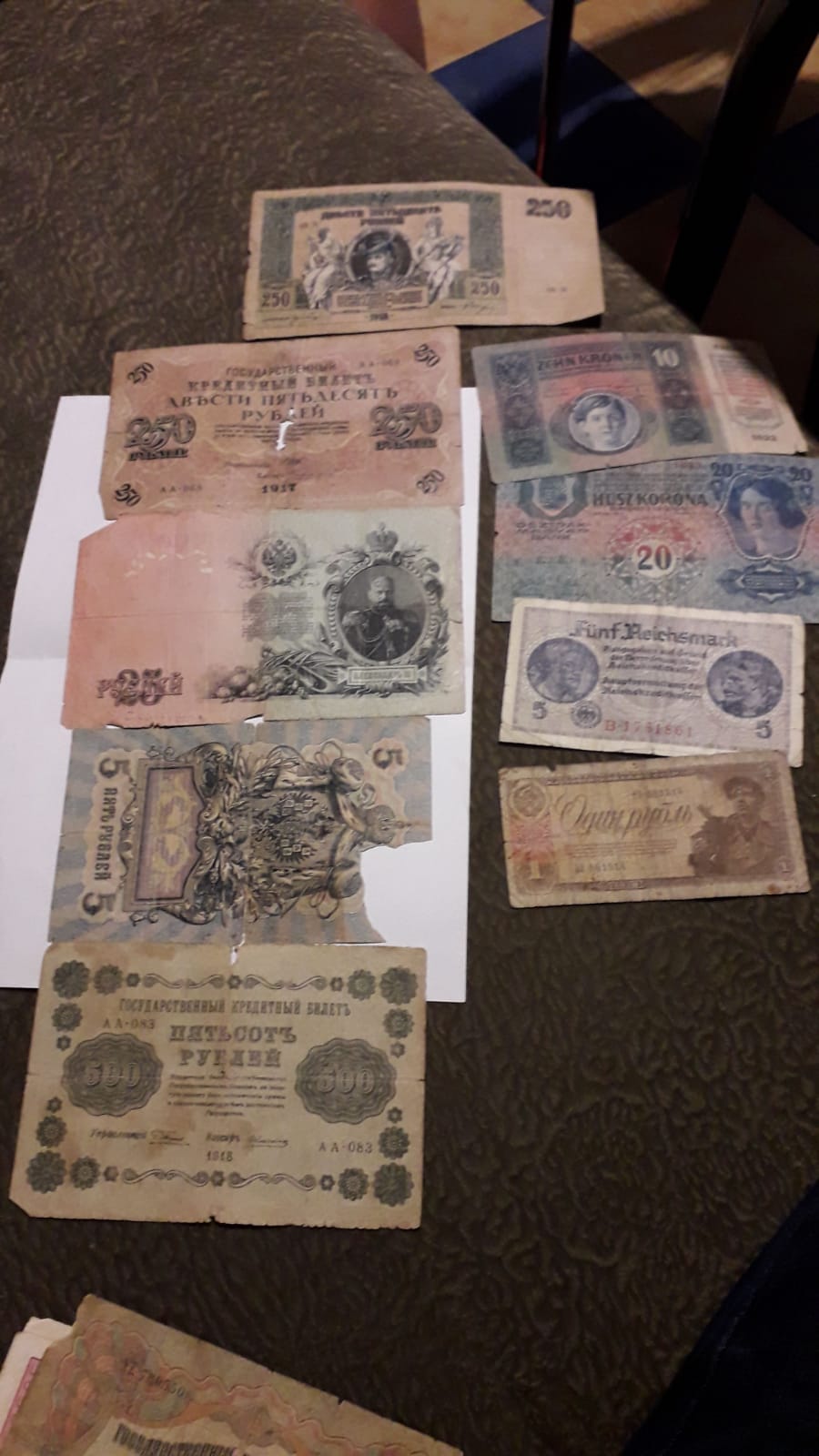
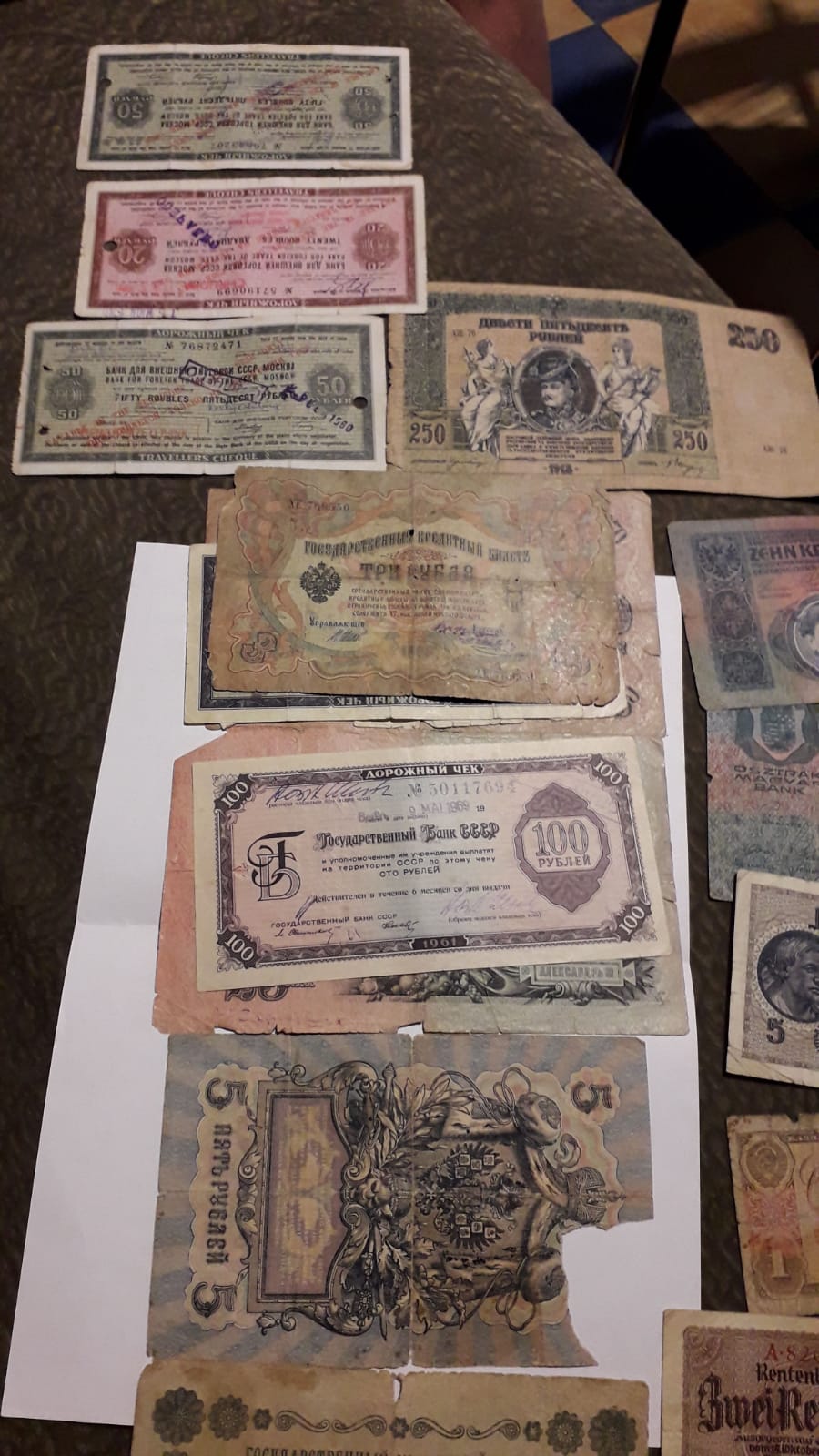
But what, ultimately, does money actually do?
Money is the fundamental medium of exchange that binds together that very exchange – the contract.
And therein lies both the brilliance and the undoing of capitalism.
Contracts depend entirely on enforcement of some kind. There must be some way to enforce contracts of voluntary exchange. Now, most of the time, this is easy enough to do. In a capitalist economy, people who fail to live up to their contracts are shunned and snubbed by others. Because people are both producers and consumers, simultaneously, any individual who renege habitually on their contracts with others become regarded as untrustworthy and their reputations are destroyed.
If the destruction of one’s reputation due to failure to meet contractual obligations is insufficient, then that is why we have evolved a huge system of tort and contract laws designed to punish contract violators and protect contract signers. That system is NOT, by the wildest stretches of anyone’s imagination, perfect. It is a vast and complicated and muddled and absurdly over-the-top collection of often highly contradictory precedents, laws, rulings, and fiats.
The point remains, though, that any successful capitalist system absolutely must have these things in place.
Any economic system is a system of contracts, by definition. The precise nature and definition of those contracts varies depending on the system. In a capitalist system, those contracts are entered into voluntarily. In a socialist system – whether Communist or Fascist, or one of the softer versions of socialism that is quite common these days – the contract is between the government and other entities, and the contract becomes less and less voluntary the more socialist the government style becomes. In feudal societies, the contracts often used to be between the King and a set of monopolies setup by royal decree to trade in certain goods and services.
These contracts between large entities then get “subcontracted” to smaller and smaller entities, until you get down all the way to the level of the individual.
The medium of exchange that allows these contracts to function smoothly and properly is called money, and it represents the time-value of a person’s labour and skills, compressed down into an almost infinitely fungible unit of measure.
Finally, there must exist a system of enforcement of these contracts that prevent liars and charlatans from abusing their positions and reneging on their contractual obligations. Again, some of these systems work better and more transparently than others. In socialist systems, the mechanisms work anywhere from inefficiently to not at all. In feudal monarchical systems, the enforcement mechanism tended to be the King, who could order people’s heads chopped off if he saw enough abuse and corruption – assuming that he, himself, was actually competent. This was all too often an extremely strong and untenable assumption.
In a capitalist system, at least in an idealised form, there are at least two enforcement mechanisms – private and public. The private mechanism depends on reputation, the public mechanism depends on use of government force. A capitalist economy CANNOT function unless both exist.
This key point is something that the libertoonians – and I readily confess that I used to be one of them – never seem to fully grasp, by the way. They just sort of assume that private enforcement mechanisms will always and everywhere work, and that serial abusers of contracts will eventually go out of business because other contract underwriters and providers will then step in and provide superior contracts.
But what happens when we see large corporations – who are basically treated legally as individuals – abuse their positions as sole contract providers so thoroughly, and so seriously, and so blatantly, that they can no longer be trusted anymore – yet are never punished at all?
You can see where I am going with this. That is precisely the situation that we have today with the social media and tech giants – Facebook, Twitter, Google, Amazon, Apple, PayPal, Patreon, and so on.
All of these companies, aside from Apple, provide platforms for publishers and content creators to market their wares and enter into contracts with others. Those publishers and creators enter into a contract with the social media giants, in which Big Social agrees to provide a space for publishers to do their thing, in exchange for almost complete control over the data that those publishers deal with.
That is a contract. You and I accept that contract every time we scroll cursorily through a long and impenetrably dense list of Terms of Service before clicking “I Accept”.
Here’s the thing: those platform providers give extremely vague ideas about what they consider to be “unacceptable conduct”, and then start kicking people off their platforms in ways both overt and covert when violations – which are never clearly defined or articulated – are encountered.
And here we run head-first into the most fundamental problem with the very basis of all economic systems.
Every economic system is based on exchange of some kind. Even the most hardcore Communist dictatorship is based on this: you give everything you own and have, including your life and your soul, and in exchange for the State taking everything, you get a miserable privation-filled starvation-level existence. That’s assuming you get an existence at all.
We know, through millennia of repeated and brutal lessons, that voluntary exchange works best as an economic system. We know that enforcement of contracts is vital to make an economy work – no matter what kind of economy. And we know that if contracts are vaguely written or poorly understood, the result is not much better than chaos.
That is what we have today – a system of exchange that has gone horribly wrong.
The enforcement mechanisms are utterly broken these days. There is no guarantee whatsoever that your contract with Big Social will be honoured – because the social media companies pretend to be platforms, which are supposed to be apolitical, but act like publishers, who can decide exactly who and what they want to publish. This is misrepresentation, plain and simple – but that blatant violation of contract cannot be enforced, in any way.
This is partly because the companies in question are so huge. There are effectively NO alternatives that provide anything like the same level of reach, power, and influence as those few tech giants. The only possible alternative is for each individual or corporation to attempt to build out their own platform – and likely be crushed by the sheer size, power, and cash of the big companies. So the private enforcement system doesn’t work.
And it is partly because various governments have also been thoroughly compromised and no longer function as institutions. We saw this ten years ago when the (still ongoing) Global Financial Crisis hit. Companies which violated their contracts were not punished but were instead bailed out with public money – the government effectively nullified existing private contracts and replaced them with a big public one, but this one was entirely involuntary in nature. So the public enforcement mechanism doesn’t work either.
The situation isn’t any better outside the West, by the way. In Russia, the government insists that all companies that have personal data on Russian citizens must house that data on servers located squarely within the Russian Federation. Companies that refuse are blocked from operations. This is what happened with LinkedIn, which is unavailable in Russia, and it is also what happened to VKontakte – Russia’s FaceBorg alternative – and Telegram. The same man founded both platforms, but when he refused to let the Russian authorities effectively rewrite the contracts between his companies and their users, he had to flee Russia for the UAE, and VKontakte was effectively taken over by new management.
No matter where you go in the world, even in supposedly “capitalist” nations, the same story repeats itself, over and over again. The system of contracts, voluntary exchange, and enforcement that makes an economy strong, successful, and wealthy, has been irreparably compromised.
What, then, are we left with?
Well, at minimum, we are left with a return to a much lower and less efficient level of economic activity. We are left with contemplating something like a return to feudalism as one possibility, where the entirety of economic activity is controlled by a handful of monopolies that the rest of us simply have to live with. Sometimes we are lucky and those monopolies actually have some idea what the hell they’re doing – but most of the time, that is not the case.
Since contracts cannot be honoured in the modern economy, that makes voluntary exchange nearly impossible. What do we replace it with? Forced exchange?
That’s a possibility, but it’s not the only one.
This, by the way, is where Vox himself got quite annoyed with a number of comments that displayed a complete inability to move beyond binary thinking.
Just because someone is saying that the current system of voluntary exchange doesn’t work, this DOES NOT mean that he is advocating for failed ideologies like Communism or Fascism. People like Vox Day and I are implacably and absolutely hostile to Communism, socialism, and all other such spectacularly failed ideas. They do not work and they cannot work, and people who think that anyone who asks these questions is an advocate for Godless dialectical materialism, is a moron.
But that still doesn’t answer our main problem, which is that the current system of voluntary exchange based on enforceable contracts simply isn’t working anymore.
I have heard about the philosophy espoused by G. K. Chesterton, known as “Distributism“, which basically argues against any form of centralisation of means of production. And that makes a LOT of sense given our current pickle with Big Social and Big Tech.
Unfortunately, there is a problem: the very reason why Big Social is big, is because each of those social media giants actually used to do good work.
Those companies got big because of a core concept in economics called economies of scale, which ensure that in many industries, companies get bigger and bigger because it is much more efficient for production to be managed in a centralised way. The most obvious analogy to Americans is that of cars; it is much easier for a handful of car manufacturers to own and manage virtually every aspect of manufacturing, shipping, and marketing cars, than for a thousand small producers to do it all themselves. Those companies compete with each other and deliver unparalleled value to the buyer.
With Big Tech – there are no real competitors right now, and they aren’t really even competing between themselves. Each one has a particular specialisation that works to its own particular advantage, and then uses the revenues from that specialisation to compete in other areas. But the core of each business remains effectively the same.
So where, then, are we to go from here? That question remains unanswered, and I am certainly not going to pretend that I’m smart enough to come up with a whole new economic system all on my lonesome.
But one thing is very clear to me: the current global economic system does not work. Whatever you choose to call it – capitalism, managed socialism, corporatocracy, technocracy, whatever – does not work.
Alternatives will emerge eventually. They already are. But it will be many years yet before Big Social and Big Tech finally meet their reckoning – and until then, the rest of us will be forced to deal with massive inefficiencies, contract violations, and breakdowns of exchange that we can do literally nothing about.









3 Comments
Fascism works to some degree actually since its market driven and designed around shifting incentives though the other command and control do not. We have something akin to it now though a functional proper one require a staunch nationalism which we do not have.
Its also not a good option
There is also distributism , basically shifting incentives to encourage working and middle class hiring of locals as the best option but no one has tried it as the elite hate that sort of thing.
That said any future economic case will require regulation. The kind of libertarian thinking that suggest we can trust any corporation or that we could live safely without things like the Pure Food and Drug act is dangerous nonsense
The natural logic of incentives in a profit driven system is to cheat so you need to deal with that via regulation
The problem is though modernity is expensive, increasingly so with the erosion of moral capital and with automation. How we reduce costs and deal with the real economy is a huge challenge
Its nice though to see folks like Vox actually putting their minds to the issue. Change starts with ideas and boy howdy have we been lacking ideas since as Keynes put it
Practical men, who believe themselves to be quite exempt from any intellectual influences, are usually the slaves of some defunct economist”
The problem is though modernity is expensive, increasingly so with the erosion of moral capital and with automation. How we reduce costs and deal with the real economy is a huge challenge
Correct. One of the reasons why modernity is so expensive is because of laws that mandate equality of hiring and universal suffrage. These laws have been tested repeatedly and found severely wanting. All they do is flood the market with women and push men out. That is a big part of the reason why the idea of the man as the sole breadwinner has all but disappeared.
The other major factor is of course the severe debasement of the currency, but that's another story.
Didact,
Just take a look at the Roman law and later the Justinian code. In civil law there are 3 pilliars: identity, obligations (i.e. written and written contracts and the obligation therefrom) and succession (i.e. death and how to split the property)
I remember the obligations courses (they were split between written and unrwitten) at law school and found them facisnating.
For a real life appraisal of what happens when you tamper and screw with contracts
take a look at this twitter feed twitter.com/BaldingsWorld
Chicoms are a case study of why (a) communism is an absymal failure
(b) whho to utterly wreck socity with you screw and tamper with contracts both written and unwritten and the obligations therefrom
xavier