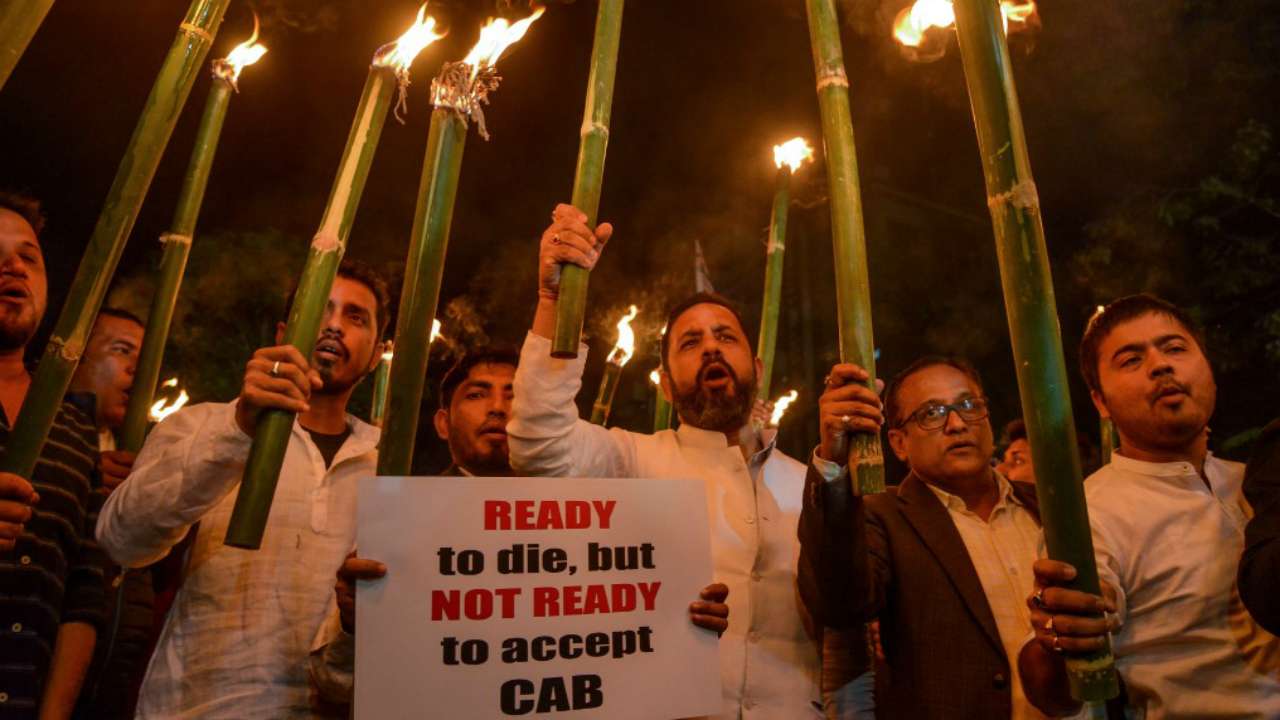
A few days ago I answered a question from reader JohnC about certain troubles brewing in India, related to the passage of what is known there as the “Citizenship Amendment Bill”. And make no mistake, there have been some serious troubles; massive protests have raged across the country, particularly in border states like Assam, West Bengal, Rajasthan, Gujarat, and now even the southern states are getting in on the act.
Parts of Calcutta, New Delhi, and other cities have been practically shut down; Calcutta in particular saw a sort of “flash riot” on Friday, which caused all sorts of problems for the people working in the city.
Three things bothered me about my original answer, which lead me to believe that it was insufficient and not properly articulated, and part of it might well have been flat-out wrong.
This means that I fell well short of my own standards.
I don’t mind being wrong – I’m wrong about A LOT of things, and I get things wrong all the time. When I get things wrong, I try to own up to it and change my mind.
I do mind shoddy thinking and bad maths. And it may well be the case that I was not merely wrong, but careless.
As I am in the business of telling the truth, insofar as I can see it, “through a glass, darkly”, so to speak, this is not acceptable. If I made a mistake with my maths, this needs to be fixed right away.
The first problem with my answer was that I didn’t really dive too deep into the numbers to figure out what all the fuss was about. In my original answer, I wrote that:
Again, remember: the point of this bill is not to give Indian citizenship to anyone. The total number of minority individuals affected by this bill is TINY. It’s less than 1% of India’s entire current population.
That estimate was based on the fact that about 4 million people in India were made stateless by recent laws in Assam and other border territories. I took this as a very rough lower bound for the total number of people who might qualify for Indian citizenship under the new CAB law.
But I didn’t do the actual maths. I will correct this here, because upon reflection I realised that there is no logical reason to believe that the number of illegal immigrants made stateless by one law, has anything to do with the number of potential people that can be made citizens by a different law. The two are “mutex”, so to speak.
The text of the CAB basically grants a way for non-Muslim minorities of India’s three major Muslim neighbours a way to get expedited Indian citizenship. So the natural question that arises is, how many people does that involve?
Based on the latest demographic estimates that we have available from Infogalactic here, here, and here, plus the latest world population estimates by country here, we can estimate the percentages of various religions in the three nations. Here is the breakdown:
–>
Simple multiplication gives us the following raw population numbers:
–>
Adding up the numbers in the last column gives us 23.5 million people who MIGHT qualify for Indian citizenship under the new bill.
Now, that’s not a small number. That’s actually more than the total number of illegal immigrants in the USA right now, by a pretty large margin.
But India has like 4 times America’s population. And the total number of people who might qualify is therefore 1.71% of India’s current population of 1,372,640,525 people (as of December 16 2019).
So I was wrong about this bill affecting “less than 1% of India’s current population”.
It actually affects less than 2% of India’s current population.
Depending on your perspective, that’s either a huge mistake, or an inconsequential one. I leave it to the reader to decide which.
This brings us to the second major problem that I have with my own work, which is that I did not, in my opinion, adequately research or attempt to understand exactly who is affected.
This article may help clear up some of the confusion:
The Bill seeks to amend The Citizenship Act, 1955 to make Hindu, Sikh, Buddhist, Jain, Parsi, and Christian illegal migrants from Afghanistan, Bangladesh, and Pakistan, eligible for citizenship of India. In other words, the Bill intends to make it easier for non-Muslim immigrants from India’s three Muslim-majority neighbours to become citizens of India.
Under The Citizenship Act, 1955, one of the requirements for citizenship by naturalisation is that the applicant must have resided in India during the last 12 months, as well as for 11 of the previous 14 years.
The amendment relaxes the second requirement from 11 years to 6 years as a specific condition for applicants belonging to these six religions, and the aforementioned three countries.
Under The Citizenship Act, 1955, a person who is born in India, or has Indian parentage, or has resided in India over a specified period of time, is eligible for Indian citizenship.
Illegal migrants cannot become Indian citizens. Under the Act, an illegal migrant is a foreigner who: (i) enters the country without valid travel documents like a passport and visa, or (ii) enters with valid documents, but stays beyond the permitted time period.
Illegal migrants may be put in jail or deported under The Foreigners Act, 1946 and The Passport (Entry into India) Act, 1920.
However, in 2015 and 2016, the government exempted specified groups of illegal migrants from provisions of the 1946 and 1920 Acts. They were Hindus, Sikhs, Buddhists, Jains, Parsis and Christians from Afghanistan, Bangladesh and Pakistan, who reached India on or before December 31, 2014.
This meant that these particular categories of illegal migrants would not be deported or jailed for being in India without valid documents.
So, the total potential population that might actually qualify for Indian citizenship shrinks instantly from 23.5 million to a small fraction of that number, simply because of the requirement for those people to live in India for 6 years before qualifying for citizenship.
In other words, this is NOT some sort of blanket amnesty. It simply makes obtaining Indian citizenship easier for non-Muslims from neighbouring Muslim countries. That’s it.
That being said, the protests against this bill come from both Hindu and Muslim sources. We know and understand why Muslims are protesting. They feel targeted – and, let’s be honest, they absolutely ARE being targeted by the resurgent waves of Hindu nationalism.
But Hindus, too, are protesting against the bill.
Why?
Because they feel as though they will quickly become swamped by hordes of illegals from Bangladesh who will then come to India, stick around, and eventually be granted amnesty by a future Indian government.
That fear is not without basis. Look at the second table above. There are some 13.5 million Hindus who might up sticks and flee to India, cross the border without permission, and stick around in West Bengal.
That state has 91 million inhabitants. An influx of 13.5 million more, in a state that is already 27% Muslim and 70.5% Hindu, would massively upset the existing, fairly delicate, balance of power in the state. And it would cause no end of headaches for the current state government, which came to power in large part by pandering to Muslims; they cannot very easily turn around and pivot to Hindus as their core constituencies.
The third problem with my original analysis was in my claim that it would not pass into law.
Strictly speaking, I was and am correct. The ruling Bharata Janiya Party (BJP) has plenty of votes to ram it through the lower house of Parliament, but probably will not get it through the upper house. That’s just a fact.
Here’s what the lower house of the Indian Parliament looks like:
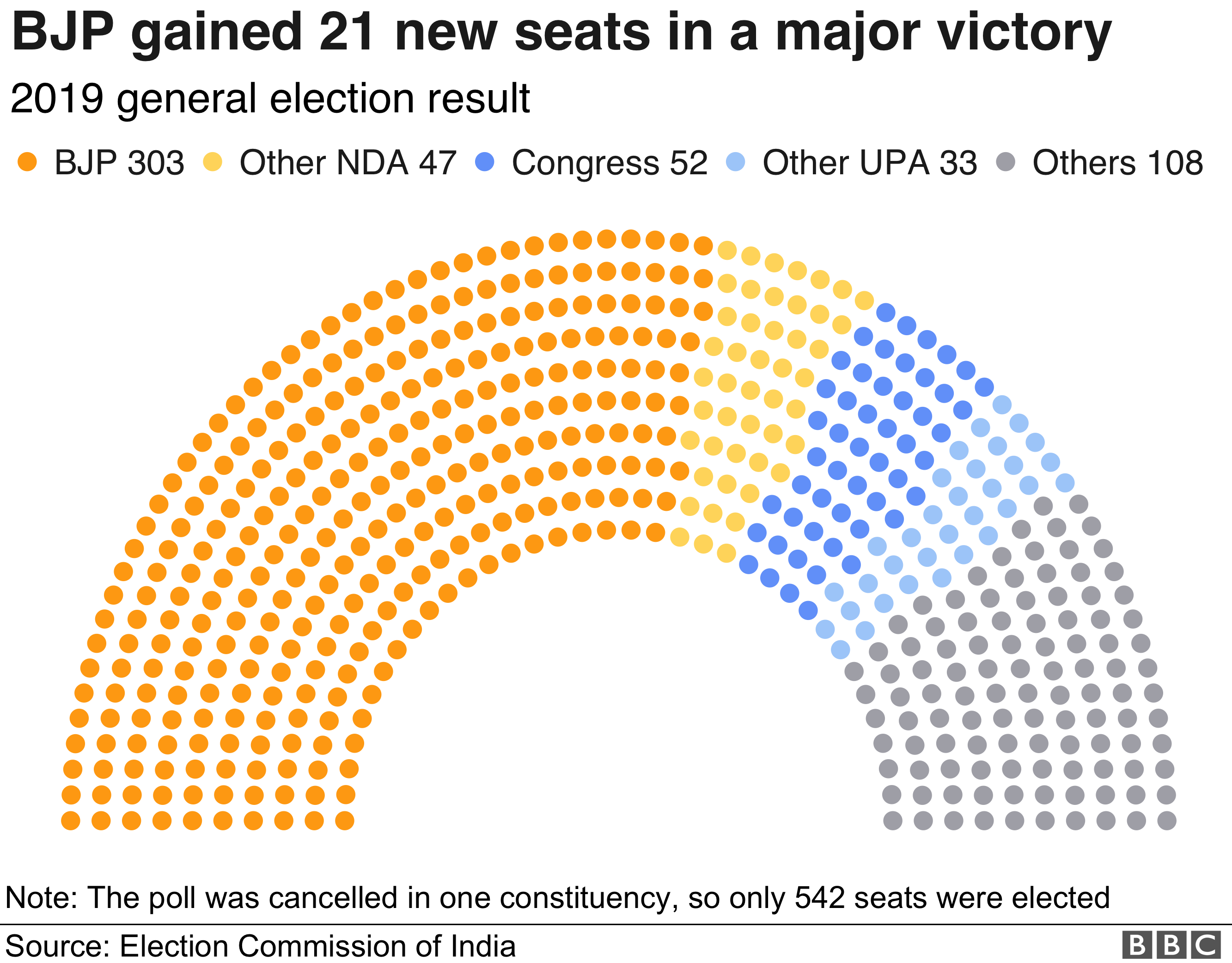
And here’s the same breakdown of the upper house:

The orange dots represent the BJP’s alliance in the upper house. As you can see, they just don’t have enough votes in that house. The reality is that this bill probably won’t pass in both houses without SIGNIFICANT revisions – and might be dropped entirely.
Plenty of Indians would argue, and have argued, that the current government will simply find ways to work around such inconveniences and figure out how to make it law without going through the usual democratic process.
Since I simply don’t give a shit about Indian domestic politics, I have no particular opinion on that subject. If they do, fine. If they don’t, also fine. I’m just pointing out the facts.
As for my personal opinion about the CAB – well, like I said above, I really couldn’t care less about it.
Seriously. It doesn’t affect me or anyone I care about in any significant way. As far as I’m concerned, if Indians want to pass it, let them. If they don’t, fine. I. DON’T. CARE.
I’m well aware that Muslims believe that this bill is just the first step in targeting them. And that’s a pretty fair assessment, actually. I do think that being a Muslim in India is going to become progressively more difficult and unpleasant over the next five years or so, and their community needs to be prepared for this fact.
What the International Community Of The Ever So Caring And Sensitive should note about Muslims in India is that they aren’t exactly choirboys.
They are kept in line through a combination of collegiality on their part, and sheer brute intimidation on the part of the Hindu majority. They know damned well that if they misbehave and try to impose their monotheistic religion on Hindu pagans, they are going to get wiped out. That has been made perfectly clear to them on numerous occasions throughout India’s turbulent modern history.
In exchange for behaving properly, Muslims are generally left alone to do as they see fit in their own areas. Anyone who has ever been to the Muslim parts of Bombay or Calcutta can attest that the moment you enter those zones, you enter a totally different world. The normal rules of traffic, etiquette, and hygiene – such as they are, in India, and they don’t amount to much – no longer apply in those parts of town.
Ultimately, India will do whatever India will do. I don’t much give a toss. I do mind when I get basic facts wrong or when my analyses do not meet my usual standard of rigour, however. Presumably this corrects my previous mistakes, which I readily and rather shamefacedly own up to.
I got some basic stuff wrong, which I shouldn’t have done. That’s on me. Consider the record corrected.
–>–>–>









0 Comments