The St. Petersburg Economic Forum, or SPIEF, as it is known in the West, closed out a couple of days ago, and it proved yet again to be a very interesting insight into modern Russia. As always, President Putin got up on-stage at the closing Q&A session and delivered a speech. Apparently, this year, they changed the format a bit, so that he did the Q&A first, and then delivered his tailored remarks. In the past, it was always the other way around, where the Neo-Tsar speechified first, and then took questions.
Once again, the MFIC was in superb form, both during the Q&A section, and the speech. I have long stated that President Putin is a man of exceptional wisdom, intellect, and personal strength – he is radically different from the caricature of the evil old man that the West loves to paint. I have read many of his speeches in English translation, and listened to him speak in Russian at some length, and I can say personally that he is an extraordinarily intelligent and highly cultured man.
His remarks at SPIEF this year spanned many key points, concerning the economy, the war in Ukraine, and the global geopolitical situation. All in all, he projected confidence, strength, and calmness, at a time of great geopolitical uncertainty.
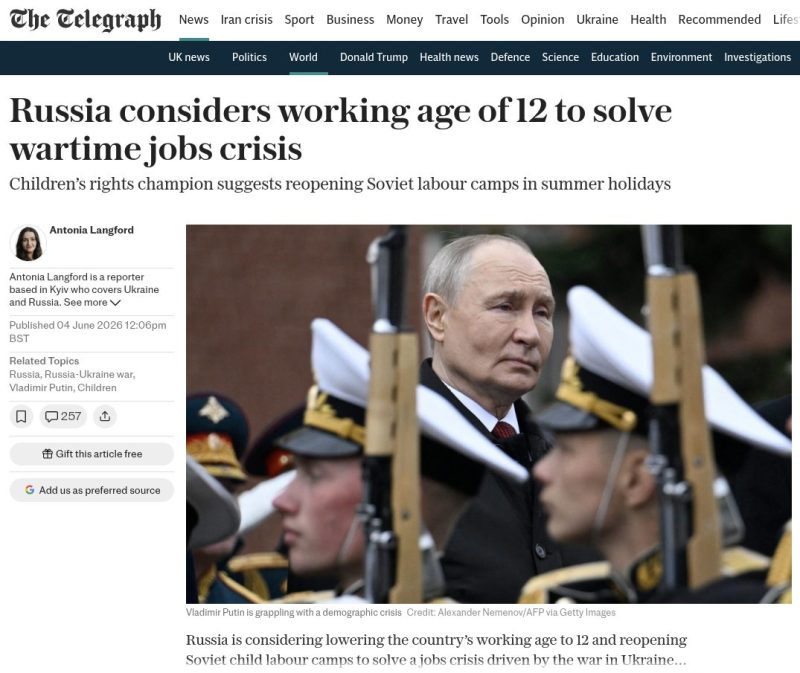
This is important, because over the past few weeks, in the wake of intensifying Ukrainian drone strikes against Russian energy and civilian targets, and seeing little to no progress in Russian advances in Donbass, the Western whore-media has repeatedly offered up increasingly retarded takes on Russia’s economy. Essentially, the whorenalists of (((media)))))))) outlets in the US, the UK, and most of continental Europe, want you to believe that Russia’s war economy is overheating, Russia is collapsing under the weight of the war, Russia is desperate for workers, Russia is making zero progress in Donbass and Ukraine is actually winning the war… and so on and so forth in endlessly stupid phrases.
Indeed, the picture you see above comes from PommieBastardLande’s The Smellygraph, and is emblematic of the kind of retarded goyslop that the presstitutes who work for Fleet Street peddle to the inbred morons who run the country. It is literally impossible to be too harsh to these people – they are paid government propagandists, not genuine investigative reporters.
That headline shows exactly why I strongly advocate firing ALL of the people who work for ANY mainstream media outlets, flaying them alive, rolling them in salt, and then denying them access to ANY healthcare FOR LIFE, while forcing them to work as toilet cleaners for the rest of their miserable existences. Perhaps then they might actually perform a useful service for the rest of humanity.
The truth about Russia’s economy is that things are nowhere near as bad as the West thinks. The title of this poast is actually a riff on something the MFIC himself said at SPIEF last year – he quoted Mark Twain‘s old saw about how “rumours of my death are greatly exaggerated”, in the context of discussions about Russia’s economy.
I can personally confirm that he was, and is, right. Russia is doing well – rather better than Britain, the US, France, or Germany.
Here are the realities of the Russian economy – I will use a mix of Russian and Western data, to provide some contrasts, you can choose which you want to believe. For the Rosstat data, you you have to download an Excel spreadsheet and go to a particular tab to see the data. For the RuMinFin data, you have to download an Excel spreadsheet from their website. I provide links to everything below. For all conversions to USD, I use today’s exchange rate at 73.7 RUB / USD.
- Russian inflation is currently running at 5% or so – and is falling according to Rosstat (tab 3.5, where you have to divide the monthly data by 100 and then apply some logic to figure out the growth over the space of a year using the product of month-over-month price increases);
- The annual change in CPI declined from 12% or so at the end of 2022 to 5.6% at the end of 2025, which is where it is currently sitting, according to the Central Bank of Russia;
- IMF data are wildly off relative to Rosstat data, arguing that Russian inflation was running at 8.72% in 2025, which is higher than in 2024 – I personally do not believe this, at all, because I was there in late summer 2025, and I saw firsthand that Russia’s economy was cooling off;
- Economic growth in Russia (tab 1.1 of the Rosstat data) slowed down from 4.9% in 2024 to 1.0% in 2025, and industrial production (tab 1.2 of the Rosstat data) contracted significantly in January and February of 2026, but rose again quite sharply in March 2026;
- Real interest rates in Russia are currently running at nearly 9% – that is to say, the difference between the official Central Bank key rate (14.5%), and the current inflation figure (5.6% or thereabouts);
- The budget deficit of the Russian government is currently at 5.88T rubles (about US$73.7B) as of April 2026, which comes to about 2.74% of Russia’s overall GDP of 214.3T rubles (US$2.91T) as of the end of 2025;
- Contrary to the idiotic representation of Russia as “a gas station with nuclear weapons” that the neoclowns keep using, Russia’s oil and gas revenues for all of 2025 came to 8.48T rubles (US$115B), which amounts to 22.7% of all Russian government revenues of 37.3T RUB (US$505.9B), and 17.4% of Russian GDP;
- Crucially, to finance that deficit, the Russian government has borrowed 6T RUB (US$81.5B) as of April 2026, ALL of which was domestically funded and financed;
- Russian government debt stands at 32.4T RUB (US$439.7B) as of May 2026, which comes to 15.1% of Russia’s total GDP at the end of 2025, and is an increase of nearly 30% of where Russia’s debt was a year prior;
- Virtually the ENTIRE increase in public indebtedness of 7.4T RUB (US$100.6B) has come from domestic, not foreign, borrowing;
- Russia’s foreign exchange reserves stand at US$421.5B as of May 2026, of which foreign currencies make up US$392B;
- From the same CBR page, we see that Russia’s gold reserves currently sit at US$326B, which is down significantly from a few months ago, as the Russians have been selling off gold to weaken the ruble a bit (it hasn’t really worked, to be honest);
- Unemployment in Russia currently stands at 2.1-2.2%, as even Western sources admit;
Put all of this together, and you get a picture of an extraordinarily resilient economy.
Keep in mind that Russia is under the world’s most intensive SANKSHUNS regime, with well over 24,000 (and counting) different restrictions placed on it by the US, the UK, the EU, the rest of the G7, and God only knows who else.
Despite that, Russia is effectively paying for a war against Ukraine, and 49 other countries, out of its own resources.
This is critical to understand. When you look at the debt levels of any of the G7 nations, they all stand at between 80% and 225% of GDP. The UK, US, and France all currently run budget deficits in excess of 5% of GDP. Every single one of the high-debt countries of the G7, and the other nations in the coalition fighting against Russia, finance their debts through external borrowing, except Japan (to my knowledge).
Russia, by contrast, could pay off literally its entire outstanding government debt with its gold and foreign exchange reserves. The Russian government finances its deficit by borrowing from its own people, not external markets. Oil and gas revenues have been declining as both a share of GDP, and a share of Russian budget revenues, for years – domestic tax receipts make up the difference, with domestic VAT having increased 19.3%, taxes on profits increasing 72.2%, and personal income tax increasing 125.3%, all from 2024 to 2025.
All of this points to a country with an increasingly diversified and robust private sector, with extremely low unemployment, rapidly expanding industrial production, and a very healthy balance sheet.
Indeed, one can make the argument that such a low level of debt to GDP is something of a problem – which is precisely what Alexander Mercouris did in one of his recent videos. It means that Russia is unable to attract high levels of external investment, which stops it from growing quite as rapidly as it actually could. Part of the reason why the EU, US, and UK all have high debt to GDP levels, is because foreign investors are willing and able to buy that debt. In Russia’s case, it has very little ability to market and sell its debt on international financial markets these days – despite the fact that it offers remarkably high interest rates.
Even so, looking at the fundamentals of the economy, you have to conclude that Western perceptions of Russia are totally distorted.
Russia poses NO default risk whatsoever with debt to GDP levels that low, very tight monetary policy, and highly restrained fiscal policy. Yet its debt is rated at junk levels, which makes absolutely zero sense. If we applied the same standards to the US, it should have a credit rating around a D, not AA or thereabouts.
Finally, we need to deal with this nonsense that Russia currently has a war economy. This is complete bilge. According to Statista, as of 2025, the Russian defence budget stood at US$190.4B. Given total Federal government expenditures of 42.9T RUB (US$582.2B) in 2025, that comes to about 33% of the entire Russian government budget – but, crucially, only about 6.5% of total GDP.
THIS IS NOT A WAR ECONOMY!!!
If the cretinous morons that write this sort of bilge understood the first thing about economics, or economic history, they would recognise that, in WWII, military expenditures regularly exceeded 40% of national income and production.
Russia’s economy has a vibrant and flourishing private sector – I can personally attest to this from my numerous trips there, including 4 since the war started in 2022 (and one coming up later this summer).
There is NO rationing, except of fuel in Crimea from time to time, and that too because of Ukrainian drone strikes on civilian vehicles travelling along the Novorossiya Highway, along with high summertime demand.
None of this is to say that Russia has zero economic problems – you would have to be very stupid to say that. Russia does have significant labour shortages. It is making up for those shortages, particularly in unskilled work, by importing lots of guest workers from its Central Asian neighbours – and, increasingly, from farther afield, including India, Pakistan, Africa, and North Korea. These are not positive signs for the long term, though it must be said that emigrating to Russia is actually very, very hard, and the Russian people have made it quite clear to the government that they do not want a high immigration rate.
Russia’s ruble is far stronger than it should be. It has strengthened significantly against international currencies, especially the USD – I recall seeing somewhere that it is the world’s best-performing major currency this year thus far. This is due to the fact that its energy exports are surging, leading to higher demand for rubles from its BRICS partners. De-dollarisation is now a real thing; SANKSHUNS have insulated the Russian economy from the vagaries of forex fluctuations on the domestic market, but those very same dynamics make its exports less competitive, due to the fact that Russia, and the BRICS in general, now focus on settling trade using national sovereign currencies, instead of the USD or EUR. The CBR’s overly tight monetary policy really is not helping in this respect – again, 9% REAL interest rates are BONKERS, by any rational measure, and they are contributing at the same time to an overly strong ruble.
One could argue that Russia also has a somewhat “unbalanced” economy, in the sense that its industrial sector holds a much larger share of its economy than a true market economy would. Russia is a model of mixed economics, featuring state-led capitalism; there is still a strong element of central planning to everything the country does, though it is nothing like as bad as it was back during the Soviet days.
I personally disagree with the above assessment, as the past few years have made it absolutely clear that true economic sovereignty requires and demands a robust industrial sector. The EU does not have real industry, which is why the YURPEEN nations are not sovereign.
Then we get to the notion that Russia is some backwards, corrupt shithole. This, again, is nonsense. No one in his right mind will ever argue that there is ZERO corruption in Russia; we saw a classic case in point when Sergei Shoigu moved from Defence Minister to National Security Adviser. The new MinDef, Andrei Belousov, came in and promptly cleaned house, with almost ALL of Shoigu’s previous deputies arrested on charges of significant corruption. All of this indicates that, while Shoigu himself may not have been personally corrupt (and probably wasn’t), he allowed, or turned a blind eye toward, corruption at astonishing levels in the RuMinDef.
But the days when oligarchs ruled the roost in Russia, are long done. The oligarchs have all been brought to heel, or fled to other countries. Here is a good case in point: Vadim Moshkovich used to run the country’s largest food conglomerate, RusAgro. He is (or was) one of the richest men in Russia for many years. Last year he was arrested on charges of bribery and fraud. Whether those hold any water, remains to be seen, but from everything I can observe, oligarchs are tolerated in Russia, provided they stay in their own lanes.
Contrast this with the way that oligarchs run things in the West. Can anyone imagine the likes of Larry Ellison, Elon Musk, Mark Zuckerberg, Satya Nadella, Sergei Brin, Miriam Adelson, or any of the other oligarchs in the US, being treated the same way?
To ask the question is to answer it.
In closing – no, Russia is not collapsing. It is not losing the war in Ukraine – its forces are now closing in on the full capture of Konstantinovka, which then opens the gateway to the full liberation of Slavyansk and Kramatorsk, and the further liberation of all of Donetsk. In Zaporozh’ye, the Russians are closing in on Orekhov, and once they liberate that, they will have completely reversed the entire Khlearly Khatastrophic Khalamitous Khollapsed Khreat Khokholite Khumvee Khounteroffensive of 2023.
According to the latest informed estimates, Ukraine has suffered over 2 million dead – that’s DEAD, only – and perhaps another 2-3 million wounded, most of them quite severely. The entire country is basically a nation of old pensioners and young kids, with almost nothing in between. Its fertility rate has collapsed to the lowest in the world – worse than South Korea’s.
Its Western backers are not doing very much better. Most of them are under severe fiscal and energy stress, thanks to their own insane green energy policies and welfare spending. Some of them are on the verge of serious fiscal crises – particularly the UK, where government borrowing rates are sitting close to 6%, and there is a genuine cost-of-living crisis across most of the country.
Russia can carry on this kind of war for many years. Its people, on the other hand, want victory NOW – and they will not tolerate some sort of half-arsed peace agreement. They will ONLY permit a full-throated victory over Ukraine and the combined West, and that is precisely what the MFIC and the Russian government must now deliver.








0 Comments