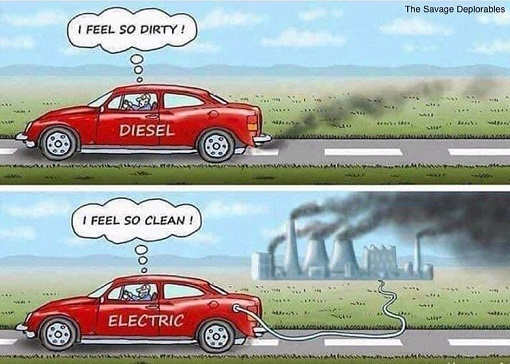
Our good friend The Male Brain, aka Dawn Pine, came across an article in his native Israel concerning the realities of so-called “green” electric cars, and their supporting infrastructure. This is especially relevant if you happen to be living in PommieBastardLande, where the feckless and hopelessly incompetent clown-car-crash of a government there, run by Boris the Floppy-Haird Sheepadoodle, has mandated that all cars sold after 2030 must be electric. The sheer stupidity of this act, in the face of BritBongLand’s gubmint’s even more stupid insistence on sourcing ALL of its power from renewable sources by 2035, defies belief and logic. It also means a highly impoverished future for anyone living there by that point in time, as our friend’s translation of the Israeli article presented below will show you.
Many thanks, as ever, to our good friend for finding this and taking the time to translate it for us.
The EV owner’s nightmare just came true, and you didn’t even notice
According to estimates, ~120 public EV charging stations collapsed for several hours on October 7 in Israel, after being cut off from the global ABB network, leaving the drivers in despair. It’s a worrisome condition, especially if a corporation relies on a single supplier.
Original in Hebrew by Tomer Hadar
On October 7, a major event took place, which the EV suppliers and providers don’t want the consumers to know about.
In the morning, public EV charging stations suddenly “went dark” all around Israel. Roughly speaking, Israel has 2 types of charging stations: private (at home) and public, of which there are currently 368. The latter serves a few charging providers such as Tesla, Afcon, Ginergy, EV Edge and the like [TMB – the unknown are Israeli brands]. On that day a good chunk of them went down.
How many? It’s hard to say, not least because the charging companies are not happy to announce it when the stations don’t work. However, sources at those companies estimate roughly one-third of the Israeli-based stations.
Yesterday, While “Calcalist” [TMB – the source of the article] was doing a drive test to an EV, lines of desperate customers tried in vain to charge their cars in the public charging stations. This left their cars in a no-go position. One may note that the problem was solved within a few hours [TMB – according to one of the companies it was 2-3 hours] and was barely mentioned. In fact, posts published by Afcon on her Facebook page were gone [TMB – untrue, I checked and they were still there after 2 days]. That doesn’t change a very disturbing fact: For a few hours, if one was driving an EV in Israel, one could not charge it unless one came to a working public station or at home.
What if you are committed to a single provider?
One should note that the issue was among Afcon and Ginergy customers. The mysterious malfunction did not originate in Israel, but was a global one.
The European energy provider company ABB’s private forum, which serves its clients directly, had a message that appeared unavailable tothe general public: “At 08:55 a large number of chargers were disconnected from the network. We are investigating it as a high priority event”. So went the ABB post.
This means, in Israel and globally, that if one relies on ABB public charge stations, one may find oneself lacking the ability to charge one’s EV.
It is important to state that if one wanted to charge one’s EV, you could pick another charging station, other than ABBs’. It’s just like if a gas station runs out of gas and you go to the next one. However, EVs of corporations are usually committed to single source supplier. For example, a lot of large corporations including Israeli government are setting up EV and charging grid for their employees. If a charging network relies on a single source supplier allowing all police vehicles to charge, a problematic and certain scenario may reoccur.
TMB Comments

Like any other new technology, EV has flaws and merits. Charging being one of the main flaws. Until recently one could only go as far as 150-200 Km (90-130 miles), now EVs can go as far as 400 km (~270 miles) which is close enough to regular car mileage. However, charging may take at least 1/4 an hour (and you won’t be fully charged). Let’s not forget to mention the issue of hackers. One can’t “hack gas stations”, but one can surely hack a charging grid.
The main issue is…regulation. Governments are pushing EV by both subsidizing the purchasing or by charging regular cars. If everyone went EV within 2-3 years, we would have a catastrophe of both power grid requirements (good luck trying to charge your car in an outage or a storm) and charger availability (the world has ~5% EV as part of the global car market. So if we quadrupled it to 20% how on earth are we going to have so many chargers available?).
My recommendation is that unless you have to (e.g. the employer supplies you with a vehicle) don’t go EV yet. It will probably take a few years for the whole ecosystem to mature. It will be sometime before we feel the heat to get one, but until then let’s stick with what is working.
The Didact Speaks

The first thing to understand about “electric” cars is that they are not environmentally friendly AT ALL. If you understand the first thing about lithium mining, then you will understand pretty quickly that it is a filthy business that generates an enormous amount of waste and heat. Those electric batteries in your whisper-quiet smugmobile actually do far more damage than the petrol and diesel fumes that come out of the poop-chute of an ordinary family hatchback or sedan.
The second thing to understand is that electric vehicles simply shift the burden of energy generation from the visible and audible to the invisible and inaudible. By this, I mean that when you drive an electric car, you still have to get the power from somewhere, and that “somewhere” is the power grid. So, instead of relying on the tried-and-true mechanics of internal combustion – which have worked for well over 130 years and are highly efficient – you have to depend solely on the power grid.
That, in turn, means an immense burden on power grids for developed nations, at a time when public pressure and Green idiocy means that building new conventional power plants is basically impossible.
You can’t build a coal-fired plant anywhere in the Western world, even though it is by far the cheapest, simplest, and easiest form of energy manufacturing.
Natural gas is hugely expensive these days – which, be it noted, it wasn’t during the legendary Administration of His Most Illustrious, Noble, August, Benevolent, and Legendary Celestial Majesty, the God-Emperor of Mankind, Donaldus Triumphus Magnus Astra, the First of His Name, the Lion of Midnight, may the Lord bless him and preserve him – and gas-fired plants take longer to “spin up” than coal-fired ones do. That is why they are generally considered “peaker plants” by most power companies – they only come online when the grid hits peak demand during summer.
Oil-fired plants have the same problems as gas-fired ones, only worse – because you can’t just take raw petroleum and burn it. Doesn’t work like that. You have to refine it first into something usable, and once you get through the “cracking” process in a refinery – which is the size of a small city, by the way – you have to transport that liquid to the plant itself for burning.
Wind and solar power are not the answers either. Not only are they utterly unreliable, you can only get them from a limited number of locations in any given country. Those locations tend to be a long damned way away from anywhere civilised, which means that you have to build very long power lines to get the electricity to where it is needed – and that means you end up losing much of the power along the way.
And that is before you get to the fact that wind and solar power is not at all “green”, either. You have to use coal to create solar panels and wind turbine blades. And when they reach the end of their useful lives, you CANNOT recycle them. They end up in a landfill, where the toxic byproducts that come from their breakdown process bleed into the soil.
All of the above mean that the “green” dream of an all-electric future, is a dystopian nightmare in the making. It will mean skyrocketing energy prices, a vastly diminished standard of living, and people freezing in winter because they have to choose between paying for food or heat.
What, then, are the solutions? The good news is that there are a few. One exists now, one is relatively difficult, and one is far in the future.
Hydrogen fuel cells already exist and are viable – but the storage and transportation of hydrogen is a huge problem. (Anyone who remembers what happened to the Hindenburg will know what I’m on about.) The beauty of hydrogen fuel cell technology is that it requires very little by way to additional infrastructure on the power grid itself, and keeps the existing system of filling stations intact. Indeed, a proper hydrogen-based car can generate enough power to generate not just your house, but all of the houses on your STREET. Put simply, hydrogen-based technology would kill the green nightmare stone dead – but it is expensive, challenging, and difficult to develop at the moment.
Nuclear fission would solve a lot of the grid capacity issues that green asshattery will impose upon us. Modern nuclear reactors are much safer than the ones that give everyone nightmares, and much easier to control. Modern Small Modular Reactor (SMR) technology allows for… well, exactly what the name says. Depending on whom you ask, thorium and pebblebed reactors are either wildly impractical or the way of the future. (I tend to side with the people who say that thorium reactors are nuts.) But the reality is that, if you want a decarbonised future (HA!), then nuclear fission is the only feasible way to go right now. Of course, nobody actually wants to build one, and dealing with the spent fuel that comes out of a nuclear reactor is not easy – which is part of the reason why building a new nuke in the USA is basically impossible at this point.
And finally, there is nuclear fusion. This technology would result in pretty much endless energy, simply by “burning” water. However, to achieve fusion on a commercial scale would require immense, and by that I mean BIBLICAL, amounts of input power to get the fusion reaction going. (There is a reason why a hydrogen bomb has, at its core, a fission device that starts the actual fusion reaction going.)
Unfortunately, the first fusion reactors are at least 20 years away, and probably a lot more than that.
In the end, you can’t get something for nothing. Green dreams are nightmares in disguise. They will impoverish entire nations and do absolutely NOTHING to stop so-called “man-made climate change”, which is not man-made nor particularly dangerous to anyone other than autistic spergy teenage girls who throw stroppy fits at Davos.
Stick to your petrol or diesel car while you can. And when the Green Stasi come for your car keys, make sure that your expensive, impractical, and not particularly safe smugmobile has a tow-bar at the back, so that you can hitch up a diesel generator to it for the inevitable moments when you find yourself at the side of the road, cursing a blue streak at the fact that the entire charging grid just went down.









2 Comments
There are a lot more topics to discuss regarding this subject. It’s a good opportunity to bring in an extra guest or two. For example, how about reducing unnecessary pollution from mass meat and vegetable oil farming just to make fast food. Sorry, but when Trump brought Mcdonalds food in the White House when he welcomed some NFL players wasn’t anything to be proud of. He could have ordered a proper steak house and some Mediterranean chef from California to prepare something better.
With regards to lithium, I heard China is teaming up with Mexico cartels to get access to the highest reserve of lithium in the world. A substance that poisons fish, cannot be recycled and has a short life expectancy.
Then you have to think of the energy used for ships and airplanes to transfer all parts for electric cars. The pollution is greater than all cars in the world combined.
Never mind the fact that we can reduce a lot of energy consumption simply by not requiring people to come to work every day or fly airplanes to do business abroad.
While European car manufacturers are rushing to virtue signal by announcing that they will be producing only EV’s by 2025, Japanese car makers are investing billions in hydrogen, and I hope they succeed. The only light at the end of the tunnel is Porsche’s synthetic fuels, but that is also at its early stages. Ironically, the Italian and German manufacturers don’t seem to be rushing all that much compared to British car makers. Enjoy the next black transexual bond with ‘xir’ electric Aston Martin.
Honestly, Europe is better off sponsoring a Koenigsegg (if you don’t know the brand, it’s some serious car porn) for every citizen than subsidizing technology like this. At least we should have some fun before we kill ourselves.
This is the next big crisis after covid, assuming they don’t print the euro and every other world currency to oblivion before they decide to print even more trillions to subsidize this abomination. Nikola Tesla is revolving in his grave.
I had to replace the battery in my bone stock Honda Civic yesterday. This battery was $80 2 years ago…$199 yesterday. The price on it has shot up.
Different technology than the Li-Ion batteries all the EV’s use but the principle is the same: Dramatic costs increases in electrical components right now will keep EV’s in the premium purchase price category, which may be the real reason the auto companies are interested in getting them to market.
Those Li-Ion batteries? Have fun with the price skyrocketing on those if EV’s do get to that 20% threshold. There is not unlimited Lithium to manufacture with.
Right now, overnight electrical rates are lower than daytime rates (at least in USA but the principle is the same elsewhere). Air conditioners run-heavy in the day, as do manufacturing plants. The dip is the overnights, so you can plug your EV in and take advantage of those ‘free nights and weekends’ promos from the electrical providers.
When EV’s hit 20%? Forget it, those nighttime hours are no longer the low use time period and their cost goes up as well.
Don’t worry. Segway is the future of transportation.